Physical Properties, Chain Length, and Branched Groups (Grade 12 NSC Matric Physical Sciences): Revision Notes
📚Revision Notes
Physical Properties, Chain Length, and Branched Groups
Introduction to physical properties in organic molecules
The physical properties of organic compounds are determined by their molecular structure and the forces that exist between molecules. Alkanes are saturated hydrocarbons containing only carbon and hydrogen atoms connected by stable C-C and C-H bonds. These molecules are relatively unreactive, but their physical properties vary significantly based on their molecular structure.
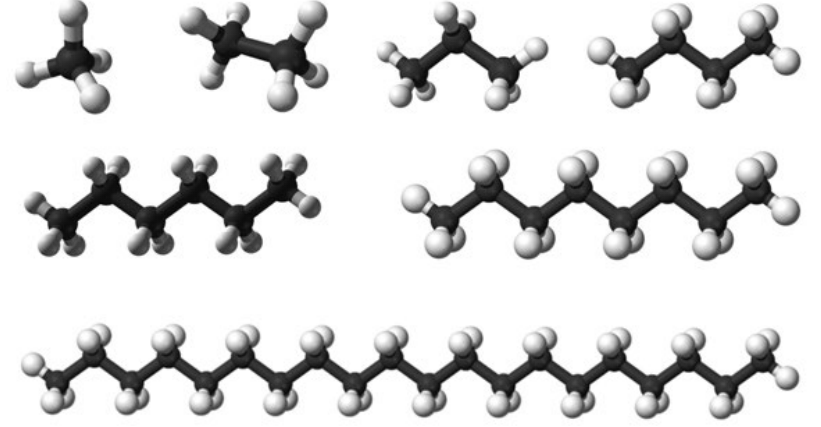
The most important factor affecting physical properties is the strength of intermolecular forces - the attractive forces between separate molecules. Understanding these forces helps explain why some organic compounds are gases whilst others are liquids or solids at room temperature.
Note
The general formula for alkanes is , where n represents the number of carbon atoms in the chain. This simple formula helps us understand how molecular size increases systematically through the alkane series.
Van der Waals intermolecular forces
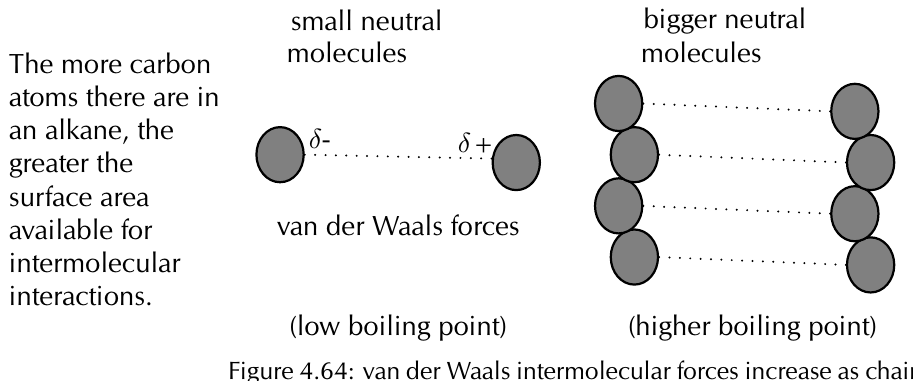
Van der Waals forces are weak intermolecular attractions that exist between all molecules. These forces become stronger as molecules get larger because there is more surface area available for interactions between neighbouring molecules.
Important
Key factors affecting Van der Waals force strength:
In alkanes, the strength of van der Waals forces depends on:
- Chain length: Longer carbon chains have more surface area
- Molecular shape: The amount of contact possible between molecules
- Molecular size: Larger molecules have stronger intermolecular attractions
As the number of carbon atoms increases in an alkane chain, the van der Waals forces become progressively stronger, leading to higher boiling and melting points.
Effect of chain length on physical properties
Boiling and melting point trends
The relationship between chain length and physical properties is clearly demonstrated in the alkane series. As we move from methane () to longer alkanes, several important trends emerge:
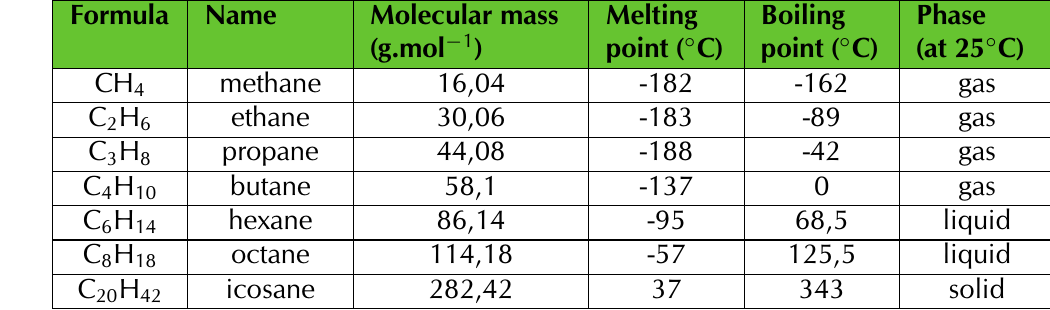
Key trends observed:
- Boiling points increase as chain length increases
- Melting points increase as chain length increases
- Molecular mass increases with additional carbon atoms
- Physical state changes from gas to liquid to solid
Physical states at room temperature
At 25°C (room temperature), alkanes exist in different physical states depending on their chain length:
- Gases: Methane to butane (1-4 carbon atoms)
- Liquids: Pentane to approximately (5-16 carbon atoms)
- Solids: Long-chain alkanes (17+ carbon atoms)
This progression occurs because longer molecules require more energy to overcome the stronger intermolecular forces holding them together.
Note
Why chain length affects properties
The increase in boiling point with chain length can be explained by intermolecular forces. Longer molecules have:
- Greater surface area for van der Waals interactions
- More points of contact with neighbouring molecules
- Stronger total intermolecular attraction
- Higher energy required to separate molecules during boiling
Effect of branched groups on physical properties
Straight chains vs branched chains
When comparing molecules with the same molecular formula but different structures (isomers), significant differences in physical properties are observed. Straight-chain alkanes have higher boiling points than their branched-chain isomers.
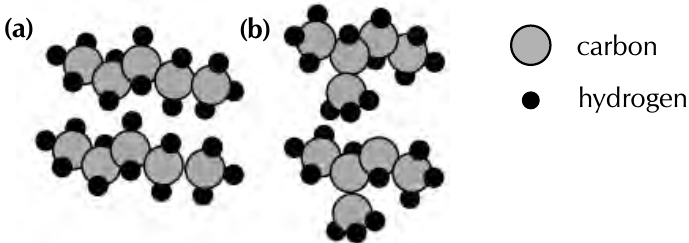
This difference occurs because:
- Straight chains can pack closely together
- More surface area is available for intermolecular contact
- Van der Waals forces are maximised
- Higher energy is needed to separate molecules
Branching effects on intermolecular forces
Branched molecules have lower boiling points because:
- The branches prevent close packing of molecules
- Less surface area is available for intermolecular contact
- Van der Waals forces are reduced
- Less energy is required to separate molecules during boiling
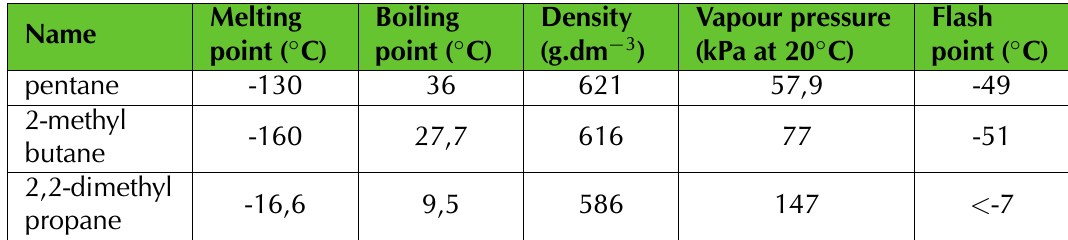
Important
Critical concept to remember: Branching decreases boiling points, not increases them! This is a common source of confusion. The more branched the molecule, the lower its boiling point due to reduced surface area for intermolecular interactions.
Isomer comparison example
Consider the three isomers of pentane ():
- Pentane (straight chain): Highest boiling point (36°C)
- 2-methylbutane (one branch): Medium boiling point (27.7°C)
- 2,2-dimethylpropane (highly branched): Lowest boiling point (9.5°C)
The more branched the molecule, the lower its boiling point due to reduced intermolecular forces.
Worked examples
Example
Worked Example 1: Predicting boiling point trends
Question: Arrange these alkanes in order of increasing boiling point: butane, methane, octane, hexane.
Solution:
- Count carbon atoms: methane (1), butane (4), hexane (6), octane (8)
- Longer chains have higher boiling points
- Order: methane < butane < hexane < octane
Example
Worked Example 2: Comparing isomers
Question: Which has a higher boiling point: pentane or 2-methylbutane?
Solution:
- Both have molecular formula
- Pentane is straight-chain, 2-methylbutane is branched
- Answer: Pentane has the higher boiling point due to better molecular packing and stronger van der Waals forces
Example
Worked Example 3: Explaining physical states
Question: Why is butane a gas at room temperature whilst octane is a liquid?
Solution:
- Butane () has weaker van der Waals forces due to shorter chain
- Octane () has stronger intermolecular forces due to longer chain
- Answer: Octane requires more energy to overcome intermolecular forces, so it remains liquid at room temperature
Applications in other functional groups
The principles of chain length and branching also apply to other organic functional groups. For example, solubility in water decreases as chain length increases because:
- Longer hydrocarbon chains are more non-polar
- Water is polar and cannot effectively interact with long non-polar chains
- The polar functional group becomes less significant compared to the large non-polar portion
Note
This principle extends beyond alkanes to alcohols, carboxylic acids, and other functional groups. The hydrocarbon portion of any organic molecule will follow the same trends for physical properties.
Exam tips and common mistakes
Important
Common exam traps:
- Don't assume all properties increase with molecular size - some decrease (like water solubility)
- Remember that branching decreases boiling point, not increases it
- Physical state depends on temperature - always check the reference temperature given
Problem-solving method:
- Identify the molecular structures being compared
- Count carbon atoms (chain length effect)
- Look for branching (branching effect)
- Apply the correct trend (longer chains = higher bp, more branching = lower bp)
Summary
Key Points to Remember:
-
Van der Waals forces increase with molecular size and surface area, leading to higher boiling and melting points in longer chain molecules
-
Chain length directly affects physical properties - longer alkane chains have higher boiling points, melting points, and molecular masses
-
Straight-chain molecules have higher boiling points than branched isomers because they can pack more closely together, maximising intermolecular forces
-
Physical states at room temperature progress from gases (short chains) to liquids (medium chains) to solids (long chains) as intermolecular forces strengthen
-
Branching reduces boiling points by decreasing the surface area available for intermolecular interactions, making molecules easier to separate