Rates of Reaction and Factors Affecting Rate (Grade 12 NSC Matric Physical Sciences): Revision Notes
📚Revision Notes
Rates of Reaction and Factors Affecting Rate
Introduction
Chemical reactions occur at different rates. Some reactions happen very quickly, like a match burning, while others take much longer, such as the rusting of a car. Understanding why reactions proceed at different speeds and how we can control these rates is crucial in chemistry.

In this topic, we explore how reaction rates are measured and the various factors that influence how fast or slow a chemical reaction proceeds.
Note
The ability to control reaction rates has enormous practical applications in industry, from manufacturing pharmaceuticals to producing food and optimising fuel efficiency in engines.
What is a reaction rate?
Reaction rate describes how quickly a chemical reaction takes place. We can measure this by observing how fast the reactants are consumed or how quickly the products are formed during the reaction.
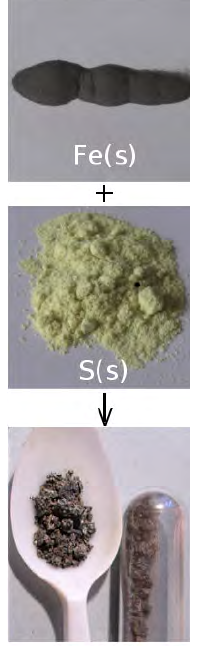
For example, when iron and sulphur react to form iron sulphide:
We can measure the reaction rate by timing how long it takes for the iron and sulphur to be completely used up, or by measuring how quickly the iron sulphide product forms.
Definition and formula
Important
Definition: Reaction rate is the average rate at which reactants are used up or products are formed during a chemical reaction.
The average reaction rate can be calculated using these formulas:
For reactant consumption:
For product formation:
Example
Worked Example 1: Calculating Reaction Rate
Question: The following reaction takes place: After two minutes, 4 g of lithium has been used. Calculate the rate of the reaction.
Solution:
Step 1: Calculate the number of moles of lithium used
Step 2: Convert time to seconds
Step 3: Calculate the reaction rate
Therefore, the rate of the reaction is 0.005 mol·s⁻¹
Collision theory
Chemical reactions don't just happen automatically when reactants are mixed together. For a reaction to occur, the reactant particles must collide with each other in a very specific way.
Important
Definition: Collision theory states that reactant particles must collide with the correct energy and orientation for the reactants to change into products.
Collision theory explains how chemical reactions occur and why reaction rates differ. For a successful reaction to take place, the reactant particles must:
- Collide with each other
- Have sufficient energy (activation energy)
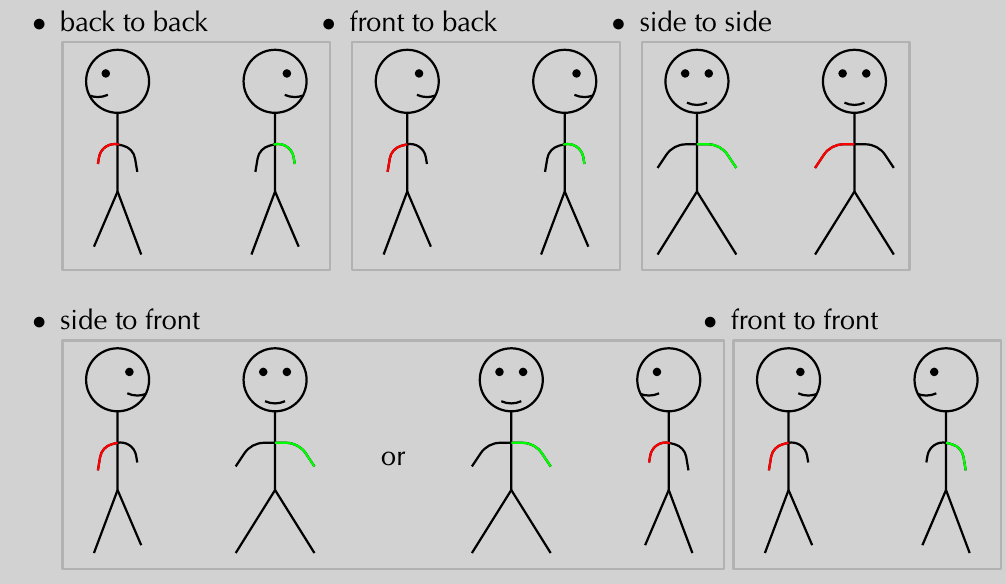
- Have the correct orientation at the moment of impact
Only collisions that meet all these requirements are called successful or effective collisions. These successful collisions break the existing bonds in the reactants and form new bonds to create the products.
Note
The diagram above shows different orientations between particles. Just like people trying to link arms, molecules need the right orientation to react successfully. Some orientations make it easy to form bonds (like "side to side"), while others make it nearly impossible (like "back to back").
Factors affecting reaction rates
Several factors can influence how fast a chemical reaction proceeds. Understanding these factors allows us to control reaction rates, which is particularly important in industrial processes.
Nature of reactants
Different substances have different chemical properties and therefore react at different rates. For example, the rusting of iron occurs much more slowly than the tarnishing of silver.
The nature of the reactants affects reaction rate because different substances require different amounts of energy to break their bonds and form new ones. Substances with weaker bonds or more reactive chemical properties will generally react faster than those with stronger bonds or less reactive properties.
Surface area
The surface area of solid reactants significantly affects reaction rate. Increasing the surface area increases the rate of reaction.
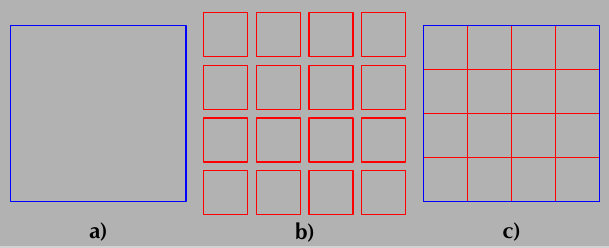
When we break a solid into smaller pieces, we increase the total surface area available for reaction. This means more reactant particles are exposed and available to collide with other reactants.
Note
For example, when marble chips react with hydrochloric acid:
Powdered marble reacts much faster than large marble chips because the powder has a much greater surface area.
Only the particles at the surface of a solid can react initially. Once they react and are removed, the next layer becomes the new surface.
The smaller the pieces of solid reactant, the greater the surface area available for collision, and therefore the faster the reaction rate.
Concentration
As the concentration of reactants increases, so does the reaction rate.
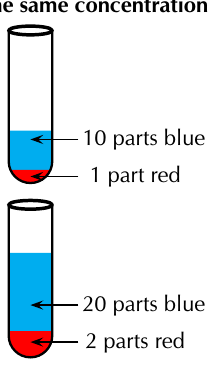
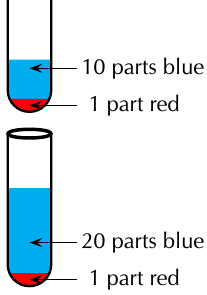
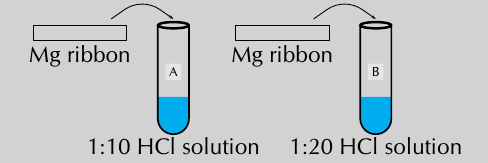
Higher concentration means there are more reactant particles per unit volume of solution. This increases the probability that reactant particles will collide with each other, leading to more successful collisions per unit time and therefore a faster reaction rate.
Note
For example, when magnesium reacts with hydrochloric acid:
A more concentrated HCl solution will react faster with magnesium than a dilute HCl solution because there are more HCl particles available to collide with the magnesium atoms.
Pressure (for gaseous reactants)
As the pressure of gaseous reactants increases, so does the reaction rate.
Higher pressure means the gas particles are compressed into a smaller volume. This increases the concentration of gas particles and therefore increases the number of collisions per unit time. More collisions lead to more successful reactions and a faster overall reaction rate.
Temperature
If the temperature increases, so does the average rate of the reaction.
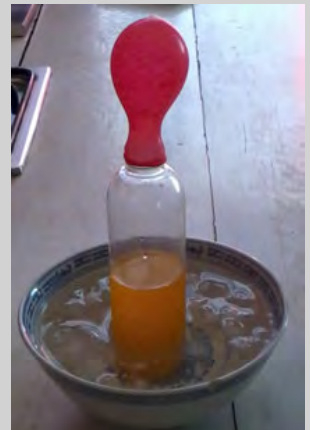
Temperature has a significant effect on reaction rate because it affects the kinetic energy of the particles. Higher temperature means:
- Particles move faster, leading to more frequent collisions
- Particles have higher kinetic energy, meaning more collisions have sufficient energy to overcome the activation energy barrier
- More collisions result in successful reactions
Important
For most reactions, a small increase in temperature can cause a large increase in reaction rate.
Catalysts
A catalyst is a substance that increases the reaction rate by lowering the energy required for a successful reaction to take place. Importantly, the catalyst is not consumed in the reaction and remains unchanged at the end.
How catalysts work:
- They provide an alternative reaction pathway with lower activation energy
- More collisions have sufficient energy to react successfully
- The reaction proceeds faster
- The catalyst can be recovered unchanged and reused
Note
For example, in the decomposition of hydrogen peroxide:
This reaction occurs slowly on its own, but adding a catalyst like manganese dioxide (MnO₂) or even yeast dramatically speeds up the reaction without being consumed.
Example
Worked Example 2: Factors Affecting Rate
Question: Write a balanced equation for the reaction between Zn(s) and HCl(ℓ). Also name three ways to increase the rate of this reaction.
Solution:
Step 1: Write the equation for zinc and hydrochloric acid The products must be a salt and hydrogen gas. Zinc ions have a charge of 2+ while chloride ions have a charge of 1-. Therefore the salt must be ZnCl₂.
Step 2: Balance the equation if necessary There are more chloride ions and hydrogen atoms on the right side of the equation. Therefore there must be 2 HCl on the left side of the equation.
Step 3: Think about methods to increase reaction rate
- A catalyst could be added
- The zinc solid could be ground into a fine powder to increase its surface area
- The HCl concentration could be increased
Example
Worked Example 3: Rate Calculations from Data
Question: Hydrochloric acid and calcium carbonate react according to:
The volume of carbon dioxide produced is measured over time. At 1 minute, 14 cm³ of CO₂ was produced. At 2 minutes, 26 cm³ total had been produced. Calculate the average rate between 1 and 2 minutes.
Solution:
Volume of CO₂ produced between 1 and 2 minutes = 26 - 14 = 12 cm³ Time interval = 2 - 1 = 1 minute = 60 seconds
Summary
Key Points to Remember:
- Reaction rate measures how quickly reactants are used up or products are formed
- Collision theory explains that particles must collide with sufficient energy and correct orientation for reactions to occur
- Six main factors affect reaction rate: nature of reactants, surface area, concentration, pressure (for gases), temperature, and catalysts
- Increasing surface area, concentration, pressure, or temperature generally increases reaction rate
- Catalysts speed up reactions by lowering activation energy without being consumed themselves
- Smaller particles react faster than larger ones due to greater surface area exposure