The Fertiliser Industry (Grade 12 NSC Matric Physical Sciences): Revision Notes
📚Revision Notes
The Fertiliser Industry
The fertiliser industry represents one of the most important sectors in industrial chemistry, producing essential nutrients that support global food production. Understanding the interconnected processes involved in fertiliser manufacturing is crucial for NSC Physical Sciences students.
Note
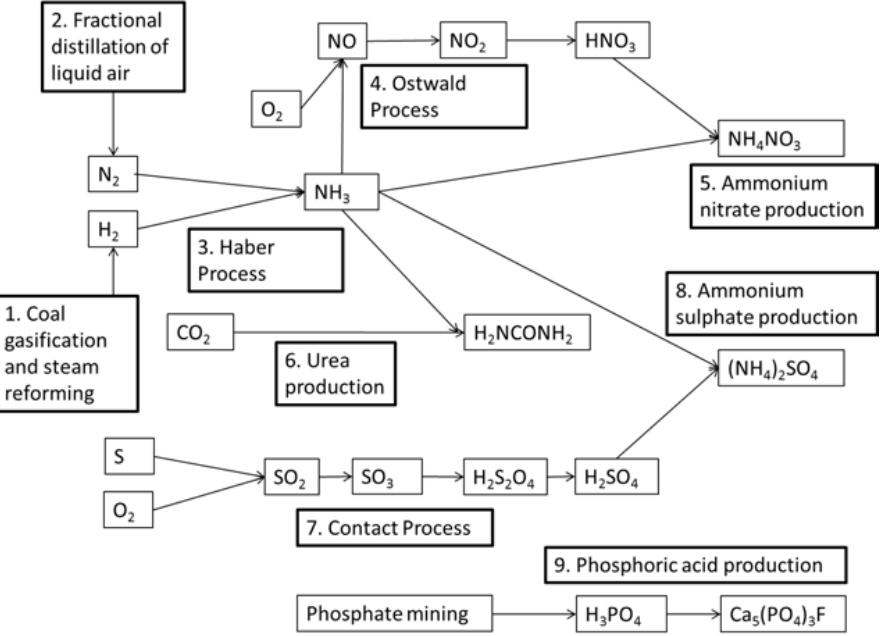
The industrial production of fertilisers involves multiple interconnected chemical processes. Each process builds upon others to create a complex network of chemical manufacturing that ultimately produces the nitrogen, phosphorus, and potassium compounds needed for plant growth.
Raw material production
Producing hydrogen through steam reforming
Steam reforming is the primary industrial method for producing hydrogen gas, which serves as a crucial raw material in fertiliser production.
The process involves reacting methane (from natural gas) with steam at high temperatures (700-1100°C) to produce syngas - a mixture of carbon monoxide and hydrogen:
This reaction is endothermic, meaning it requires continuous heat input to maintain the process.
Example
Step-by-Step: Water Gas Shift Reaction
Step 1: The water gas shift reaction occurs at lower temperatures (around 130°C)
Step 2: Steam reacts with carbon monoxide to produce additional hydrogen:
Step 3: This exothermic reaction strips oxygen atoms from steam to oxidise carbon monoxide to carbon dioxide, while simultaneously producing more hydrogen gas and releasing energy to help maintain the overall process.
Obtaining nitrogen through fractional distillation
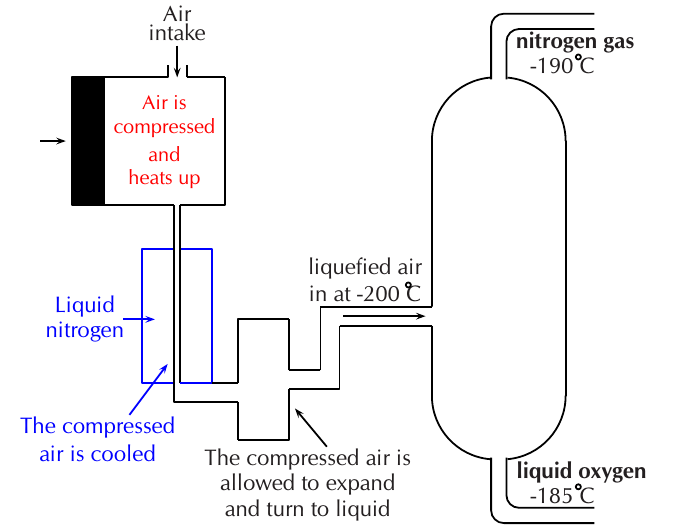
Fractional distillation is a separation method that exploits the different boiling points of air components to isolate nitrogen gas.
Example
Process Steps: Air Separation
- Air is compressed and heated, then cooled using liquid nitrogen
- The compressed air expands and liquefies at extremely low temperatures (-200°C)
- The liquefied air mixture is separated in a fractional distillation column
- Nitrogen gas is collected at -190°C while oxygen remains as a liquid at -185°C
Important
This process is essential because nitrogen makes up 78% of air but exists as unreactive N₂ molecules that plants cannot use directly.
Key industrial processes
The Haber process for ammonia production
The Haber process converts nitrogen and hydrogen gases into ammonia, which forms the foundation for most nitrogen-containing fertilisers.
The balanced equation is:
Important
Essential conditions:
- Catalyst: Iron (Fe)
- Pressure: 200 atmospheres
- Temperature: 450-500°C
The reaction is exothermic and reversible. High pressure favours ammonia formation because there are fewer gas molecules on the product side (4 reactant molecules → 2 product molecules). However, high temperature actually decreases the yield due to Le Chatelier's principle, but is necessary to achieve reasonable reaction rates.
Note
The ammonia produced is immediately removed from the reaction vessel to prevent the reverse reaction from occurring, maximising the yield of product.
The Ostwald process for nitric acid production
The Ostwald process converts ammonia into nitric acid through a three-step oxidation sequence.
Example
Step-by-Step: Ostwald Process
Step 1: Ammonia oxidation (strongly exothermic)
This step requires a platinum catalyst and produces nitrogen monoxide and water vapour.
Step 2: Nitrogen monoxide oxidation
Step 3: Nitrogen dioxide absorption
Note
The nitrogen monoxide produced in step 3 is recycled back into the process, making it highly efficient. The nitric acid is then concentrated to the required strength for further chemical processes.
The Contact process for sulphuric acid production
The Contact process produces sulphuric acid, which is needed for manufacturing certain fertilisers like ammonium sulphate.
Example
Step-by-Step: Contact Process
Step 1: Sulphur combustion
Step 2: Sulphur dioxide oxidation (using vanadium(V) oxide catalyst)
Step 3: Sulphur trioxide absorption
This process produces sulphuric acid with 98-99% purity, making it suitable for industrial applications.
Fertiliser production
Ammonium nitrate production
Ammonium nitrate is produced by combining ammonia and nitric acid in an acid-base neutralisation reaction:
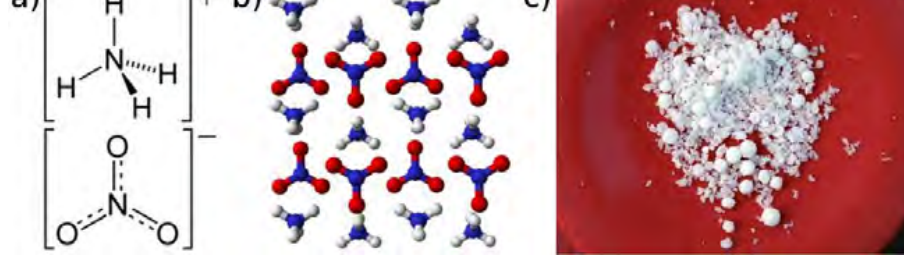
Ammonium nitrate appears as white crystalline crystals and is highly soluble in water. This makes it an excellent nitrogen source for plants, but also requires careful handling since it can be explosive under certain conditions.
Note
The compound contains both ammonium cations (NH₄⁺) and nitrate anions (NO₃⁻), providing plants with readily available nitrogen in two different chemical forms.
Urea production
Urea [(NH₂)₂CO] has the highest nitrogen content (46.4%) of all commonly used solid nitrogen fertilisers.
The production involves two reactions:

Example
Urea Production Process
Step 1: Ammonia reacts with carbon dioxide to form ammonium carbamate (H₂NCOONH₄) as an intermediate product
Step 2: The ammonium carbamate decomposes to form urea and water
Result: The final urea product is highly water-soluble and provides an efficient way to deliver nitrogen to plants.
Ammonium sulphate production
Ammonium sulphate is produced by reacting ammonia with sulphuric acid:
The solution is concentrated by evaporating water until ammonium sulphate crystals form. This fertiliser provides both nitrogen and sulphur, making it valuable for crops that require both nutrients.
Phosphoric acid and super phosphates
Phosphate fertilisers begin with producing phosphoric acid from phosphate rock (fluorapatite):
Example
Super Phosphate Production
Single super phosphate (SSP) is produced by:
Triple super phosphate (TSP) is produced by:
Important
These processes convert insoluble phosphate rock into water-soluble forms that plants can absorb and utilise.
Compound fertilisers and NPK ratios
The nitrophosphate process produces complex fertilisers containing multiple nutrients. It involves acidifying calcium phosphate with nitric acid to create a mixture of phosphoric acid and calcium nitrate:
When ammonia is added, this produces compound fertilisers containing nitrogen, phosphorus, and calcium. Adding potassium chloride or potassium sulphate creates NPK fertilisers that provide all three primary plant nutrients.
Note
NPK ratios (such as 4:2:3) indicate the relative proportions of nitrogen, phosphorus, and potassium in the fertiliser, allowing farmers to select products that match their soil's specific nutrient requirements.
Advantages and disadvantages of inorganic fertilisers
Advantages of inorganic fertilisers
Inorganic fertilisers offer several important benefits for modern agriculture:
- Precise nutrient control: Manufacturers can produce fertilisers with exact nutrient concentrations to match specific crop requirements
- Water solubility: Inorganic fertilisers dissolve readily in soil water, making nutrients immediately available to plant roots
- High efficiency: Much smaller quantities are needed compared to organic fertilisers to achieve the same nutritional effect
- Large-scale production: Industrial processes can produce vast quantities to meet global agricultural demands
- Consistent quality: Manufacturing processes ensure uniform nutrient content across all batches
Disadvantages of inorganic fertilisers
However, inorganic fertilisers also present significant challenges:
- Manufacturing costs: Industrial production requires substantial investment in chemicals and energy, making fertilisers expensive
- Environmental pollution: Manufacturing processes release pollutants into the atmosphere, contributing to air quality problems
- Soil contamination: Nutrients not absorbed by plants can accumulate in soil, potentially altering soil chemistry
- Water pollution: Excess fertilisers wash away from fields and contaminate groundwater, rivers, and dams through leaching and runoff
- Dependence on industrial processes: Agricultural productivity becomes reliant on continuous industrial chemical production
Summary
Key Points to Remember:
-
The fertiliser industry connects multiple industrial processes: steam reforming → Haber process → Ostwald process → fertiliser production
-
Key equations to memorise: Haber process (), Ostwald process (3 steps), and Contact process (3 steps)
-
Fractional distillation separates air components based on different boiling points to obtain pure nitrogen gas
-
NPK fertilisers provide the three primary plant nutrients: Nitrogen, Phosphorus, and Potassium in specific ratios
-
Inorganic fertilisers offer precise nutrient control and high efficiency but cause environmental concerns through pollution and water contamination