Social, Economic, and Cultural Influences on Biotechnology (HSC SSCE Biology): Revision Notes
📚Revision Notes
Social, Economic, and Cultural Influences on Biotechnology
Introduction
Biotechnology has been utilised by humans for approximately years to improve various aspects of life. Modern biotechnological applications are increasingly complex and possess significant potential to transform both society and the environment. Although biotechnologies are fundamentally designed to enhance human wellbeing, different individuals and groups hold varying perspectives on specific biotechnological developments. These perspectives are shaped by personal needs, values, and priorities.
Note
When evaluating any biotechnology, it is essential to consider how social, economic, and cultural factors influence its development, acceptance, and implementation. Your viewpoint may differ significantly from others based on these contextual considerations.
Social context
What is social context?
Social context refers to the physical and social environment in which people live. In biotechnology, the techniques available to a society depend on several factors:
- The specific needs of that society
- Governmental decisions and policies
- Individual and national wealth
- The overall economic status of the country
DNA fingerprinting and STR analysis
A prominent example of socially-driven biotechnology is DNA fingerprinting, which is extensively used in forensic science and paternity testing across many countries. This technique analyses non-coding DNA segments to identify differences and similarities between samples.
Short tandem repeats (STR)
Important
The most widely used DNA fingerprinting method is Short Tandem Repeat (STR) analysis. This powerful technique allows scientists to identify individuals with remarkable accuracy by examining specific genetic markers.
Key features include:
- STRs are sequence markers located on chromosomes
- Repeats typically range from bases in length
- The number of repeats varies between individuals in a population
- Primers are used to locate these repeats by matching complementary base sequences
- The number of STRs in alleles is counted to determine shared alleles between samples
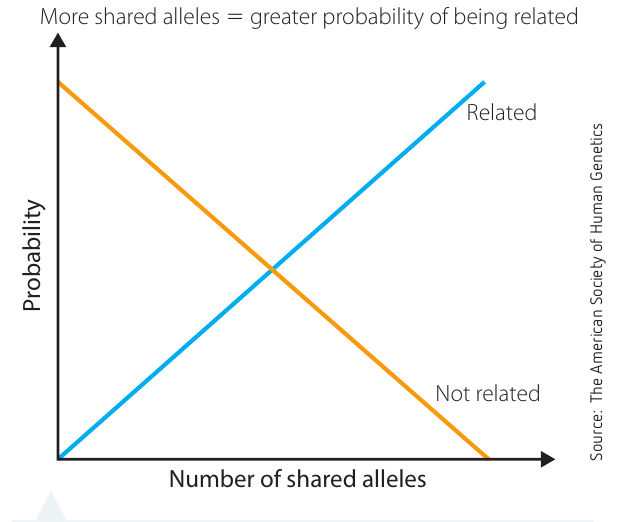
The graph above illustrates an important principle: the greater the number of shared alleles between two samples, the higher the probability that the individuals are related. Conversely, unrelated individuals will share fewer alleles.
Advantages and limitations of DNA analysis
DNA analysis techniques like STR enable investigators to match samples with high accuracy, solve forensic problems effectively, and establish biological relationships definitively.
Note
Significant Challenges in DNA Analysis
However, important limitations must be considered:
- Time-consuming: Analysis requires considerable laboratory work
- Costly: Equipment and expertise are expensive
- Limited availability: Not accessible in all regions globally
- Ethical concerns: Including discrimination risks, ownership and privacy issues regarding genetic information, and potential misuse of the technology
Economic context
The economics of genetically modified foods
Developing genetically modified (GM) foods requires substantial research and development investment. This creates tensions between multiple stakeholders:
Farmers' perspective
- Need to generate profit from crops
- Face potentially high costs for GM seeds
- May benefit from increased yields
Consumers' perspective
- Require affordable food prices
- Want access to quality produce
Biotechnology companies' perspective
- Often patent their GM products, owning exclusive rights to specific technologies
- This creates potential monopolies for large multinational corporations
Concerns about GM food economics
Important
Developing countries: Small-scale farmers in developing nations frequently cannot afford GM crop seeds. This situation perpetuates wealth inequality between developed and developing countries, raising questions about fair access to biotechnology.
Patents: When biotechnology companies patent their products, they gain exclusive control over those technologies. Critics argue this gives too much power to large corporations.
Potential economic benefits
Despite concerns, GM foods can offer economic advantages:
- Production of greater crop volumes at similar or reduced costs
- Increased financial returns for farmers
- Lower prices for consumers
Example
Worked Example: GM Atlantic Salmon Economics
GM Atlantic salmon can potentially be produced in larger quantities than naturally-bred salmon. This demonstrates how biotechnology can create economic benefits:
For farmers:
- Higher production volumes = increased income
- More efficient growth rates = reduced time to market
For consumers:
- Greater supply = lower retail prices
- Improved accessibility to nutritious protein
Overall impact: This creates a win-win scenario where both producers and consumers benefit economically from the biotechnology.
Cultural context
Understanding cultural influences
Cultural context encompasses the shared meanings, ideas, beliefs, and characteristics that define a particular society. Several factors shape cultural perspectives on biotechnology:
- Values and worldviews
- Religious and moral beliefs
- Educational background
- Traditional practices and customs
These factors influence whether groups or individuals are receptive to using specific biotechnologies.
Case study: Mungo Man and DNA testing

DNA testing of ancient human remains demonstrates how cultural context influences biotechnology application. The Mungo Man fossil, discovered at Lake Mungo in New South Wales, provides an important example.
Example
Case Study: Mungo Man DNA Analysis
Initial DNA testing (2001): Mitochondrial DNA analysis of Mungo Man's remains suggested the possibility that another human lineage inhabited Australia before Aboriginal peoples. This claim was controversial and culturally significant.
Revised DNA testing (2016):
- The original study's reliability was questioned due to potential sample contamination
- New testing used improved DNA analysis techniques
- Researchers compared the fossil DNA with DNA from current inhabitants of the region
- Results confirmed that Mungo Man was of Aboriginal lineage
- This proved Aboriginal peoples were indeed the first inhabitants of the Australian continent
Cultural considerations: The DNA testing and permission to retest Mungo Man's remains required agreement from the Muthi Muthi people, the traditional custodians of Mungo Man. This demonstrates the importance of respecting cultural ownership and Indigenous rights when applying biotechnologies to culturally significant materials.
Assessing influences on biotechnology use
The importance of evaluating different perspectives
Modern biotechnological advances, particularly in stem cell research and cloning, have generated considerable expectations about:
- Curing diseases like cancer
- Repairing damaged tissues
- Potentially saving millions of lives
However, not everyone supports all new techniques. Opposition often arises from religious beliefs, ethical concerns, and philosophical positions about the sanctity of life.
Religious perspectives
Important
Christianity and other faiths: Some religious individuals oppose:
- Cloning that destroys embryos
- Termination of pregnancies following diagnosis of genetic abnormalities
- Arguments centre on the sanctity of human life and concerns about "playing God"
Influence on policy: In countries where religion strongly influences public policy and opinion, religious views significantly affect biotechnology regulation.
Note
Example - Synthetic biology: A survey across European countries revealed that people with strong belief in God showed greater opposition to synthetic biology. They perceived creating new organisms as conflicting with the religious concept that creation is a divine activity.
Islam: Islamic scholars have raised concerns about introducing pig genes into food sources or developing organs for transplants, as Islam forbids pork consumption.
Framework for assessing impacts
When evaluating any biotechnology, consider its effects across three categories:
| Category | Considerations |
|---|---|
| Social impacts | Human rights, benefits to humans, sustainability of resources |
| Economic impacts | Financial costs, financial benefits, market access |
| Cultural impacts | Religious opinion, differences based on location and customs, traditional practices |
Evaluating information sources
When researching biotechnologies, assess your sources using three key criteria:
| Criterion | Evaluation questions |
|---|---|
| Accuracy | Is the information substantiated across multiple sources, including scientific literature? Is it consistent and valid? |
| Reliability | Is the information current? Is the source reputable? (Check the URL) Does the article aim to create bias? (Examine author credentials, publication date, and organisational affiliations) |
| Validity | Does the information directly relate to your research question? |
Conducting biotechnology impact research
When investigating a specific biotechnology (such as xenotransplantation, recombinant DNA applications, human cloning, or IVF), follow a systematic approach:
Research process
- Select a specific biotechnology to investigate
- Gather information from diverse sources (books, journals, videos, internet)
- Organise findings into social, economic, and cultural categories
- Develop a comprehensive reference list
- Critically evaluate source reliability, accuracy, and validity
Note
Important Considerations
- Bias awareness: Consider how social and cultural factors may bias different perspectives
- Multiple viewpoints: Recognise that biotechnologies can be controversial
- Comprehensive analysis: Examine all three contexts (social, economic, cultural) for balanced understanding
Remember!
Summary
Key Takeaways: Social, Economic, and Cultural Influences on Biotechnology
-
Social context (the physical and social setting) determines which biotechnologies are available to a society, influenced by needs, government choices, wealth, and economic status
-
Economic factors significantly impact biotechnology development, particularly through research costs, patents, and the balance between profitability and accessibility
-
Cultural context (shared beliefs, values, and characteristics) shapes whether societies accept and use specific biotechnologies
-
DNA fingerprinting using STR analysis exemplifies socially-driven biotechnology with important ethical considerations around privacy, discrimination, and appropriate use
-
When evaluating biotechnologies, always assess information sources for accuracy, reliability, and validity to form well-informed conclusions