Mutation (HSC SSCE Biology): Revision Notes
📚Revision Notes
Effects of Mutations
What is a mutation?
A mutation is a change in the DNA nucleotide sequence. While mutations are molecular changes in DNA, they have effects at three different levels:
- Cellular level - affects how cells function
- Individual level - affects the organism's characteristics (phenotype)
- Population level - introduces new genetic variation
The type of cell affected by a mutation determines how far-reaching its effects will be.
Note
The same molecular change in DNA can have vastly different consequences depending on whether it occurs in a body cell or a reproductive cell. This is why understanding the cellular location of mutations is crucial for predicting their effects.
Somatic and germline mutations
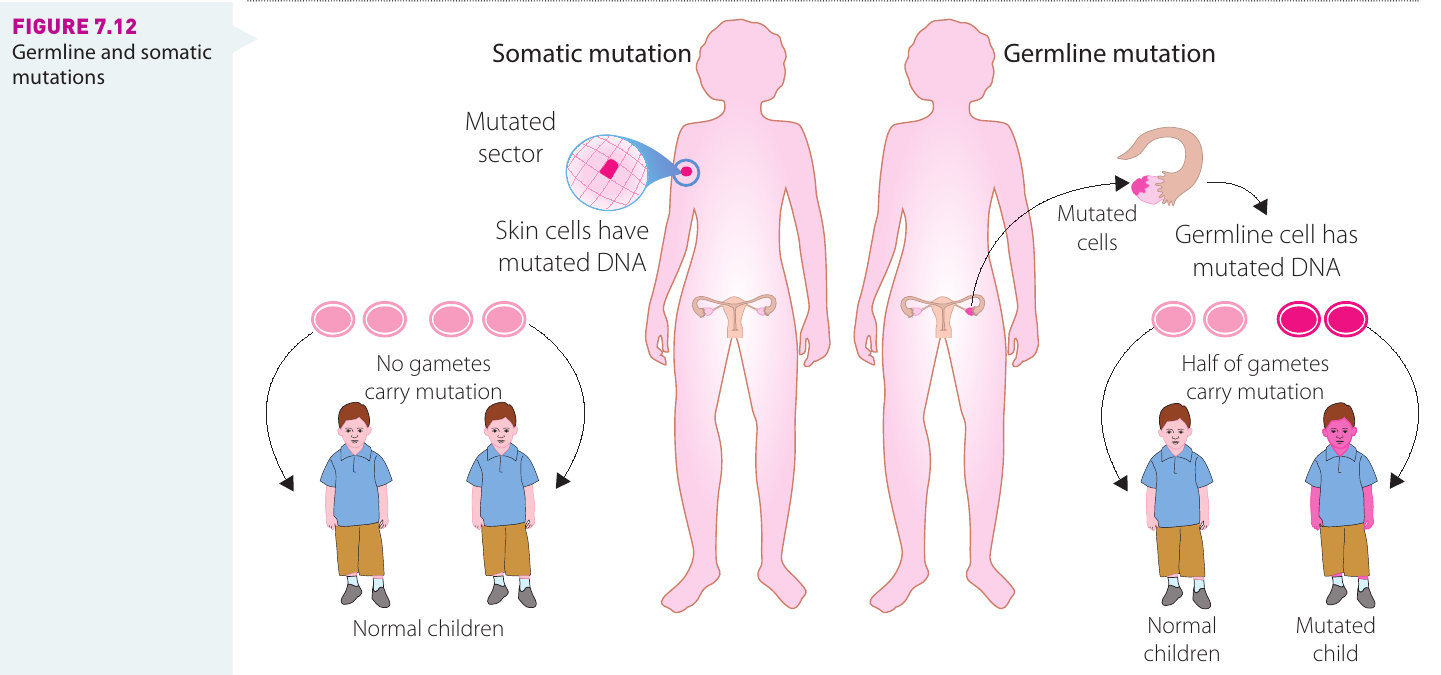
Not all mutations are inherited. Whether a mutation passes to the next generation depends on which type of cell is affected.
Somatic mutations
Somatic mutations occur in regular body cells (non-reproductive cells). These mutations:
- Arise during mitosis, often as replication errors in the S phase of the cell cycle
- Are passed on to daughter cells when the mutated cell divides
- Affect only patches of tissue derived from the mutated cell
- Are not inherited by offspring
- Have greater effects if they occur early in development (because they affect more cells)
Common examples of somatic mutations:
- Skin cancer
- Liver cancer
- Brain tumours
- Localized tissue changes (like pigmented patches)
Some somatic mutations don't cause visible changes but affect cell function, such as those causing cystic fibrosis, thalassaemia, and Tay-Sachs disease.
Note
Memory Aid: SOMA
- SOme cells
- MAke tumours
This helps remember that somatic mutations affect only some cells and can lead to tumours, but are not passed to offspring.
Germline mutations
Germline mutations (also called gametic mutations) occur in the reproductive cells that produce gametes (egg and sperm cells). These mutations:
- Occur in germline cells in the gonads
- Are inherited by offspring
- Affect every cell in the offspring's body
- Are replicated in all cells as the embryo develops
When a gamete carrying a mutation fuses with another gamete during fertilization, the resulting embryo contains the mutation in every single cell.
Note
Memory Aid: GERM
- Goes to
- Every
- Reproductive cell
- Makes all cells
This helps remember that germline mutations go to every reproductive cell and end up in all cells of the offspring.
Important
Key Difference Between Somatic and Germline Mutations:
The diagram above shows the critical distinction: somatic mutations affect only some body tissues and produce no mutated gametes, while germline mutations result in half the gametes carrying the mutation, which can then be passed to offspring.
This means that germline mutations have evolutionary significance because they introduce heritable variation, while somatic mutations affect only the individual organism.
Mutations in coding DNA
Coding DNA contains genes that code for proteins. Since proteins determine an organism's characteristics and cell functions, mutations in coding DNA directly affect the protein products.
How coding DNA mutations affect proteins
Mutations in coding genes usually:
- Change the type or sequence of amino acids in a protein
- Affect gene splicing in eukaryotes
- Modify the function or levels of the protein product
For example, a mouse's coat colour depends on proteins that make pigment. A mutation in the coding region changes the protein, which changes the coat colour.
DNA repair genes
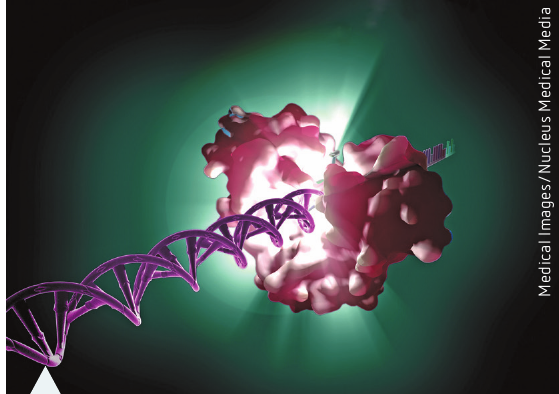
Prokaryotes (bacteria) have mostly coding DNA, with much of it devoted to genes for DNA repair enzymes. These enzymes are essential for survival because they maintain DNA integrity.
Important
Mutations in DNA repair genes are particularly serious because they lead to increased mutation rates throughout the genome. This creates a cascading effect where one mutation leads to many more.
Example
Disease Example: Xeroderma Pigmentosum (XP)
Xeroderma pigmentosum demonstrates the critical importance of DNA repair mechanisms:
- Cause: Mutation in a gene for DNA repair
- Effect: People with XP are extremely susceptible to UV light damage
- Consequence: They are 1000 times more likely to develop skin cancer than people without the mutation
This shows how a single mutation affecting DNA repair can have devastating consequences for the entire organism.
Other important mutations in coding DNA:
- Tumour suppressor genes - mutations can result in cancer
- Proto-oncogenes - mutations that activate these genes promote cell division or reduce cell death, leading to cancer
Mutations in non-coding DNA
For many years, scientists didn't understand the function of non-coding DNA. We now know that while non-coding DNA doesn't code for proteins, much of it has important functions.
Functions of non-coding DNA
Non-coding DNA includes:
- Regulatory sequences that control gene expression
- Promoters that 'switch on' genes
- Silencers that 'switch off' genes
- Enhancers that increase gene activity
- RNA-coding genes that produce:
- rRNA (ribosomal RNA) - the machinery for translation
- Small nuclear RNA - helps determine which introns are removed during splicing
- Structural elements
- Centromeres (chromosome attachment points)
- Telomeres (chromosome end caps)
Effects of non-coding DNA mutations
Mutations in non-coding DNA can have significant effects on development and disease susceptibility.
Affect development:
- Cause developmental abnormalities in embryos
- Lead to congenital (birth) defects
- Result in embryo or foetus abortion if severe
Example
Congenital Heart Defect Example:
An isolated congenital heart defect results from a mutation in the TBX5 enhancer gene in a non-coding region.
This demonstrates that even though this DNA doesn't code for a protein, the mutation disrupts gene regulation during development, leading to structural heart abnormalities present from birth.
Predispose to disease:
- Heart disease
- Diabetes
- Cancer
- Obesity
- Even some infectious diseases like hepatitis C
These mutations work by disrupting gene expression, which leads to abnormalities in the organism's characteristics.
Evolutionary advantages of non-coding DNA
Note
Non-coding DNA may provide evolutionary benefits:
- Acts as a 'buffer zone' between genes, minimizing damage from frameshift mutations
- Provides flexibility during crossing over, so recombination doesn't need pinpoint accuracy
This suggests that having large amounts of non-coding DNA may actually be advantageous for long-term survival of species by protecting essential coding regions.
The human genome composition
Only a small fraction of the human genome actually codes for proteins.
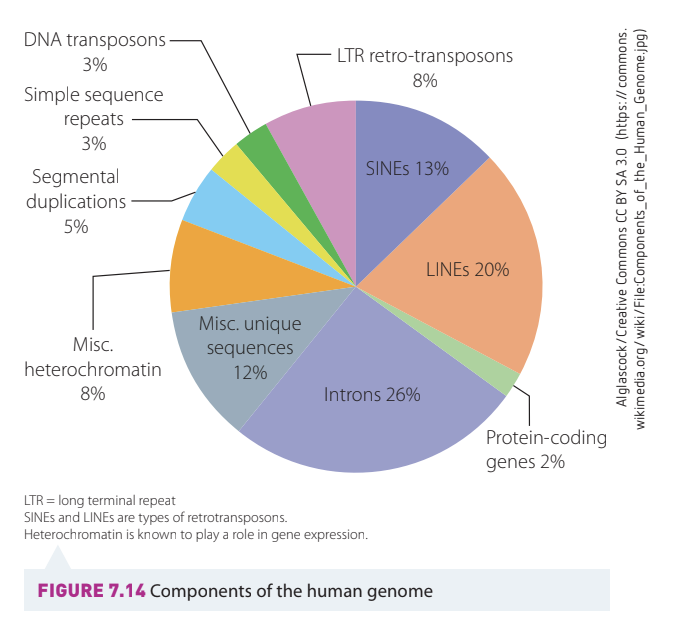
From the pie chart, we can see:
- Protein-coding genes: Only 2%
- Introns: 26%
- Retrotransposons (LINEs and SINEs): 33%
- Other non-coding elements: The remaining ~39%
Important
"Only 2% Codes" - A Surprising Finding
This shows that the vast majority (98%) of human DNA doesn't code for proteins, yet much of it serves important functions in gene regulation and expression.
This discovery challenged the initial assumption that non-coding DNA was useless and revealed the complexity of genome organization and regulation.
Junk DNA and transposable elements
What is junk DNA?
The term 'junk DNA' was coined in 1972 for parts of non-coding DNA that seem to have no protein-coding or regulatory function. This term specifically refers to highly repetitive DNA sequences whose nature and function remain mysterious.
Note
What Junk DNA is NOT:
Junk DNA does not include:
- Regulatory sequences (promoters, silencers, enhancers)
- DNA with known functions (centromeres, telomeres)
The term is specifically reserved for sequences whose function, if any, remains unknown.
Transposable elements
Much of what was called 'junk DNA' consists of mobile genetic elements.
Transposons - DNA segments that can move to different positions in the genome
Retrotransposons - Viral RNA that has been reverse-transcribed back into DNA and inserted into the genome
These elements:
- Originated from viruses that inserted their genetic material into host cells
- Can make numerous copies of themselves within the cell's DNA
- Are sometimes called 'selfish DNA' because they use cell resources but give nothing back
- May introduce variation and keep the genome diverse, providing opportunities for natural selection
Note
The debate continues among scientists about whether these elements serve any beneficial function or are simply molecular parasites. Some researchers argue they contribute to genetic diversity and evolutionary flexibility, while others maintain they are purely parasitic with no benefit to the host organism.
Mutations during meiosis
Meiosis is an important source of genetic variation, but it can also introduce harmful mutations.
Sources of variation during meiosis
Normal variation:
- Crossing over - exchange of DNA between homologous chromosomes
- Random segregation - random distribution of maternal and paternal chromosomes
- Fertilization - fusion of two different gametes with different gene combinations
Mutation-based variation:
- Replication errors - mistakes during DNA copying, leading to point mutations
- Chromosomal aberrations - structural changes to chromosomes
- Non-disjunction - errors in chromosome separation
Chromosomal errors
Errors during crossing over can cause chromosomal aberrations:
Inversions: DNA segment is inverted before being inserted onto the corresponding chromatid
Duplications and deletions:
- A chromosome breaks during crossing over
- If followed by chromosome duplication, one chromatid gets a duplication while the other gets a deletion
- May result in chromatids with two centromeres that pull apart incorrectly during anaphase
Important
Female Gametes are Particularly Vulnerable
These errors can be caused by exposure to mutagens (mutation-causing agents). Female gametes are particularly vulnerable because they remain in meiosis I for many years - from embryonic life until ovulation - giving more opportunity for mutagen exposure.
This is why protective measures (like X-ray shielding) are especially important for females of reproductive age.
Non-disjunction - changes in chromosome number
Non-disjunction occurs when homologous chromosomes or sister chromatids fail to separate properly during nuclear division. This leads to gametes with incorrect chromosome numbers.
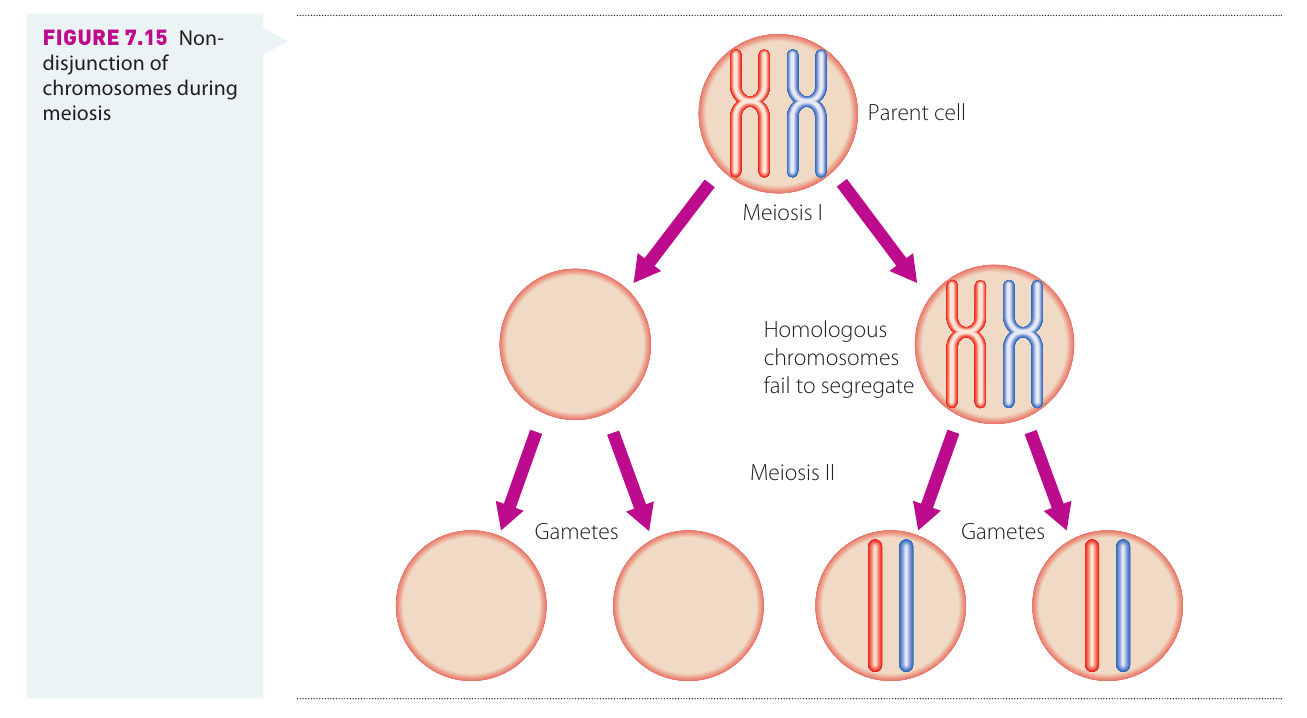
The diagram shows:
- Normal parent cell with two pairs of homologous chromosomes
- During Meiosis I, the homologous chromosomes fail to segregate
- After Meiosis II, this produces four abnormal gametes:
- Two gametes with no chromosomes
- Two gametes with both chromosomes
Example
Disease Example: Down Syndrome
Down syndrome illustrates the consequences of non-disjunction:
- Cause: An extra copy of chromosome 21 (three copies instead of two)
- Mechanism: Results from non-disjunction during meiosis
- Risk factors: Risk increases with parental age and certain environmental factors
When a gamete with an extra chromosome 21 fuses with a normal gamete during fertilization, the resulting embryo has three copies of chromosome 21 in every cell, leading to the characteristic features of Down syndrome.
Mutations and genetic variation
Mutations are essential for evolution and adaptation because they create the raw material for natural selection.
Mutations are essential for evolution and adaptation because they:
- Create new alleles - all genetic variation ultimately comes from mutations
- Introduce variation into populations - providing raw material for natural selection
- Allow populations to adapt - greater variability improves survival chances when environments change
Variability in populations
Variability refers to how much individuals in a population differ genetically from each other. Greater variability is beneficial because:
- Populations can better adapt to environmental changes
- There's an increased chance of survival
- Evolution by natural selection can occur
Variation refers to the new gene combinations in individuals.
Three sources of genetic variation
Genetic variation is increased by:
- Mutation - creates new alleles
- Meiosis - recombines genetic material through crossing over and random segregation
- Fertilization - combines genes from two different gametes
Together, these processes ensure that organisms are not genetically identical, even if they share the same ancestors.
Note
The interplay between these three processes creates the enormous genetic diversity we see in populations. While mutation provides the original variation, meiosis and fertilization shuffle and recombine this variation in countless ways, generating unique individuals in each generation.
Summary
Key Points to Remember:
- Somatic mutations occur in body cells and are not inherited; they only affect tissues derived from the mutated cell
- Germline mutations occur in reproductive cells and are inherited by all cells in the offspring
- Coding DNA (only 2% of human genome) directly affects protein products when mutated
- Non-coding DNA (98% of human genome) often affects gene regulation and expression when mutated
- Mutations during meiosis can cause chromosomal errors (aberrations) or changes in chromosome number (non-disjunction)
- All new alleles come from mutations, making them essential for evolution and adaptation
- Genetic variation results from the combination of mutation, meiosis, and fertilization