Deviations From Mendel’s Ratios (HSC SSCE Biology): Revision Notes
📚Revision Notes
Deviations from Mendel's ratios
Introduction
Although Mendel's inheritance patterns provide a strong foundation for understanding genetics, later research revealed that inheritance doesn't always follow his predicted ratios. These deviations from Mendelian patterns occur under specific conditions and help us understand the full complexity of genetic inheritance.
Several key factors cause variations from typical Mendelian ratios:
Non-standard dominance patterns: Rather than showing clear dominant-recessive relationships, some genes exhibit codominance (where both alleles are fully expressed) or incomplete dominance (where alleles blend to create an intermediate phenotype).
Gene linkage: Not all genes assort independently as Mendel proposed. Genes located on sex chromosomes, for instance, show sex-linked inheritance patterns where the ratios differ between male and female offspring.
Note
Understanding these deviations is essential for predicting inheritance patterns in real-world genetics, from human genetic counselling to animal and plant breeding programmes.
Sex determination
Sex determination refers to the process by which sex chromosomes separate during meiosis and later recombine at fertilisation to establish whether offspring will be male or female.
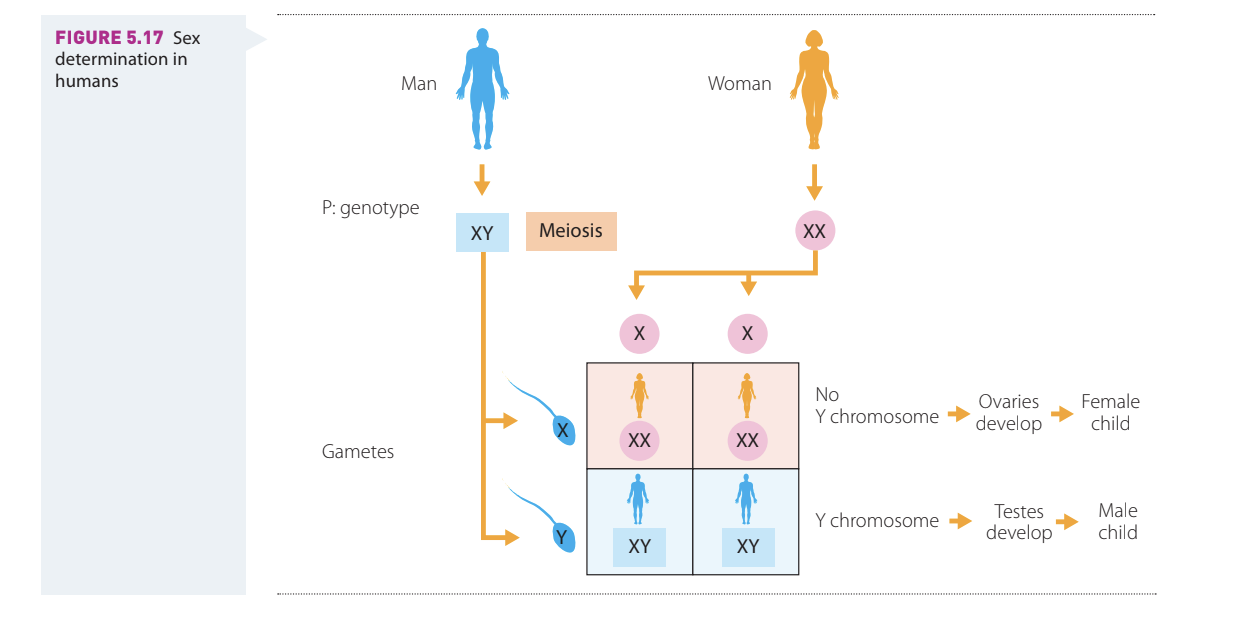
The mechanism of sex determination
During meiosis, sex chromosomes segregate just like any other pair of homologous chromosomes. Each gamete receives only one chromosome from each pair:
In females ( autosomes ): When chromosome number halves during meiosis, every egg cell receives autosomes .
In males ( autosomes ): Half of the sperm cells receive autosomes , whilst the other half receive autosomes .
Note
At fertilisation, the sex chromosome from the male gamete determines the offspring's biological sex:
- Female offspring (): Inherits an chromosome from both mother and father
- Male offspring (): Inherits an chromosome from mother and a chromosome from father
The role of sex chromosomes
In humans, genes on the and chromosomes control the development of sexual reproductive organs and secondary sexual characteristics. The chromosome carries the testis-determining gene, making any individual with a chromosome develop as male. This pattern doesn't apply universally across all animal species.
Chromosomal abnormalities
Occasionally, non-disjunction occurs during meiosis, meaning chromatids fail to separate properly. This results in offspring with an incorrect chromosome number (for example, or chromosomes instead of the normal ).
Important
When non-disjunction affects sex chromosomes:
- An individual with only one chromosome () develops as female
- An individual with () develops as male, because the chromosome is present
The presence of the chromosome is the key determinant of male development.
Sex linkage
Sex linkage occurs when genes located on the or chromosomes code for characteristics unrelated to the individual's biological sex. This creates distinctive inheritance patterns that differ from standard Mendelian ratios.
Why sex linkage affects inheritance ratios
When a gene is located on the chromosome, females possess two alleles for that gene (one on each chromosome), whilst males have only one allele (since they have just one chromosome). This fundamental difference means recessive disorders appear much more frequently in males than females.
Examples of X-linked traits
Colour vision: Genes controlling red-green colour vision are carried on the chromosome. The mutant form may result in red-green colour blindness, where affected individuals cannot distinguish between red and green colours.
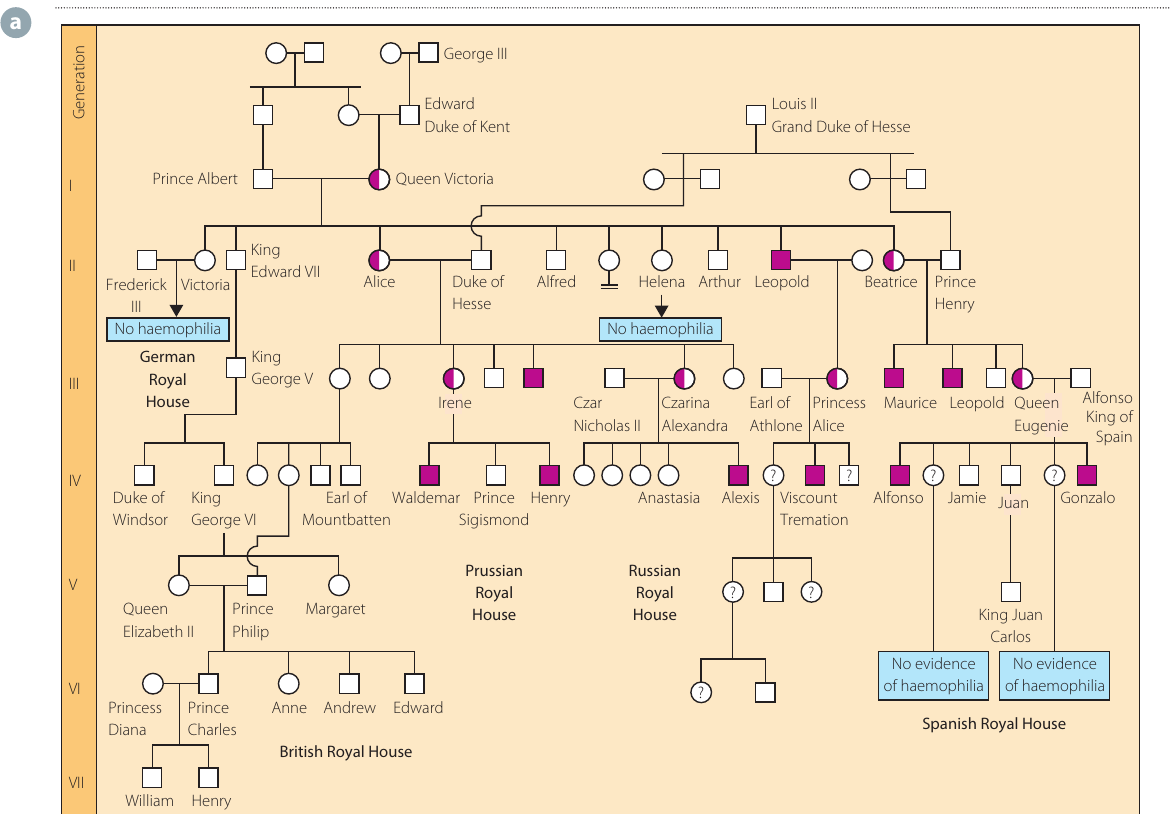
Haemophilia: This bleeding disorder results from a mutant allele on the chromosome. Males who inherit one copy of the mutant allele (from their mother) will develop the condition. Because males lack a second chromosome that could carry a dominant healthy allele to mask the defective one, a single copy of this recessive gene causes the disorder.
Carriers and affected individuals
Females have two chromosomes, one from each parent. Therefore:
- A female who inherits one mutant allele for haemophilia will not develop the disorder if her other allele is the dominant healthy version
- Such females are termed carriers - they don't show symptoms but can pass the defective allele to their children
- Sons who inherit the mutant allele will be affected
- Daughters who inherit the mutant allele may be carriers or affected, depending on which allele they receive from their father
- If a daughter inherits two defective alleles (one from each parent), the condition is lethal
Important
Why are males more affected by X-linked disorders?
Males are hemizygous for X-linked genes - they have only one copy of each X-linked gene. This means:
- A single recessive allele on the chromosome will be expressed in males
- There is no second chromosome to mask a recessive allele
- Females need two copies of a recessive allele to be affected, making X-linked disorders much rarer in females
Notation for sex-linked crosses
When representing sex-linked inheritance, genetic notation must show both the allele and the chromosome carrying it. The standard approach uses:
- A letter representing the allele ( = normal blood clotting, = haemophilia)
- Written as a superscript on the chromosome symbol ( or )
Note
Example genotypes:
- = normal female (homozygous)
- = carrier female (heterozygous)
- = haemophiliac female (homozygous - lethal)
- = normal male
- = haemophiliac male
Sex-linked genetic cross example
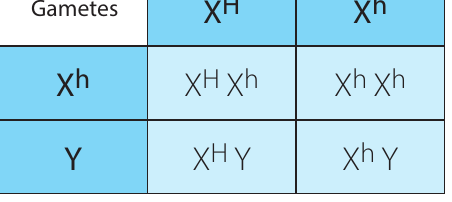
Consider a cross between a haemophiliac male and a carrier female:
Example
Worked Example: Sex-Linked Cross Analysis
Cross: Haemophiliac male () × Carrier female ()
Analysis of results:
- The ratio of males to females =
- Among males only: phenotypic ratio of normal : affected
- Overall probability: of any offspring will be affected
- For male offspring specifically: probability of being affected
This demonstrates how X-linked traits create different inheritance patterns between male and female offspring.
Y-linked inheritance
Some genes are found exclusively on the chromosome (termed 'Y-linked') and therefore appear only in males. These are less common than X-linked traits. An example is Y chromosome infertility.
Incomplete dominance
Incomplete dominance represents a departure from Mendel's law of dominance. Rather than one allele completely masking another, the heterozygous phenotype shows a blending of both parental traits, creating an intermediate appearance.
The snapdragon example
When red snapdragon flowers are crossed with white snapdragon flowers, the offspring produce pink flowers - a colour intermediate between the two parents. This pink phenotype results from incomplete dominance, where neither the red nor white allele is fully dominant.
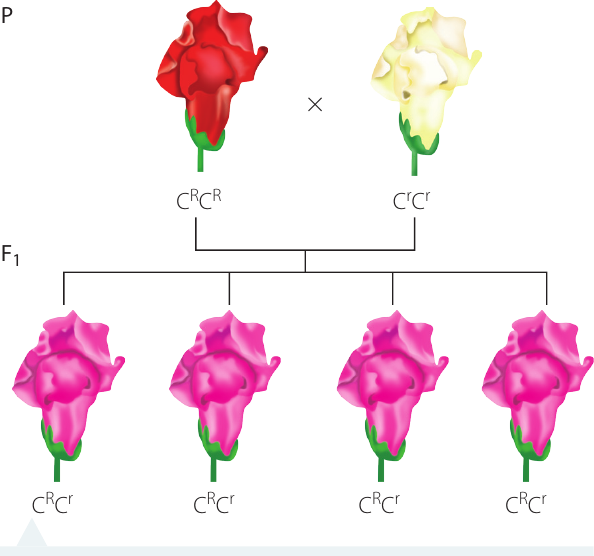
Other plants showing incomplete dominance for flower colour include tulips, carnations and roses.
Special notation for incomplete dominance
Because neither allele is fully dominant, standard uppercase/lowercase notation would be misleading. Instead:
- Choose a letter representing the gene (e.g., for colour)
- Write each allele as a superscript
- Red allele:
- White allele: (or for white)
The pink heterozygote is represented as .
Expected ratios
Example
Worked Example: Incomplete Dominance Cross
When two pink snapdragons () are crossed:
Genotypic ratio:
Phenotypic ratio: red : pink : white
This ratio differs from Mendel's typical ratio because the heterozygote has a distinct phenotype.
Codominance
Codominance differs from incomplete dominance because both alleles are fully expressed simultaneously, rather than blending. The term 'codominant' literally means 'together dominant' - both alleles behave as dominant because both are expressed in the phenotype.
Codominance in cattle
Pure-breeding cattle may have either red or white coat colour. When these are crossed:
- Red bull () × White cow ()
- Offspring have roan coats ()
Note
The roan appearance consists of both red and white hairs interspersed throughout the coat - not mixed into pink, but both colours distinctly present. This demonstrates that both alleles are fully expressed.
Codominance in chickens
Andalusian chickens provide another example. When homozygous black fowl are crossed with homozygous white fowl, the heterozygous offspring appear 'blue'. Closer examination reveals both black and white feathers are present - a characteristic pattern of codominance rather than true colour blending.
Notation for codominance
Because both alleles are fully expressed, each receives a capital letter:
- Choose a letter for the gene (e.g., for colour)
- Red allele: (capital superscript)
- White allele: (capital superscript)
- Roan heterozygote:
Note
The use of capital letters for both alleles emphasises that neither is recessive - both are expressed.
Multiple alleles
Whilst individual organisms typically have only two alleles for each gene (or one in sex-linked cases), populations may contain three or more different alleles for a single gene. Traits controlled by such genes are termed multi-allelic.
The ABO blood group system
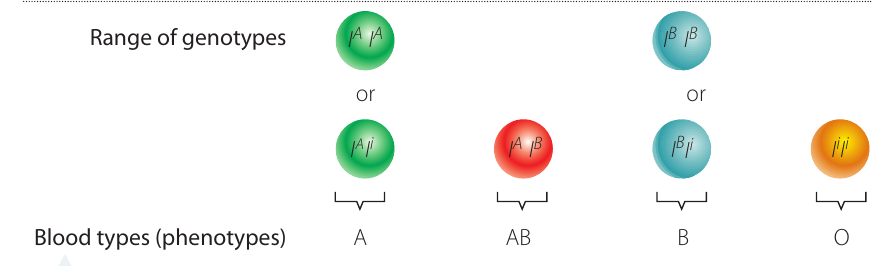
Human blood groups exemplify multiple allele inheritance. The gene controlling ABO blood type has three alleles in the population: , , and .
Why blood groups matter
Important
Blood groups are extensively studied because transfusing incompatible blood types can be fatal. Red blood cells carry molecular markers on their surfaces, which allow the immune system to recognise the body's own cells as 'self' rather than foreign material.
Genetic notation for blood groups
The gene is represented as (for immunoglobulin), with alleles shown as superscripts:
- - codes for type A molecular marker
- - codes for type B molecular marker
- - produces no molecular marker (recessive)
Dominance relationships
Alleles and are codominant - when both are present, red blood cells display both molecular markers. The allele produces no marker and is recessive to both and .
Genotypes and phenotypes
This creates four possible blood type phenotypes from six possible genotypes:
| Genotype | Phenotype (Blood Group) | Pattern |
|---|---|---|
| or | Type A | Homozygous or heterozygous |
| or | Type B | Homozygous or heterozygous |
| Type AB | Codominance | |
| Type O | Homozygous recessive |
Other examples of multiple alleles
Coat colour in rabbits involves four different alleles: normal, chinchilla, himalayan and albino. Each population member carries only two of these alleles, but the variety of combinations creates diverse phenotypes.
Multiple alleles versus polygenic traits
Important
Don't Confuse These Two Concepts!
It's crucial not to confuse multiple alleles with polygenic traits:
Multiple alleles: One gene exists in three or more versions within a population
- Example: ABO blood groups (one gene, three alleles)
- Shows discontinuous variation (distinct categories)
Polygenic traits: Multiple genes control a single characteristic
- Example: Human height (many genes involved)
- Shows continuous variation (smooth gradation from short to tall)
- Each gene has its own set of alleles
Comparison of inheritance patterns
Understanding how different inheritance patterns deviate from standard Mendelian ratios helps predict outcomes in genetic crosses.
Sex linkage deviations
Standard Mendelian condition: Individuals have two alleles for each characteristic.
Sex linkage variation: The heterogametic sex (males in humans) may have only one allele. Males have chromosomes, and because the is much smaller than the , it lacks many genes present on the . Therefore, X-linked genes have only one copy in males.
Effect on ratios: Recessive X-linked genes appear more frequently in male phenotypes because there's no second allele to mask them. This creates different male:female ratios for affected individuals.
Codominance and incomplete dominance deviations
Standard Mendelian condition: The trait expressed in heterozygous individuals is dominant, whilst the masked trait is recessive.
Codominance variation: Both alleles in the heterozygote are fully expressed. Neither dominates the other. Example: roan cattle display both red and white hairs.
Incomplete dominance variation: Both alleles are expressed as a blend of characteristics. Example: red flowers crossed with white produce pink offspring.
Effect on ratios: Monohybrid crosses produce a 1:2:1 ratio rather than 3:1 because the heterozygote has a unique phenotype distinct from both homozygous parents.
Summary
Key Points to Remember:
-
Sex determination in humans depends on which sex chromosome the sperm carries - produces female offspring, produces male offspring.
-
Sex-linked traits appear more frequently in males because recessive alleles on the chromosome are always expressed when there's no second to mask them.
-
Incomplete dominance creates intermediate phenotypes through blending (red + white = pink), whilst codominance expresses both traits fully (red and white hairs in roan cattle).
-
Multiple alleles means one gene has three or more variants in the population (like A, B, and O blood type alleles), which differs from polygenic traits where many genes control one characteristic.
-
The ABO blood system demonstrates both multiple alleles (three alleles: , , ) and codominance (A and B are codominant, both dominant to O).