Genetic Variation – Meiosis, Fertilisation, and Mutations (HSC SSCE Biology): Revision Notes
📚Revision Notes
Genetic Variation – Meiosis, Fertilisation, and Mutations
Introduction to genetic variation
Sexual reproduction is essential for creating genetic diversity in populations. While chromosomes are accurately replicated and passed from parent to offspring, the processes of meiosis and fertilisation introduce important variations. These variations provide the raw material for natural selection, enabling species to adapt and survive in changing environments.
Understanding variation and variability
Two related but distinct concepts help us understand genetic diversity:
Variation refers to observable differences between individual organisms. For example, siblings might differ in height, eye colour, or fur pattern. These are the physical manifestations of different genetic combinations.
Variability describes the total range of genetic diversity within a population. It encompasses all the different versions (alleles) of genes present in the population's gene pool. For instance, in a population of Australian kelpie dogs, coat colour variability includes black, red, blue, and fawn, with or without tan markings. Each individual dog shows variation in its specific coat colour.
Note
Key Distinction: Variation describes the differences we observe between individuals, while variability refers to the total genetic diversity within entire populations. Think of variation as what makes each person unique, and variability as all the genetic possibilities present in humanity.
What is meiosis?
Meiosis is a specialized type of cell division that produces gametes (sex cells - sperm and eggs). Through meiosis, species maintain consistent chromosome numbers across generations.
Every species has a characteristic chromosome number in its body cells. Humans have chromosomes, organised as pairs. Meiosis ensures this number stays constant from generation to generation.
Reduction division
Meiosis is often called reduction division because it reduces the chromosome number by half. A diploid parent cell (containing two complete sets of chromosomes) divides to produce four haploid daughter cells called a tetrad. Each haploid cell contains just one set of chromosomes.
Important
Why Reduction Matters: This reduction is crucial because when two haploid gametes fuse during fertilisation, they restore the diploid number in the offspring. Without this halving, chromosome numbers would double with each generation!
Chromosome structure and terminology
Understanding chromosome structure helps explain how meiosis creates variation:
Homologous pairs
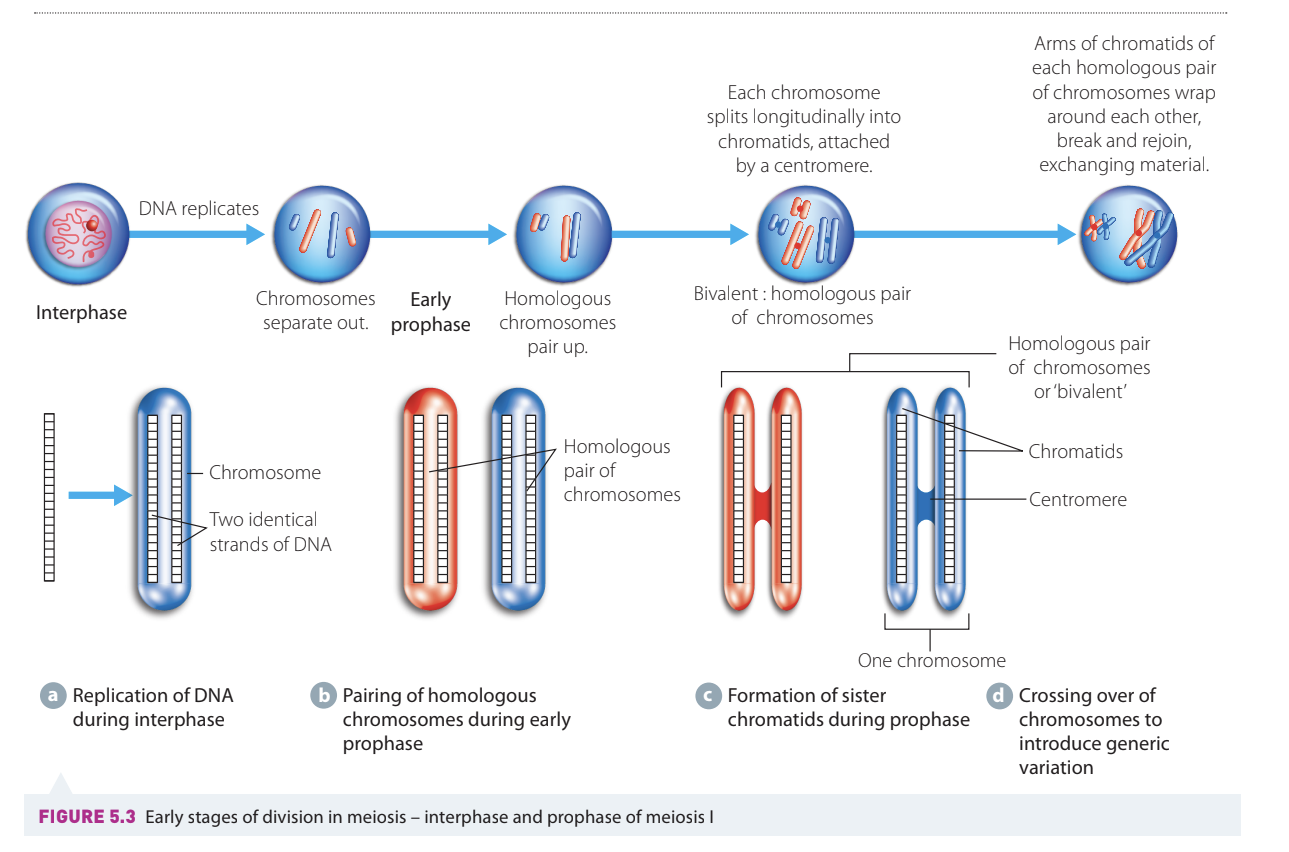
A diploid cell contains two sets of chromosomes - one inherited from the mother (maternal) and one from the father (paternal). Matching maternal and paternal chromosomes form homologous pairs. These pairs carry genes for the same traits but may have different versions (alleles) of those genes.
Bivalents
When homologous pairs align during early meiosis, each pair is termed a bivalent. This pairing is essential for the exchange of genetic material.
Chromatids and centromeres
Before meiosis begins, during interphase, DNA replicates. Each chromosome then consists of two identical strands called sister chromatids, joined at a point called the centromere.
Note
Chromosome Terminology: Understanding these terms is essential for following meiosis:
- Homologous pairs - matching chromosomes from each parent
- Bivalent - a pair of homologous chromosomes joined during meiosis
- Sister chromatids - two identical DNA copies joined at the centromere
- Centromere - the connection point between sister chromatids
Comparing meiosis and mitosis
Meiosis and mitosis share several features but have crucial differences:
Similarities
Both processes:
- Use the same stage names: interphase, prophase, metaphase, anaphase, and telophase
- Begin with interphase, when DNA replicates
- Transform chromatin into visible chromosomes during prophase
- Break down the nuclear membrane and form a spindle apparatus
- Complete with cytokinesis to separate daughter cells
Key differences
The main differences lie in:
- Number of divisions: Meiosis involves two divisions (meiosis I and II), while mitosis has one
- Chromosome behaviour: Homologous chromosomes pair and exchange material in meiosis
- Outcome: Meiosis produces four genetically different haploid cells; mitosis produces two identical diploid cells
Meiosis I - creating genetic variation
Meiosis I is where the chromosome number is halved and most genetic variation is introduced. This occurs through three key mechanisms:
Interphase and DNA replication
Before meiosis begins, during interphase, the cell's DNA replicates completely. Each chromosome becomes two identical sister chromatids joined at the centromere. This ensures sufficient genetic material for division.
Prophase I - chromosome pairing
During early prophase I, homologous chromosomes pair up. Each pair (bivalent) consists of one maternal and one paternal chromosome carrying genes for the same traits.
Crossing over (synapsis)
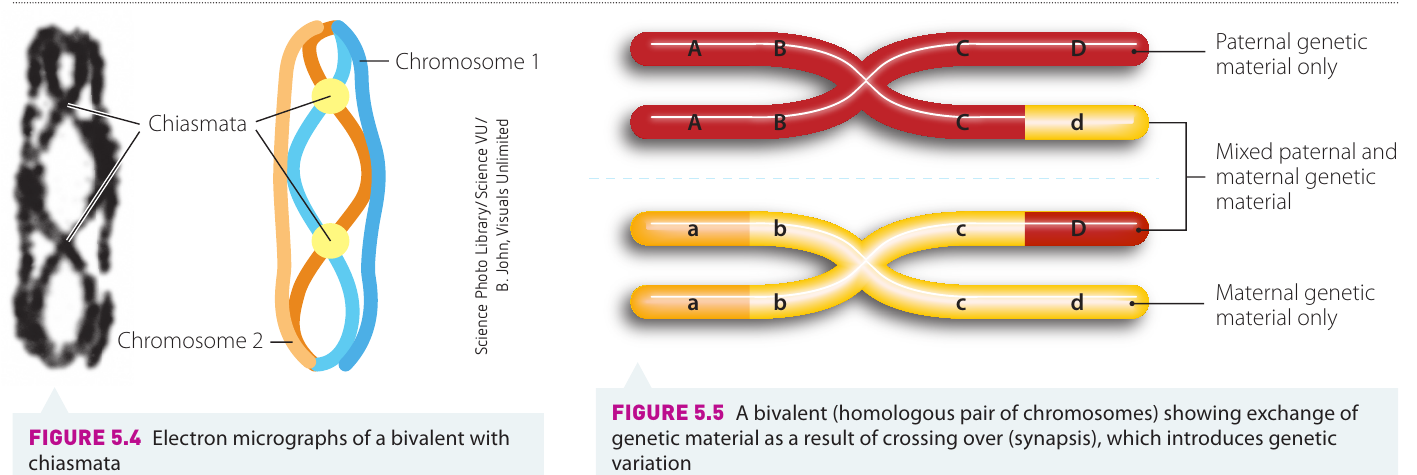
During late prophase I, a crucial process called crossing over or synapsis occurs:
- The arms of paired homologous chromosomes wrap around each other
- They make contact at specific points called chiasmata (singular: chiasma)
- At these contact points, the chromosome arms break
- The broken segments swap between maternal and paternal chromosomes
- The chromosomes rejoin with exchanged genetic material
Important
Significance of Crossing Over: This exchange creates new combinations of alleles that didn't exist in either parent. Genes located on the same chromosome are said to be linked. Crossing over ensures that linked genes aren't always inherited together, significantly increasing genetic diversity. After crossing over, no two chromatids are genetically identical.
Independent assortment
During metaphase I, chromosome pairs align along the cell's equator. Crucially, each pair lines up independently of other pairs. The orientation is random - either the maternal or paternal chromosome can face either pole.
This independent assortment means different combinations of maternal and paternal chromosomes can end up in gametes. For a cell with pairs of chromosomes, there are possible combinations.
Example
Worked Example: Calculating Possible Combinations
For humans with chromosome pairs:
- Number of possible combinations =
- Calculating:
- This means approximately 8.4 million different combinations are possible from independent assortment alone!
Remember: The formula applies to any organism, where is the number of chromosome pairs.
Random segregation
During anaphase I, the paired chromosomes separate. One complete chromosome from each homologous pair moves to opposite poles of the cell. This separation is random - whether the maternal or paternal chromosome of each pair goes to a particular pole is entirely by chance.
By the end of telophase I and cytokinesis I, two daughter cells form. Each contains:
- Half the original chromosome number (haploid)
- A unique combination of maternal and paternal chromosomes
- Chromosomes with mixed maternal and paternal genetic material (from crossing over)
Meiosis II - completing the division
The two cells produced by meiosis I each undergo meiosis II, which resembles mitosis:
- Metaphase II: Chromosomes align at the cell's equator
- Anaphase II: Sister chromatids separate at the centromere and move to opposite poles
- Telophase II: Nuclear membranes form around each chromosome set
- Cytokinesis II: Cells divide, producing four haploid daughter cells (the tetrad)
Note
Outcome of Meiosis II: Each of the four resulting cells contains:
- Half the original chromosome number (haploid)
- A unique combination of genetic material
- Chromosomes that differ from those in the original parent cell
Unlike meiosis I, meiosis II doesn't create new genetic combinations - it simply separates sister chromatids.
Fertilisation and genetic variation
Gametes are haploid cells containing recombined genetic material from crossing over and independent assortment. Fertilisation adds yet another layer of variation.
During fertilisation, any sperm can potentially fuse with any egg. This random fusion creates enormous genetic diversity:
- If independent assortment creates possible sperm types and possible egg types
- Then fertilisation can produce different genetic combinations
- This equals approximately 70 trillion possible genetic combinations!
Example
Worked Example: Total Genetic Variation in Humans
Step 1: Calculate possible gamete types from one parent
Step 2: Calculate total combinations from both parents
Step 3: Express the result
This astronomical number explains why siblings (except identical twins) are genetically unique!
Cross-fertilisation versus self-fertilisation
Genetic diversity is greatest when gametes come from genetically different parents:
- Cross-fertilisation (between different individuals) produces more genetically diverse offspring
- Self-fertilisation (in plants with both sex organs) produces less diverse offspring
- Offspring from unisexual animals show more variation than those from hermaphroditic (bisexual) animals
This explains why sexual reproduction between different individuals is so effective at maintaining genetic diversity in populations.
Mutations - another source of variation
While meiosis and fertilisation shuffle existing genetic material, mutations create entirely new genetic variants. Mutations can occur at any stage but most commonly arise during DNA replication in interphase, before cell division begins.
Note
Mutations and Evolution: Mutations introduce new alleles into the population, further contributing to genetic variability. These novel genetic variants provide additional material for natural selection to act upon during evolution. Without mutations, populations would only shuffle existing genes without creating new variations.
Remember!
Summary
Key Points to Remember:
-
Variation describes differences between individuals, while variability refers to the total genetic diversity in a population's gene pool
-
Meiosis produces four haploid gametes from one diploid cell through two divisions, maintaining constant chromosome numbers across generations
-
Three key processes introduce variation during meiosis:
- Crossing over exchanges genetic material between homologous chromosomes
- Independent assortment randomly distributes chromosome pairs
- Random segregation separates chromosomes randomly into daughter cells
-
Fertilisation multiplies variation by randomly combining gametes, creating unique genetic combinations in every offspring
-
The potential for genetic variation is enormous: in humans, over 70 trillion different combinations are possible from meiosis and fertilisation alone!
-
The formula calculates possible gamete combinations, where is the number of chromosome pairs