Predicting and Controlling the Spread of a Disease (HSC SSCE Biology): Revision Notes
📚Revision Notes
Predicting and Controlling the Spread of a Disease
Introduction to epidemiology
Epidemiology comes from Greek words meaning 'the study of people'. When applied to infectious diseases, epidemiology refers to studying how diseases spread through populations, what patterns they follow, and how we can identify their causes. This field of study is essential for managing and controlling disease outbreaks effectively. By examining where diseases occur, who they affect, and when they spread, epidemiologists can develop strategies to prevent further transmission and protect public health.
The practice of epidemiology involves collecting and analysing data about disease incidence (new cases appearing) and distribution patterns within communities. This information helps health authorities make informed decisions about prevention measures, treatment approaches, and resource allocation during outbreaks.
Note
The term "epidemiology" derives from Greek: "epi" (upon), "demos" (people), and "logos" (study). This etymology reflects the field's focus on understanding how diseases affect entire populations rather than individual patients.
Historical approaches to disease control
Early quarantine measures
The concept of quarantine has ancient roots as a disease control strategy. The first documented use of quarantine occurred in Dubrovnik, Croatia, in 1377 when authorities implemented measures to control a plague outbreak. This pioneering approach involved separating potentially infected individuals from the healthy population to prevent disease transmission.

Following this initial success, specialised isolation facilities called lazarettos were established. The first permanent plague hospital, or lazaretto, opened on the island of Santa Maria di Nazareth in 1423. Later, in 1467, a similar facility for leprosy patients was established in Marseille, France. These lazarettos were strategically positioned to utilise natural barriers such as seas, rivers, or mountains, creating physical separation between infected patients and populated areas.
Important
The principles behind these early quarantine measures remain relevant today. During the global SARS (severe acute respiratory syndrome) outbreak in 2003, similar isolation strategies were employed. Infected individuals were separated in hospitals or confined to their homes to contain the infection. These approaches served multiple purposes: they prevented disease transmission, slowed the outbreak's progression, reduced public panic, and helped maintain social stability during crisis periods.
Sydney's epidemic history
Australia's experience with infectious disease outbreaks provides valuable lessons in disease control. Sydney, despite its relatively short history, has faced numerous epidemic challenges including measles (1866–67), scarlet fever (1876–76), smallpox (appearing in 1789, 1881–82, and 1913–17), the Asiatic Flu pandemic (1890–91), plague (1900), and the devastating Spanish influenza pandemic (1918–19). The public health responses developed during these early epidemics established the foundations for New South Wales' modern public health system.
John Snow and field epidemiology
The cholera investigation
John Snow is widely recognised as the 'father of field epidemiology' due to his groundbreaking work during London's 1854 cholera epidemic in the Golden Square area. His innovative approach to disease investigation revolutionised how we study and control infectious diseases. Snow developed and tested hypotheses about cholera transmission through careful observation and systematic data collection.
Mapping disease patterns
Snow's methodology involved using maps to record each cholera death in the affected area. This visual representation of disease distribution was revolutionary for its time. By plotting deaths on a map of Broad Street and surrounding areas, Snow could identify spatial patterns that revealed the disease's source. His mapping technique showed a clear cluster of cases around a specific location, leading him to pinpoint a single water pump in Broad Street as the source of contamination.
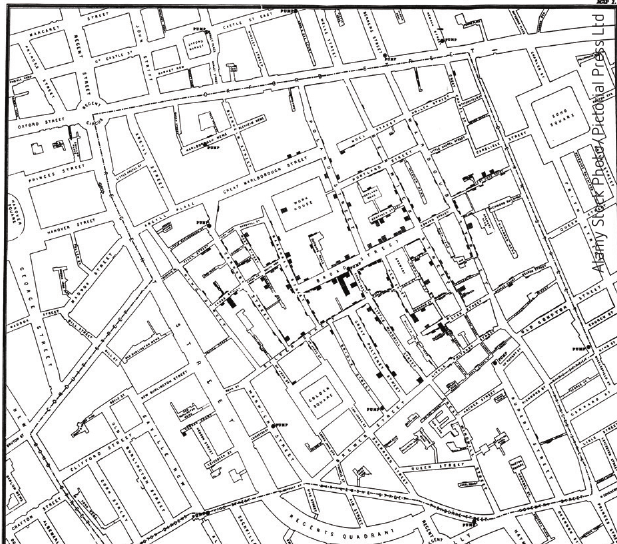
Example
John Snow's Investigative Method:
Step 1: Snow observed the cholera outbreak and noted its geographical pattern in London's Golden Square area.
Step 2: He systematically mapped each death from cholera on a detailed street map, recording the exact location of each victim's residence.
Step 3: By analysing the spatial distribution of deaths, he identified a clear cluster around the Broad Street water pump.
Step 4: Snow investigated the water source and discovered it was contaminated with sewage.
Step 5: He convinced local authorities to remove the pump handle, which led to a rapid decline in new cholera cases.
This geographical approach to disease investigation demonstrated how systematic data collection and visual analysis could reveal disease transmission patterns. Snow's work proved that cholera spread through contaminated water rather than through the air (as was commonly believed at the time), fundamentally changing our understanding of disease transmission. His methods established principles that modern epidemiologists continue to use when investigating disease outbreaks, including detailed case mapping, statistical analysis, and hypothesis testing.
Cultural influences on disease control
Understanding culture and disease
Culture encompasses integrated patterns of human behaviour, including language, thoughts, communications, actions, customs, beliefs, values, and institutions of racial, ethnic, religious, or social groups. Cultural factors can significantly influence how diseases spread through communities and how effectively control measures can be implemented. Some cultural beliefs and practices may unintentionally facilitate disease transmission, whilst others may provide protective effects.
Cultural barriers to disease control
The 2014 Ebola outbreak in Africa demonstrated how cultural practices can complicate disease control efforts. The epidemic spread rapidly due to a combination of factors including poverty, famine, and corruption. However, a significant contributor was the traditional cultural practice of paying respects to deceased family members through close physical contact with corpses. Since Ebola can be transmitted through contact with bodily fluids from infected individuals, including the deceased, this funeral ritual facilitated disease transmission between family members and community members.
Important
Effective control measures required more than just medical interventions; they needed to address these cultural practices. Public health authorities had to develop culturally sensitive education programmes that respected traditional beliefs whilst promoting safer alternatives for funeral practices. This case illustrates why understanding local customs and beliefs is crucial when designing disease prevention strategies.
Traditional disease prevention methods
Different cultures have developed effective disease control methods even without understanding the underlying scientific mechanisms. In the Philippines, traditional foods play an important role in preventing and managing diseases. Garlic and onions are believed to lower blood pressure, and modern research has confirmed that onions contain quercetin, a natural compound that does indeed help reduce blood pressure. This example shows how traditional practices can have genuine health benefits that align with modern scientific understanding.
Note
Historical records suggest that mosquito nets were used by the Egyptian queen Cleopatra (69–30 BCE) for protection, even though the connection between malaria and mosquitoes wasn't scientifically established until much later. This demonstrates how practical observation and experience led cultures to develop effective prevention methods long before understanding disease transmission mechanisms.
Summary
Key Points to Remember:
-
Epidemiology involves studying disease patterns in populations to understand causes and develop control strategies, originating from Greek words meaning 'the study of people'.
-
Historical quarantine measures, beginning in 1377 in Croatia with lazarettos (isolation hospitals), used natural barriers to separate infected individuals from healthy populations and remain relevant in modern disease control.
-
John Snow pioneered field epidemiology by using mapping techniques to identify the source of London's 1854 cholera outbreak, demonstrating how systematic data collection and visual analysis can reveal disease transmission patterns.
-
Cultural factors significantly influence disease control, as beliefs and practices can either facilitate disease spread (like Ebola funeral rituals) or provide protection (like traditional use of mosquito nets), requiring culturally sensitive public health approaches.