Adaptations in Endotherms (HSC SSCE Biology): Revision Notes
📚Revision Notes
Adaptations in Endotherms
What are endotherms?
Endotherms are organisms that maintain their body temperature within a very narrow range, regardless of the temperature of their environment (ambient temperature). Unlike ectotherms, which rely on external heat sources, endotherms generate heat internally through metabolic activity in their cells.
Note
The key difference between endotherms and ectotherms:
- Endotherms (like mammals and birds) generate their own body heat through metabolism
- Ectotherms (like reptiles and amphibians) depend on external heat sources to regulate temperature
An adaptation is any characteristic that helps an organism survive and reproduce successfully in its environment. For endotherms, these adaptations specifically help with thermoregulation - the control of body temperature.
Endotherms living in hot environments need adaptations that reduce heat exposure and increase heat loss. Those in cold environments need adaptations that increase heat gain and reduce heat loss.
Types of adaptations
Adaptations for thermoregulation fall into three main categories:
- Behavioural - how the organism acts
- Structural - the physical features of the organism
- Physiological - how the organism's body functions internally
Behavioural adaptations
Behavioural adaptations involve actions that organisms take to regulate their temperature. These are often the first line of defence against temperature extremes.
Body positioning and seeking shelter
Endotherms can alter their body position or move to different locations to increase or decrease sun exposure on their surface area.
When temperatures are too high, animals may:
- Change body position to reduce surface area exposed to sun
- Seek shade or shelter
- Move into burrows
- Enter water to cool down
Example
Example: Red Kangaroo Temperature Regulation
The red kangaroo (Macropus rufus) during the hottest part of the day will sit in a shaded position with its hind legs and tail at right angles to its body, pointing forward. This reduces the large surface area that would otherwise be exposed to direct sunlight.
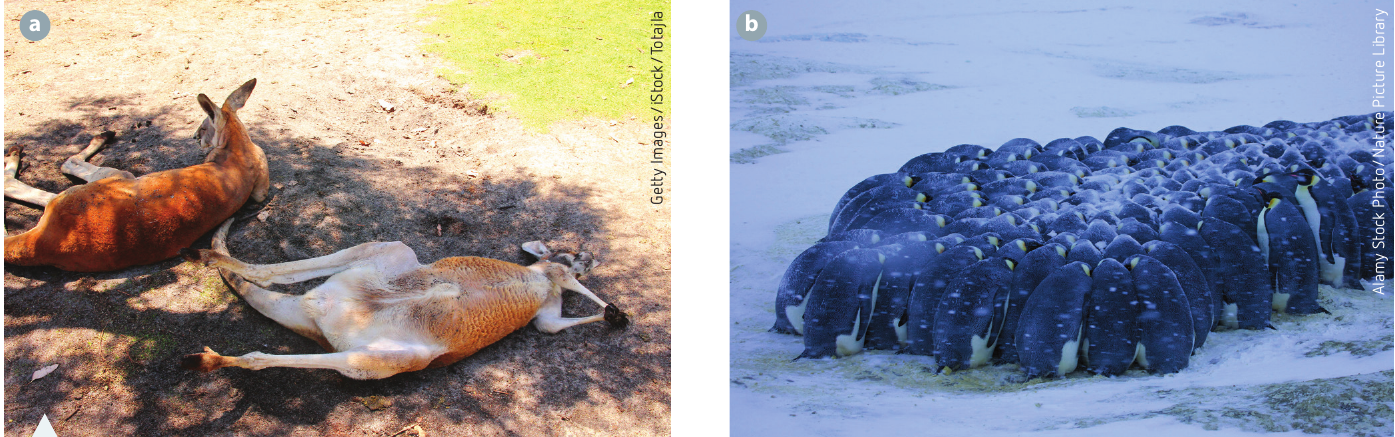
Fairy penguins (Eudyptula minor) move into water to cool down when overheated. In cold conditions, many penguin species huddle together in groups. This reduces the surface area of each individual penguin exposed to the cold air, helping them conserve heat.
Note
The mountain pygmy possum curls into a tight ball, drawing all its appendages (legs, nose, ears and tail) close to its body. This minimises the surface area exposed to cold temperatures. It also uses burrows for shelter during short periods of low temperature.
Nocturnal activity
Many endotherms living in hot environments are nocturnal - they are active at night and rest during the day. This behavioural adaptation helps regulate body temperature because:
- Nocturnal animals avoid the intense heat of the day
- Remaining inactive during hot periods prevents generating extra metabolic heat from muscle activity
- The cooler night-time temperatures make it easier to maintain optimal body temperature
Example
Example: Bilby Nocturnal Behaviour
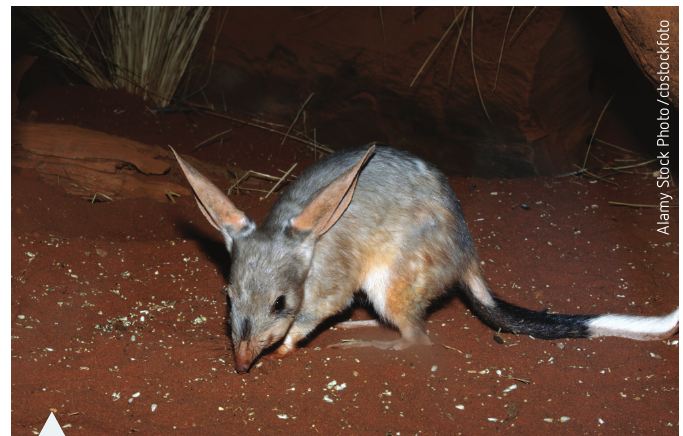
The bilby (Macrotis lagotis) is an excellent example of this adaptation. It inhabits hot, dry regions of Australia and shelters in its burrow during the day, only emerging at night to search for food.
Migration
Migration is a behavioural adaptation where organisms move to a different habitat that is within their tolerance range for temperature.
Example
Example 1: Grey Plover Migration
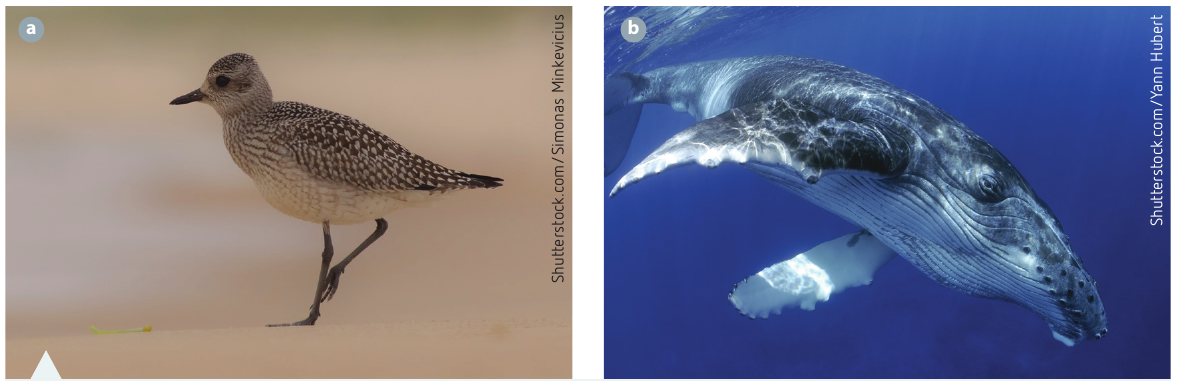
The grey plover (Pluvialis squatarola) breeds in the northern hemisphere between May and August. During August, these birds migrate to Australia and remain until April. This allows them to avoid the severe winter weather of the northern hemisphere.
Example
Example 2: Humpback Whale Migration
Humpback whales (Megaptera novaeangliae) in the southern hemisphere migrate annually from their cold southern feeding grounds near Antarctica to warmer northern waters. They make this journey to mate and give birth in more favourable temperature conditions.

Important
Exam tip: When describing behavioural adaptations, always explain how the behaviour helps with thermoregulation - don't just list the behaviour.
Structural adaptations
Structural adaptations are physical features of an organism that help control temperature. These features are permanent parts of the animal's body.
Insulation
Insulation materials trap a layer of air close to the skin, which reduces heat loss to the environment. Common forms of insulation include:
- Fur and hair (in mammals)
- Feathers (in birds)
- Blubber (in marine mammals)
Note
The thickness of the insulating layer can sometimes be adjusted. For example, fairy penguins can:
- Lift their feathers away from their skin in cold conditions, increasing the trapped air layer and providing greater insulation
- Flatten their feathers against their skin in hot conditions, reducing the trapped air layer and allowing more heat loss
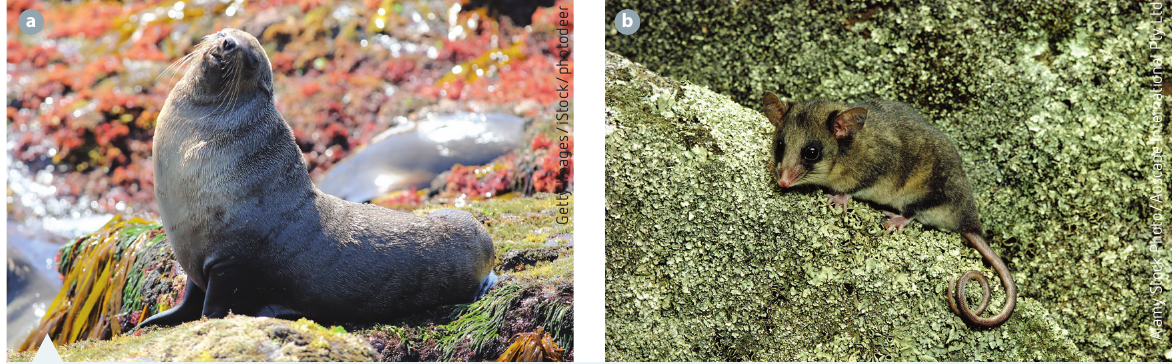
Blubber is a thick layer of fat found beneath the skin of marine mammals like the Australian fur seal (Arctocephalus pusillus). This layer provides excellent insulation in cold water environments, where heat loss would otherwise be rapid.
Surface area to volume ratio
The surface area to volume ratio (SA
) is a crucial structural component of temperature regulation.In cold environments:
- Animals tend to be larger with a small SA ratio
- Less surface area relative to volume means less area for heat loss
- This helps the body conserve heat
- Example: Polar bears have large, compact bodies
In hot environments:
- Animals tend to be smaller with a large SA ratio
- More surface area relative to volume means more area for heat loss
- This helps the body lose excess heat
- Example: The bilby has a small body size
Important
Ear size is another structural feature related to SA:V:
- Animals in cold environments often have small ears to reduce surface area for heat loss
- Example: Mountain pygmy possum (Burramys parvus) has small ears and lives in alpine regions above metres
- Animals in hot environments often have large, thin ears that allow rapid heat loss
- Examples: Bilby and African elephant
The mountain pygmy possum has additional structural features for cold environments: short legs, a round body, and small ears with limited blood circulation. All these features help minimise heat loss.
Note
Exam tip: Remember the rule of thumb - "Hot climate = big ears, small body; Cold climate = small ears, big body."
Physiological adaptations
Physiological adaptations involve internal body processes and functions that help regulate temperature.
Metabolic rate changes
In endotherms, the main source of internal heat comes from metabolic activity, particularly in muscle and liver cells.
In cold conditions:
- Metabolic rate increases to generate more heat
- Shivering is a rapid muscle contraction that produces heat
- Increased cellular respiration in organs like the liver generates heat
In hot conditions:
- Reduced activity decreases metabolic rate
- Lower metabolic rate means less heat production
- This helps prevent overheating
Hibernation and torpor
Some organisms escape temperature extremes by entering states of reduced activity.
Hibernation:
- An extended period of inactivity in response to cold
- Body temperature does not drop below
- Heart rate and oxygen consumption drop considerably
- A milder, longer-lasting form of torpor
- Example: Mountain pygmy possum hibernates during cold winters
Torpor:
- A short-term state of reduced activity
- Body temperature drops much lower (below )
- Metabolism, heart rate and respiratory rate all decrease significantly
- Reduced response to external stimuli
- More intense than hibernation but shorter in duration
- Example: Common wombat (Vombatus ursinus) slows its metabolism to one-third of normal rate on hot days when sheltering in its burrow
Note
The wombat's use of torpor is particularly useful because wombats do not have sweat glands to assist with heat loss.
Evaporative cooling
Evaporative cooling is a highly effective method of heat loss. As water evaporates from the body surface, it removes heat energy.
Common mechanisms include:
- Sweating - water secreted from sweat glands evaporates from skin
- Panting - rapid breathing that evaporates water from the respiratory surfaces
- Licking - some animals lick their fur or skin to promote evaporative cooling
Example
Example: Red Kangaroo Evaporative Cooling
Red kangaroos lick their forearms to increase heat loss through evaporation of saliva.
Blood flow regulation
Because blood carries heat throughout the body, controlling where blood flows can help regulate temperature.
Vasodilation - when blood vessels near the skin surface widen:
- Increases blood flow to the skin
- More heat is transferred from the blood to the skin surface
- Heat is then released to the cooler surroundings
- Used when the body needs to lose heat
Note
The red kangaroo uses vasodilation in its forearms (combined with licking) to increase heat loss.
The bilby has an extensive network of capillaries throughout its large ears. Blood flowing through these capillaries releases heat to the surrounding air.
Countercurrent exchange
Countercurrent exchange is a sophisticated mechanism that reduces heat loss at extremities (such as feet, flippers, or tails) that are exposed to cold environments.
How it works:
- Warm blood flows from the heart towards the extremity in arteries
- Cool blood returns from the extremity towards the heart in veins
- The arteries and veins run very close together
- Heat transfers from the warm arterial blood to the cool venous blood
- This pre-warms the blood returning to the heart
- Less heat is lost from the extremity to the environment
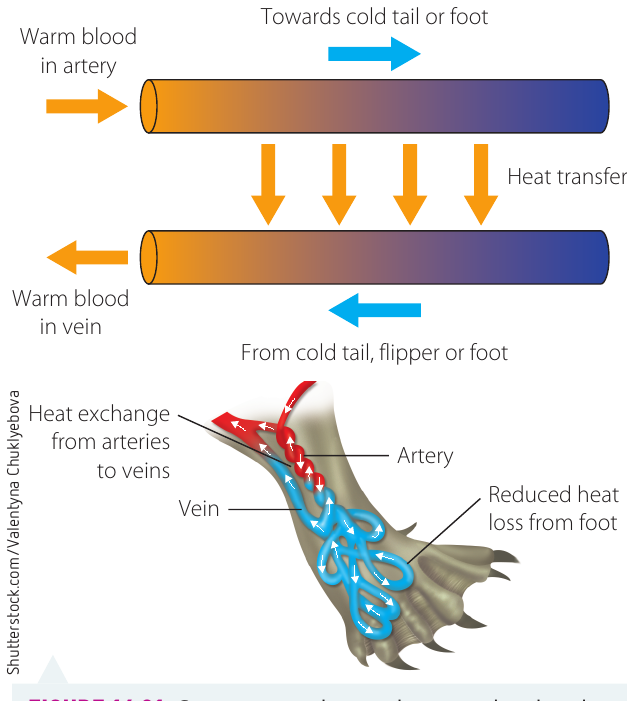
This mechanism occurs in:
- The feet of the platypus (Ornithorhynchus anatinus)
- The flippers of the Australian fur seal
- The feet of many waterbirds
Important
Countercurrent exchange prevents the internal core temperature from being lowered by cold blood returning from extremities that have large surface areas exposed to cold water.
Exam tip: When explaining countercurrent exchange, describe it as a heat transfer between arteries and veins, not just blood flow direction.
Summary of adaptations
The following table summarises the key adaptations of endotherms for thermoregulation:
| Behavioural | Structural | Physiological |
|---|---|---|
| Change position/alignment of body | Insulation (fur, feathers, blubber) | Changes to metabolic rate |
| Burrow | Surface area to volume ratio related to body shape and size of structures such as ears | Hibernation/torpor |
| Nocturnal activity | Evaporative cooling | |
| Migration | Regulation of blood flow to surface and extremities | |
| Countercurrent exchange |
Summary
Key Points to Remember:
- Endotherms maintain constant body temperature through internal heat generation, regardless of environmental temperature
- Three types of adaptations work together: behavioural (actions), structural (physical features), and physiological (internal processes)
- Hot environments favour: large SA ratios, big ears, nocturnal activity, and evaporative cooling mechanisms
- Cold environments favour: small SA ratios, small ears, insulation (fur, feathers, blubber), and countercurrent exchange
- Behavioural adaptations are often the first response to temperature change, while structural and physiological adaptations provide longer-term solutions