Water Balance in Plants (HSC SSCE Biology): Revision Notes
📚Revision Notes
Water Balance in Plants
Introduction to water balance in plants
Plants face a critical challenge in balancing their water needs. They must maintain enough water for essential processes while avoiding dehydration, especially in hot and dry environments. Understanding how plants achieve this balance is fundamental to appreciating plant survival strategies.
The primary way plants lose water is through a process called transpiration. This is the evaporation of water from tiny pores called stomata found on the surface of leaves. While this water loss might seem wasteful, transpiration actually serves two vital functions:
- It creates a continuous flow of water called the transpiration stream, which moves water and dissolved minerals from the roots up through the stem to all parts of the plant, even to the very top of tall trees.
- It provides evaporative cooling, which works like sweating in animals. As water evaporates from the leaf surface, it removes heat, helping to regulate the plant's temperature and prevent overheating.
Important
The Plant's Dilemma
Stomata must remain open to allow the exchange of gases needed for photosynthesis ( enters, exits). This means plants cannot simply close their stomata to prevent water loss, as this would stop photosynthesis and the plant would die.
Plants living in areas with limited water supply face a particular challenge. They must carefully balance:
- Water loss through cooling
- Water loss through transpiration
- The need for gas exchange
- The risk of dehydration
Xerophytes and their adaptations
Plants that thrive in arid (extremely dry) conditions are called xerophytes. These remarkable plants have evolved special adaptations that allow them to survive in hostile environments where water is scarce. Most xerophyte adaptations involve modifications to leaves, though stems and leaf stalks may also be modified.
Note
An important feature of some xerophytes is that their stems and leaf stalks (called petioles) contain photosynthetic tissue and appear green, despite having very few stomata distributed across their surface. This adaptation allows plants with reduced or absent leaves to continue photosynthesis whilst minimising water loss.
Mechanisms to conserve water in plants
Xerophytes employ several strategies to maintain water balance. Let's explore each mechanism in detail.
Reducing internal temperature
Some xerophytes have developed special structural features or physiological mechanisms that help reduce their internal temperature without relying solely on transpiration. By keeping cooler through other means, these plants can use less water for evaporative cooling whilst still maintaining temperatures suitable for metabolic processes.
Shiny waxy cuticle or thick leathery cuticle: The outer surface of leaves may be covered with a shiny, waxy layer or a thick, tough, leathery coating called a cuticle. This waterproof barrier is crucial because it prevents water from evaporating directly from the epidermal cells (surface cells) of the leaf. All the epidermal cells are sealed, so water can only escape through the stomata, giving the plant much greater control over water loss.
White hairs on leaf surfaces: Many xerophytes have leaves covered in tiny white or silvery hairs. These hairs act like a natural sunscreen, reflecting sunlight away from the leaf surface. When less sunlight is absorbed, the leaf's surface temperature decreases. A cooler leaf surface means less evaporation and therefore reduced water loss through the stomata.
Reducing the exposure of transpiring plant structures to sunlight
Plant organs with the highest number of stomata experience the greatest rates of transpiration. Some xerophytes have evolved ways to reduce how much sunlight these high-transpiration organs receive.
This can be achieved by:
- Orienting leaves so that stomata face away from direct sunlight
- Reducing the surface area of organs that contain many stomata
- Completely losing transpiring plant parts such as leaves or flowers (though these plants need additional adaptations to compensate for these losses)
Let's examine specific adaptations in this category:
Reduced leaf size: Some xerophytes have evolved smaller leaves to reduce the surface area available for water loss. In some species, each leaf is divided into smaller sections called pinnae or leaflets, which further reduces the overall transpiring surface.
In more extreme adaptations, leaves are reduced to tiny brown scales or bracts, losing their photosynthetic function entirely. When this happens, other plant parts must take over photosynthesis:
- Cladodes: photosynthetic stems that replace leaf function
- Phyllodes: photosynthetic leaf stalks that replace leaf function
Note
These modified structures are particularly effective because they have very few stomata compared to normal leaves, dramatically reducing transpiration whilst maintaining sufficient photosynthetic surface area. Many cladodes and phyllodes also feature additional water-conserving adaptations such as white hairs and sunken stomata.
Example
Worked Example: Cacti Adaptations
Cacti are excellent examples of plants with extremely reduced leaves. Their leaves have been modified into spines, which not only reduce water loss but also protect the plant from herbivores. The green, fleshy stem of the cactus performs all the photosynthesis.
This demonstrates how multiple adaptations work together:
- Reduced leaves (modified to spines) = minimal water loss
- Photosynthetic stems (cladodes) = maintained photosynthesis
- Protective function (spines) = additional survival advantage
Reduced flower size or absence of petals: Some xerophytes produce smaller flowers or flowers without petals. This adaptation reduces both the amount of water the plant needs to produce flowers and the water lost through evaporation from flower surfaces.
Shedding leaves: Some plants respond to extremely dry conditions by dropping their leaves entirely. This dramatically reduces the overall water loss from the plant. When conditions improve and water becomes available again, the plant can grow new leaves.
Leaf orientation on the stem: The way leaves are arranged on the stem can minimise water loss. By positioning leaves so their stomata are not directly exposed to intense sunlight during the hottest part of the day, plants can reduce the rate of evaporation whilst still keeping stomata open for gas exchange.
Regulating the opening and closing of stomata
Rather than keeping their stomata open all day, some xerophytes have evolved to open their stomata only during the cooler parts of the day, such as early morning and late afternoon. During these cooler periods, the air temperature is lower, which naturally reduces the rate of evaporation. This means the plant loses less water whilst still allowing necessary gas exchange for photosynthesis.
Note
The rate of transpiration is largely determined by the difference in water concentration between the inside of the leaf and the surrounding air. On a hot, dry day, the air contains very little water vapour, creating a large concentration gradient. Water molecules rapidly diffuse out of the leaf to equalise this difference, leading to high rates of water loss. On a cooler or more humid day, the air already contains more moisture, reducing the concentration gradient and therefore slowing transpiration.
Creating a microclimate: Since plants cannot change their external environment, many xerophytes have evolved clever ways to create their own small microclimate in the air immediately surrounding each leaf. Structures such as:
- Hairy leaves
- Rolled or curled leaves
- Sunken stomata (stomata located in pits or grooves below the leaf surface)
Important
How Microclimates Work
These features work by trapping water vapour in the immediate vicinity of the leaf surface. This trapped moisture keeps the air around the plant humid, creating a smaller concentration gradient between the inside and outside of the leaf. Additionally, these structures create a physical barrier that prevents dry air currents from sweeping away the moist air layer. The result is that plants can keep their stomata open for longer periods with minimal water loss, allowing photosynthesis to continue efficiently.
Water storage
Some plants, called succulents, have evolved specialised tissues for water storage. These plants possess adaptations such as fleshy, swollen stems or leaves that can absorb and store large amounts of water when it becomes available (such as after rainfall). During subsequent dry periods, the plant survives by slowly using this stored water reserve.
Common examples of succulents include:
- Cacti (store water in their thick stems)
- Aloe vera (stores water in thick, fleshy leaves)
- Jade plants (store water in leaves and stems)
Fruits
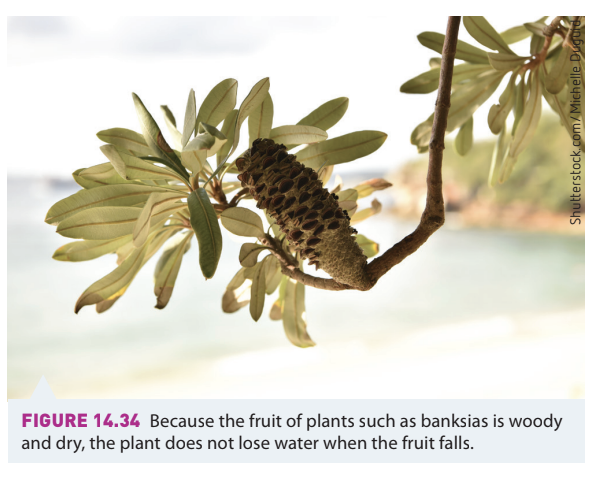
Fruits are plant structures that contain seeds and are eventually removed from the parent plant to allow seed dispersal. In xerophytic environments, many plants produce woody fruits rather than fleshy, juicy fruits.
Woody fruits are dry and hard, containing very little water. When these fruits detach and fall from the plant, very little water is lost in the process. Compare this to a fleshy fruit like a tomato or peach, which contains large amounts of water that would be lost from the plant when the fruit drops. For a plant living in an arid environment where every drop of water is precious, producing woody fruits is a much more water-efficient strategy.
Summary of key adaptations
The table below summarises the main types of adaptations xerophytes use to maintain water balance:
| Type of adaptation | How it assists in maintaining water balance |
|---|---|
| Shiny waxy cuticle | Waterproofs all epidermal cells, preventing uncontrolled water loss from leaf surface |
| White hairs on leaves | Reflects sunlight, reducing leaf temperature and evaporation rate |
| Reduced leaf size | Decreases total transpiring surface area |
| Phyllodes | Photosynthetic leaf stalks with few stomata replace leaves |
| Reduced flower size | Minimises water requirements and evaporative surface area |
| Leaf orientation | Positions stomata away from direct intense sunlight |
| Sunken stomata | Creates humid microclimate around stomata, reducing concentration gradient |
| Curled leaves | Traps moisture, creating humid microclimate and reducing water loss |
| Succulent tissues | Stores water for use during dry periods |
| Stomatal regulation | Opens stomata only during cooler times when evaporation rates are lower |
Summary
Key Points to Remember:
- Transpiration is the main source of water loss in plants, but it serves essential functions: moving water and minerals up the plant and providing evaporative cooling.
- Xerophytes are plants specially adapted to survive in arid conditions by balancing water loss with essential plant processes.
- Plants cannot simply close their stomata permanently because they need gas exchange for photosynthesis to occur.
- Xerophytes use multiple strategies simultaneously: reducing internal temperature, minimising exposed surface area, regulating stomatal opening times, creating humid microclimates, storing water, and producing woody rather than fleshy fruits.
- Modified structures like cladodes (photosynthetic stems) and phyllodes (photosynthetic leaf stalks) allow plants to photosynthesise whilst having minimal stomata and reduced leaves.