The Ear (HSC SSCE Biology): Revision Notes
📚Revision Notes
The Ear
Introduction to the ear
The ear is a sense organ that acts as a communication pathway between the external environment and the body. It allows us to detect and interpret sounds from our surroundings. Our ability to hear properly depends on the complex structure and function of the ear, the auditory nerve, and the brain working together.
Structure of the ear
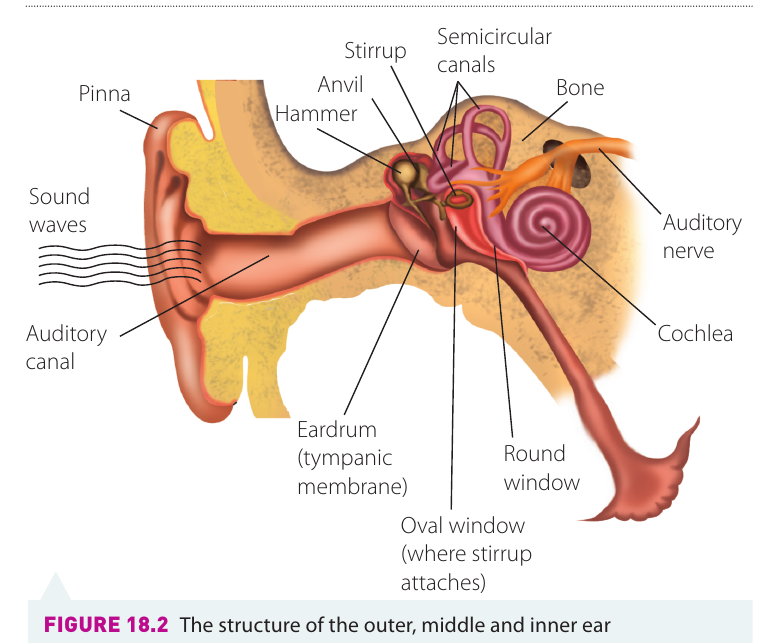
The ear is divided into three main sections: the outer ear, the middle ear, and the inner ear. Each section has specialized structures that play specific roles in hearing.
Note
Understanding the three-part structure of the ear is essential for understanding how hearing works. Each section transforms sound energy in a different way, working together to convert sound waves into signals the brain can interpret.
Outer ear
The outer ear consists of two main parts:
- Pinna: The visible part of the ear that collects sound waves and channels them into the ear canal
- Auditory canal: A tube that carries sound waves from the pinna to the eardrum
The outer ear is filled with air and helps to direct sound waves toward the middle ear.
Middle ear
The middle ear is also air-filled and contains several important structures:
- Tympanic membrane (eardrum): A thin membrane that vibrates when sound waves hit it. The frequency of vibration matches the frequency of the sound waves
- Ossicles: Three tiny bones that amplify and transfer vibrations:
- Hammer (malleus): Attached to the eardrum
- Anvil (incus): Connects the hammer to the stirrup
- Stirrup (stapes): Attached to the oval window
- Oval window: A membrane that separates the middle ear from the fluid-filled inner ear. It receives vibrations from the stirrup
The middle ear acts as an amplifier, making vibrations stronger before passing them to the inner ear.
Note
Remember the ossicles: Think of "HAM" - Hammer, Anvil, and stirrupM. These three bones are the smallest bones in the human body, yet they play a crucial role in amplifying sound vibrations.
Inner ear
The inner ear is fluid-filled and contains:
- Cochlea: A spiral-shaped structure filled with fluid called perilymph. It contains the receptor cells for hearing
- Round window: A membrane that acts as a pressure relief valve for waves moving through the cochlea fluid
- Auditory nerve: Carries electrical signals from the cochlea to the brain
- Semicircular canals: Structures involved in balance (not the focus of hearing)
How hearing works
Hearing involves transforming energy from one form to another as sound travels through the ear.
Energy transformation pathway
The ear transforms energy through three main forms:
- Sound energy: Sound waves enter the ear
- Kinetic energy: Sound waves create vibrations in structures of the ear
- Electrical energy: Vibrations are converted into nerve impulses sent to the brain
Important
The key to understanding hearing is recognizing that it involves energy transformation. Sound energy is converted to kinetic energy (vibrations), which is then converted to electrical energy (nerve impulses). This is how physical sound waves become signals the brain can interpret.
The pathway of sound through the ear
Sound follows this pathway through the ear:
Pinna → Auditory canal → Tympanic membrane → Hammer → Anvil → Stirrup → Oval window → Cochlea → Round window
Here's how each step works:
- The pinna collects sound waves and directs them into the auditory canal
- Sound waves cause the tympanic membrane to vibrate with the same frequency as the sound
- These vibrations pass through the three ossicles (hammer, anvil, stirrup), which amplify them
- The stirrup transfers the amplified vibrations to the oval window
- Vibrations pass from the oval window into the fluid inside the cochlea
- The round window relieves pressure created by waves in the cochlea fluid
The role of the cochlea
The cochlea is a fluid-filled structure composed of three canals: an upper canal, a lower canal, and a middle canal. The middle canal contains the Organ of Corti, which holds the receptor cells responsible for detecting sound.
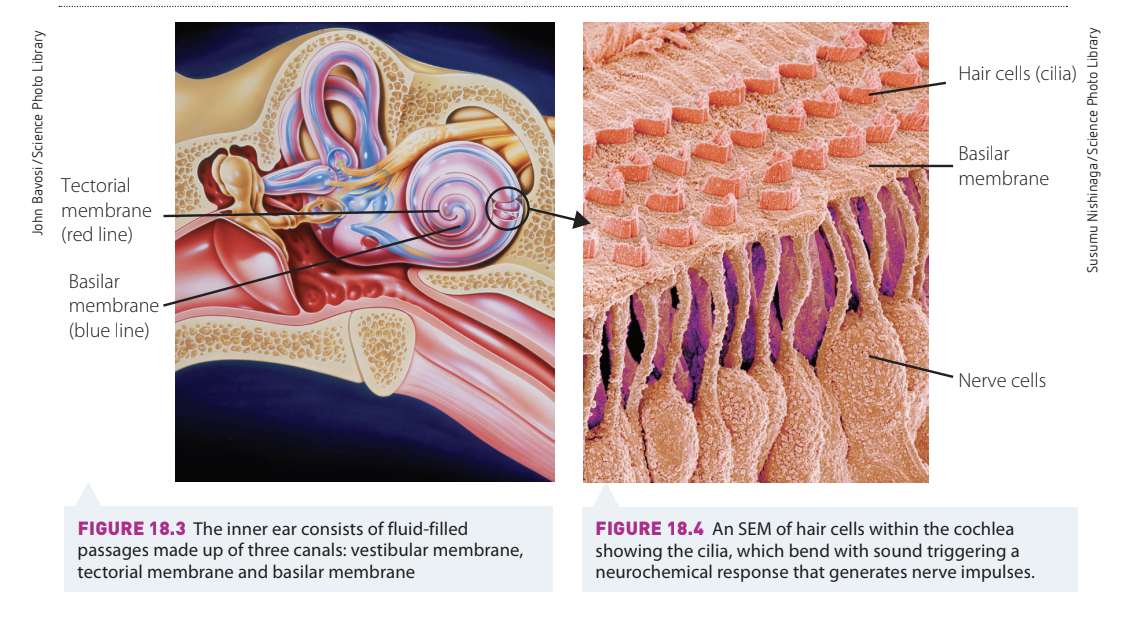
The Organ of Corti has two important membranes:
- Tectorial membrane: The upper membrane
- Basilar membrane: The lower membrane
Between these two membranes are hair cells, which are the actual receptor cells of the ear.
Hair cells and sound detection
When a pressure wave moves through the fluid-filled cochlea, it pushes up on the basilar membrane. This causes the hair cells to bend against the tectorial membrane. This bending is the stimulus that transforms kinetic energy (vibrations) into electrical energy (nerve impulses).
The nerve impulses travel along the auditory nerve to the brain, where they are interpreted as sound.
Note
The bending of hair cells is the critical moment when mechanical vibrations become electrical signals. Without this transformation, the brain would have no way to receive information about sounds in the environment.
Frequency detection
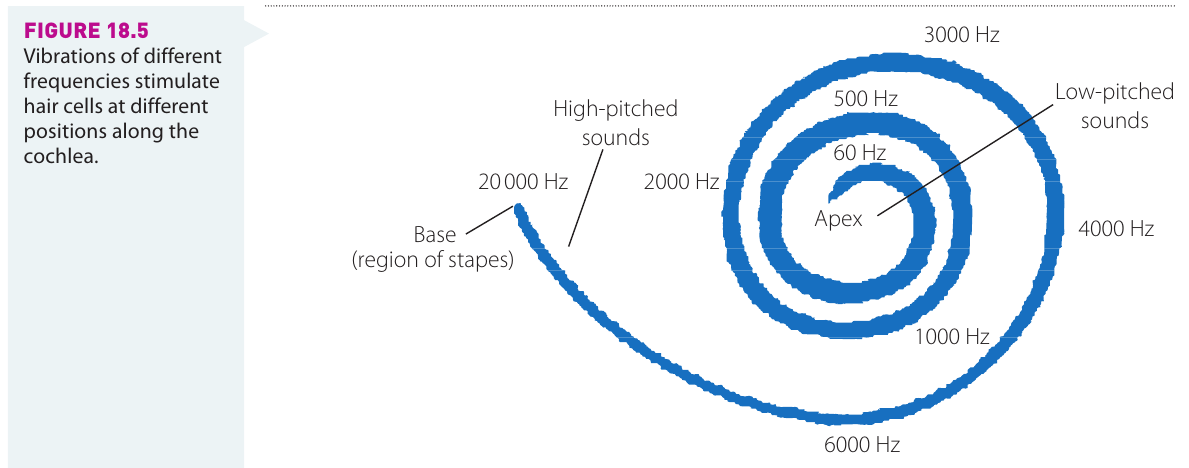
Different sound frequencies (pitches) are detected at different locations along the cochlea:
- High-pitched sounds ( Hz) stimulate hair cells near the base of the cochlea (closest to the oval window)
- Low-pitched sounds ( Hz) stimulate hair cells at the apex of the cochlea (the far end)
- Medium-pitched sounds stimulate hair cells at positions in between
Important
There is a finite number of hair cells in the cochlea. If hair cells are damaged, the frequencies they detect will no longer be heard. This is why hearing loss from loud noise exposure is often permanent - damaged hair cells cannot be replaced.
Hearing loss
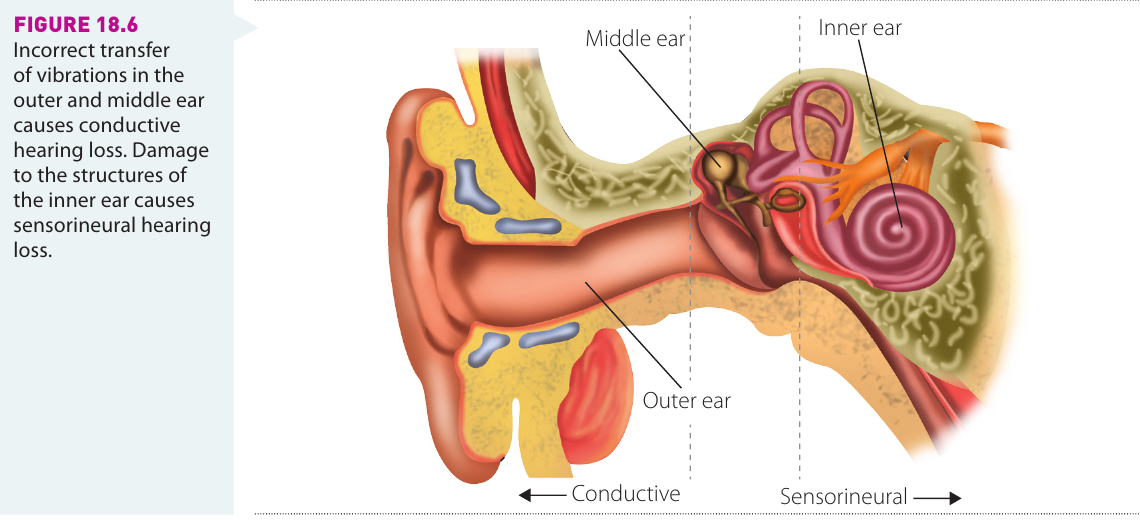
Hearing loss occurs when structures in the ear are malformed, damaged, or not functioning correctly. The type of hearing loss depends on which part of the ear is affected.
Types of hearing loss
There are two main types of hearing loss:
- Conductive hearing loss: Problems with the outer or middle ear
- Sensorineural hearing loss: Problems with the inner ear or auditory nerve
Note
The key to understanding hearing loss is identifying where the problem occurs. Conductive hearing loss involves the structures that conduct vibrations (outer and middle ear), while sensorineural hearing loss involves the sensors (hair cells) or nerves that create and transmit electrical signals.
Conductive hearing loss
Conductive hearing loss occurs when vibrations cannot be transferred effectively through the outer and middle ear.
Causes include:
- Malformation of outer or middle ear structures
- Perforated (torn) eardrum
- Infections in the outer or middle ear
- Damage to the ossicles from trauma (such as explosions or head injuries)
- Hardening of the stapes bone
Effect on hearing: Conductive hearing loss primarily affects the loudness of sound. Vibrations cannot reach the inner ear at normal intensity, making sounds quieter than they should be.
Note
Conductive hearing loss can often be treated medically or surgically because it involves mechanical problems with structures that conduct vibrations. The inner ear and auditory nerve typically remain functional.
Sensorineural hearing loss
Sensorineural hearing loss occurs when the inner ear, including the hair cells or auditory nerve, is damaged or malformed.
Causes include:
- Excessive noise exposure (most common cause)
- Heredity (genetic factors)
- Birth defects
- Infections
- Tumours
- Certain medications
- Ageing
Effect on hearing: Sensorineural hearing loss affects both the loudness and clarity of sound. This type of hearing loss is usually permanent because hair cells and nerve tissue do not regenerate.
Important
Sensorineural hearing loss is usually permanent because hair cells and nerve tissue cannot regenerate. This is why protecting your hearing from excessive noise is so important - once hair cells are damaged, they cannot be replaced naturally.
When the inner ear is damaged, vibrations cannot be transformed into electrical impulses to send to the brain for interpretation.
Technologies to assist with hearing loss
Scientific research has developed various technologies to help people with hearing loss. The type of technology used depends on the cause and type of hearing loss.
Hearing aids
Hearing aids are devices used to magnify sound vibrations, making them louder. This helps vibrations travel more effectively through the outer ear to the middle ear and then to the inner ear.
Suitable for:
- Both conductive and sensorineural hearing loss
- People who have some remaining hearing ability
How they work: Hearing aids amplify (make louder) incoming sound waves before they enter the ear canal, helping damaged or weak structures to function better.
Note
Hearing aids are the most common assistive technology for hearing loss. They work by simply making sounds louder, which is why they're effective for people who have some remaining hearing ability but need amplification.
Bone conduction implants
Bone conduction implants bypass the outer and middle ear entirely by transmitting vibrations through bone directly to the inner ear.
Suitable for:
- Conductive hearing loss
- People with malformed or damaged outer or middle ear structures
How they work:
- A microphone detects sound waves
- The device converts sound into vibrations
- Vibrations pass through the implant to the bone above the ear
- The bone conducts vibrations directly to the cochlea in the inner ear
- The cochlea processes the vibrations normally
Note
Bone conduction implants are particularly useful for people with conductive hearing loss because they bypass damaged outer and middle ear structures entirely. The sound reaches the functioning inner ear through bone vibration instead of through the normal air-conduction pathway.
Cochlear implants
Cochlear implants are electronic devices that bypass damaged hair cells and directly stimulate the auditory nerve.
Suitable for:
- Severe sensorineural hearing loss
- People whose hair cells are damaged but whose auditory nerve still functions
How they work:
- An external speech processor with a microphone detects sound
- Sound is converted into digital signals
- Signals are sent to an external transmitter coil
- The transmitter sends signals to an internal receiver implanted under the skin
- The receiver converts digital signals to electrical signals
- Signals travel to an electrode array implanted in the cochlea
- The electrodes directly stimulate nerve endings in the cochlea
- Nerve impulses travel along the auditory nerve to the brain for processing
Important
Cochlear implants represent a remarkable technological achievement. They can restore hearing to people with severe sensorineural hearing loss by bypassing damaged hair cells completely and directly stimulating the auditory nerve. However, they only work if the auditory nerve itself is still functional.
Remember!
Summary
Key Points to Remember:
- The ear transforms energy through three forms: sound energy → kinetic energy (vibrations) → electrical energy (nerve impulses)
- The pathway of sound is: Pinna → Auditory canal → Tympanic membrane → Hammer → Anvil → Stirrup → Oval window → Cochlea
- Hair cells in the Organ of Corti are the receptor cells that detect sound by bending against the tectorial membrane
- High-pitched sounds are detected at the base of the cochlea, while low-pitched sounds are detected at the apex
- Conductive hearing loss occurs when vibrations cannot pass through the outer or middle ear effectively
- Sensorineural hearing loss occurs when the inner ear (especially hair cells) or auditory nerve is damaged, and is usually permanent
- Different technologies help different types of hearing loss:
- Hearing aids amplify sound
- Bone conduction implants bypass damaged outer/middle ear
- Cochlear implants directly stimulate the auditory nerve