Brønsted–Lowry Overview (HSC SSCE Chemistry): Revision Notes
📚Revision Notes
Brønsted–Lowry Overview
Understanding the Brønsted-Lowry theory
The Brønsted-Lowry theory provides a comprehensive framework for understanding acid-base chemistry that extends beyond earlier models. This approach focuses on the transfer of protons (hydrogen ions) between chemical species, offering a more versatile way to describe acid-base reactions in aqueous solutions.
Water plays a central role in this theory. As the most common solvent found in nature, water participates in countless chemical reactions. The unique properties of water molecules make them essential components in acid-base chemistry, particularly because water can behave as both an acid and a base depending on the circumstances.
Core definitions
Important
The Brønsted-Lowry theory establishes clear definitions based on proton transfer:
Acid: A substance that donates one or more protons (hydrogen ions, ). When an acid participates in a reaction, it loses a proton to another substance.
Base: A substance that accepts one or more protons. When a base participates in a reaction, it gains a proton from another substance.
These definitions create a complementary relationship between acids and bases. Every acid donation requires a base acceptance, and vice versa. This makes bases the "mirror companions" of acids, as they work together in proton transfer reactions.
Amphiprotic substances
Some substances possess a remarkable dual nature—they can function as either acids or bases. These substances are called amphiprotic. The behaviour of an amphiprotic substance depends on what other species are present in the reaction.
Note
Water () is the most important example of an amphiprotic substance. In some reactions, a water molecule can donate a proton and act as an acid. In other reactions, a water molecule can accept a proton and act as a base. This flexibility makes water an essential participant in many acid-base reactions.
When water molecules interact with each other through a process called hydrolysis, they can ionise to form hydroxide ions () and hydronium cations (). The term "hydrolysis" comes from Greek roots: "hydro" meaning water and "lysis" meaning to unbind. This process demonstrates water's amphiprotic nature directly.
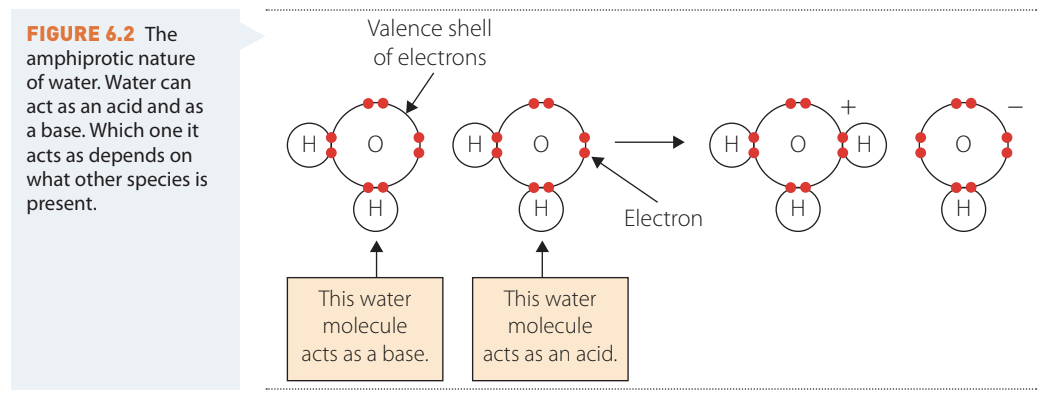
The diagram above illustrates how one water molecule can donate a proton (acting as an acid) while another water molecule accepts that proton (acting as a base). The electrons in the valence shell of the oxygen atom play a key role in this proton transfer process.
Conjugate acid-base pairs
A powerful concept in Brønsted-Lowry theory is the idea of conjugate pairs. When acids and bases participate in reactions, they form products that are themselves bases and acids. These related species are called conjugate acid-base pairs.
Understanding conjugate relationships
Important
Members of a conjugate acid-base pair differ from each other by exactly one proton (). When an acid loses a proton, it forms its conjugate base. When a base gains a proton, it forms its conjugate acid.
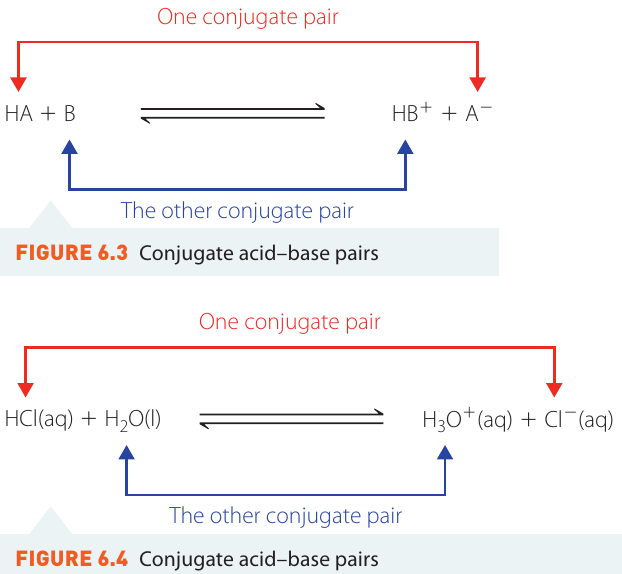
Consider a general acid-base reaction:
In this reversible reaction, several important relationships exist:
In the forward direction: acts as an acid by donating a proton to base . The base accepts this proton from .
In the reverse direction: The ion acts as an acid by donating a proton to the ion. The ion acts as a base by accepting this proton from .
This creates two conjugate pairs:
- and (differing by one )
- and (differing by one )
Identifying conjugate pairs in reactions
To identify conjugate pairs in any acid-base equation, look for species that differ by exactly one hydrogen ion. Let's examine a specific example:
Example
Worked Example: Identifying Conjugate Pairs with HCl
When hydrochloric acid () reacts with water:
Step 1: Identify the acid and what it forms The acid donates a proton to form its conjugate base .
Step 2: Identify the base and what it forms Water accepts the proton and acts as a base, forming its conjugate acid (hydronium ion).
Step 3: List the conjugate pairs The two conjugate pairs are:
- and (one pair)
- and (the other pair)
Additional example
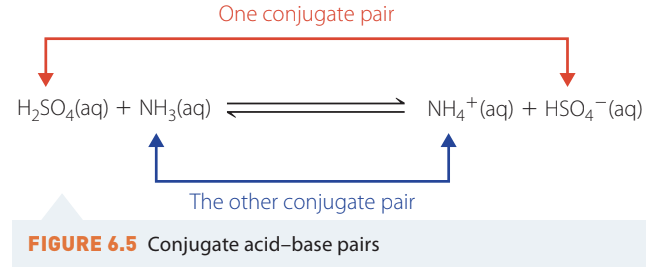
Another clear example involves sulfuric acid reacting with ammonia:
Example
Worked Example: Sulfuric Acid and Ammonia Reaction
In this reaction:
- Sulfuric acid () donates a proton to form hydrogen sulfate (), its conjugate base
- Ammonia () accepts a proton to form ammonium (), its conjugate acid
The conjugate pairs are:
- and
- and
Exam tips
Note
Strategies for Success in Identifying Conjugate Pairs:
When identifying conjugate pairs in exam questions:
- Look for species that differ by exactly one
- Remember that the acid always has one more hydrogen than its conjugate base
- Draw arrows connecting conjugate pairs to avoid confusion
- Check that charges differ by exactly one positive unit between conjugates
Remember!
Summary
Key Points to Remember:
- An acid donates protons () while a base accepts protons—they are complementary partners in chemical reactions
- Amphiprotic substances like water can act as either acids or bases depending on what other chemicals are present
- Conjugate acid-base pairs differ from each other by exactly one transferable proton ()
- Every acid-base reaction involves two conjugate pairs working together in a reversible process
- The measurement of hydronium ion concentration () is key to defining the degree of acidity in solutions