Changes in Understanding of Acids and Bases (HSC SSCE Chemistry): Revision Notes
📚Revision Notes
Changes in Understanding of Acids and Bases
Introduction
Scientific understanding of acids and bases has evolved significantly over the past 250 years. The way we define these substances has changed multiple times as chemists developed deeper insights into their chemical nature. This evolution shows how scientific knowledge progresses from simple observations to sophisticated molecular explanations.
Early identification of acids and bases
Observable properties
The ancient Greeks were among the first to identify acids. They recognized sour-tasting substances and called them oxein. This word was later translated into Latin as acetum, which eventually became the English word "acid." Over time, scientists discovered other characteristic properties of acids:
- They change the colour of litmus paper (turning it red)
- They corrode metals
- They have a sharp, sour taste
Bases were recognized as substances that could neutralise or counteract the effects of acids. The word "alkaline" comes from the Arabic word for roasting, because early soap-making involved roasting ashes and then reacting them with water and slaked lime.
Note
Operational versus conceptual definitions
These early observations provided what we call an operational definition - a definition based on what substances do and how they behave in the laboratory. Operational definitions are practical and useful for identifying substances through testing.
However, chemists wanted to go further and develop a conceptual definition - one that explains what acids and bases actually are at a chemical level, not just what they do. This deeper understanding required investigating the composition and structure of these substances.
Early chemical theories
Lavoisier's oxygen theory
In 1776, French scientist Antoine Lavoisier proposed the first chemical theory to explain acids. He suggested that oxygen was the key component that made a compound acidic. This was a significant step forward because it attempted to identify a specific chemical element responsible for acidic properties.
Important
Why Lavoisier's theory was incorrect:
Scientists discovered that:
- Many acids do not contain oxygen at all
- Some basic substances actually do contain oxygen
Despite being wrong, Lavoisier's theory was historically important as the first attempt to chemically characterise acids.
Davy's hydrogen theory
English chemist Humphry Davy challenged Lavoisier's oxygen theory through a series of experiments. He demonstrated that , , and were all acids, even though none contained oxygen.
This led Davy to propose that hydrogen was the key component giving acids their properties. He suggested that acids were substances containing hydrogen that could be replaced by a metal. This was closer to our modern understanding, though still incomplete.
The Arrhenius theory
In the late 19th century, Swedish chemist Svante Arrhenius developed a theory to explain acids and bases based on the particles they produce in aqueous solution.
Arrhenius definitions
According to Arrhenius:
- An acid is a substance that ionises in solution to produce hydrogen ions ()
- A base is a substance that in solution produces hydroxide ions ()
Example
Mathematical Representation of Arrhenius Theory
We can represent these definitions with general equations. If represents an acid and represents a base:
Acid ionisation:
Base ionisation:
This theory worked well for all known acids at the time and explained the behaviour of many bases. However, it had several important limitations.
Limitations of Arrhenius theory
Important
Critical limitations that challenged the Arrhenius theory:
The solvent problem: The theory only considers aqueous (water-based) solutions. It doesn't account for the role of the solvent. Acids and bases should exhibit their properties in any solvent, but when organic solvents like benzene are used, many acids and bases do not dissociate into ions.
Insoluble bases: Not all bases are soluble in water. If a base cannot dissolve, it cannot produce ions in solution. This suggests that hydroxide ions are not essential for a substance to be a base.
Non-aqueous solvents: When bases dissolve in solvents other than water, no hydroxide ions are present. Yet these substances still behave as bases.
Salt solutions: According to Arrhenius theory, all salts formed from acid-base reactions should be neutral. In reality, this is not always the case. For example, when acetic acid reacts with sodium hydroxide, the resulting solution is actually basic, not neutral.
The hydronium ion: The theory suggests acids produce ions, but this ion doesn't actually exist freely in aqueous solutions. Instead, the hydrogen ion bonds to a water molecule to form the hydronium ion ().
The ammonia dilemma
The most significant challenge to Arrhenius theory came from ammonia. Ammonia clearly behaves as a base, yet it doesn't fit the Arrhenius definition. This created a dilemma: either ammonia wasn't a base (which contradicted observations), or the definition needed to be changed.
Ammonia's behaviour with water
Some chemists argued the Arrhenius definition could still work because when ammonia dissolves in water, this reaction occurs:
Example
Ammonia reacting with water:
This reaction does produce hydroxide ions, so ammonia could still be considered a base according to Arrhenius.
Ammonia's reaction without water
However, the real problem appeared when ammonia gas reacts with hydrochloric acid fumes. This reaction forms ammonium chloride:
Example
Ammonia reacting with HCl gas (no water present):
This is clearly an acid-base reaction, but there is no water present. No ions or ions are involved at all.
This demonstrated conclusively that the Arrhenius definition needed to be revised.
Investigation 5.3: White smoke demonstration
This investigation demonstrates that acid-base reactions can occur without water. When concentrated ammonia solution and concentrated hydrochloric acid are placed at opposite ends of a glass tube, their vapours diffuse along the tube. Where the vapours meet, a white smoke appears - this is solid ammonium chloride forming from the gas-phase reaction.
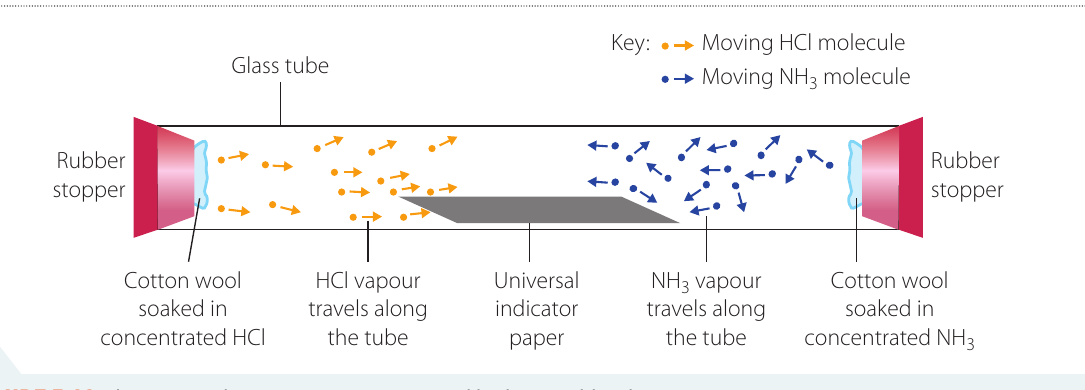
Important
Key safety considerations: This demonstration must be performed in a fume cupboard with proper ventilation. Both concentrated ammonia and hydrochloric acid produce toxic and corrosive fumes. Safety glasses and gloves must be worn.
Note
Key observation:
The white smoke forms because the gaseous ammonia molecules and gaseous hydrogen chloride molecules react directly with each other, with no water or hydroxide ions present. This proves that water is not essential for acid-base reactions to occur.
Brønsted-Lowry theory
Danish chemist Brønsted and English chemist Lowry independently developed a broader definition that could account for ammonia and other exceptions to Arrhenius theory.
Brønsted-Lowry definitions
According to the Brønsted-Lowry theory:
- An acid is a substance that donates one or more protons (hydrogen ions, )
- A base is a substance that accepts one or more protons
This definition shifts the focus from the ions produced in solution to the transfer of protons between substances.
Understanding the ammonia reaction
Using Brønsted-Lowry theory, we can now properly explain ammonia's behaviour. In the gas-phase reaction:
Example
Ammonia as a Brønsted-Lowry base:
- Ammonia accepts a proton from the HCl molecule to form an ammonium ion (). This makes ammonia a base.
- Hydrochloric acid donates a proton to form a chloride ion (), making it an acid.
Water as an acid and a base
The Brønsted-Lowry theory reveals interesting behaviour in reactions involving water. Consider when hydrochloric acid dissolves in water:
Example
Water acting as a base:
In this reaction:
- HCl acts as an acid (donates a proton)
- Water acts as a base (accepts the proton to form )
Now consider the reaction of ammonia with water:
Example
Water acting as an acid:
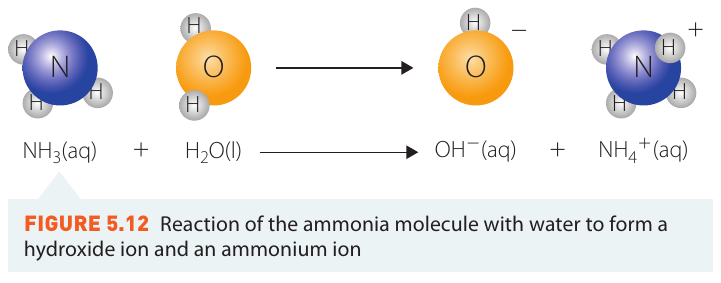
In this reaction:
- Ammonia acts as a base (accepts a proton)
- Water acts as an acid (donates a proton to form )
Amphiprotic substances
Important
Amphiprotic behaviour of water:
Water can act as either an acid or a base, depending on what other substance is present. This behaviour is called amphiprotic. An amphiprotic substance can both donate and accept protons.
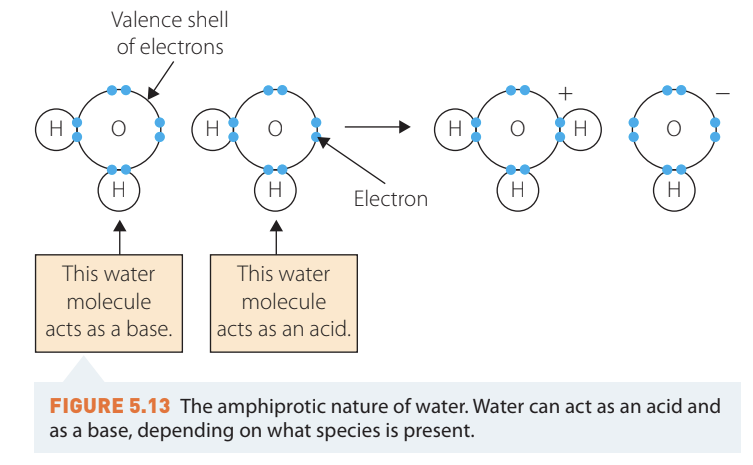
The diagram shows how water molecules can interact with each other. One water molecule can donate a proton (acting as an acid) while another accepts it (acting as a base). This explains water's unique ability to act as both an acid and a base.
Advantages of Brønsted-Lowry theory
The Brønsted-Lowry definition is broader than Arrhenius because:
- It explains ammonia's basic behaviour
- It doesn't require water or any specific solvent
- It explains why some acid-base reactions produce non-neutral solutions
- It introduces the concept of proton transfer between molecules
Limitations of Brønsted-Lowry theory
Despite its improvements, the Brønsted-Lowry theory still has limitations:
Note
Hydrogen requirement: For a substance to be identified as an acid or base using this theory, a hydrogen ion () must be transferred. This means the theory doesn't explain acid-base behaviour where no proton transfer occurs.
Solvent limitations: The theory requires a solvent with hydrogen attached to oxygen or nitrogen (such as water, ammonia, or acetic acid). It doesn't work well in other solvents.
Important
Critical limitations:
Oxide reactions: The theory cannot explain reactions between acidic oxides (like , , ) and basic oxides (like , , ) that occur without any solvent:
Hydrogen-free acids: Some substances act as acids but don't contain hydrogen at all. Examples include and . Since they have no hydrogen, they cannot donate protons, yet they still show acidic behaviour.
Lewis definition
Gilbert Lewis wanted a definition that was not limited by the chemical environment. It should allow acids and bases to be identified even without a solvent or proton transfer.
Lewis definitions
Lewis proposed:
- An acid is an electron pair acceptor
- A base is an electron pair donor
This definition focuses on electrons rather than protons. It's even broader than Brønsted-Lowry because it doesn't require hydrogen ions or proton transfer at all.
Understanding Lewis acids and bases
A Lewis acid is any atom, ion, or molecule that can accept electrons. A Lewis base is any atom, ion, or molecule that can donate electrons.
Note
Looking back at the water molecule diagram, we can see:
- One water molecule donates an electron pair to a hydrogen ion, making it a Lewis base
- The hydrogen ion accepts the electron pair, making it a Lewis acid
Advantages of Lewis theory
The Lewis definition explains reactions that Brønsted-Lowry cannot. For example, reacts with ammonia even though no protons are involved:
Example
Lewis acid-base reaction without proton transfer:
The boron in accepts a non-bonding electron pair from the nitrogen in . According to Lewis:
- is a Lewis acid (electron pair acceptor)
- is a Lewis base (electron pair donor)
This forms the compound without any proton transfer.
Relationship between theories
Note
How the three theories relate:
The three definitions are related but not identical:
- All Brønsted-Lowry acids and bases are also Lewis acids and bases
- However, not all Lewis acids and bases are Brønsted-Lowry acids and bases
- The Lewis definition is the broadest and most comprehensive
The theories are complementary. Sometimes a substance is classified as an acid or base according to one definition but not another. This shows how scientific definitions become more sophisticated as understanding deepens.
Remember!
Summary
Key Points to Remember:
-
Scientific definitions evolve: Our understanding of acids and bases has changed from observable properties to complex chemical theories involving electrons.
-
Three major theories: Arrhenius (ions in water), Brønsted-Lowry (proton transfer), and Lewis (electron pair transfer) - each theory is broader than the previous one.
-
Arrhenius limitations: Only works in aqueous solutions and couldn't explain ammonia as a base or reactions without water.
-
Brønsted-Lowry key concept: Acids donate protons, bases accept protons. Water is amphiprotic - it can act as either an acid or a base.
-
Lewis theory advantage: The broadest definition that explains acid-base behaviour without requiring protons or specific solvents - focuses on electron pair transfer instead.