Naming Inorganic Compounds (HSC SSCE Chemistry): Revision Notes
📚Revision Notes
Naming Inorganic Compounds
Understanding chemical nomenclature
Chemistry relies on a systematic way of naming compounds so that scientists worldwide can communicate clearly. The International Union of Pure and Applied Chemistry (IUPAC) develops these naming rules, known as chemical nomenclature. This standardised system ensures that everyone uses the same names for the same substances.
Note
IUPAC has created different guides for naming different types of compounds:
- The Red Book contains rules for naming inorganic compounds (compounds that generally don't contain carbon)
- The Blue Book covers organic compounds
- The Purple Book deals with polymers
The naming system you learned previously is called compositional or stoichiometric naming. This tells us about the composition of a compound based on its formula, but doesn't provide information about its structure.
Acids and bases in everyday life
Before we look at naming rules, it's helpful to recognise that acids and bases are all around us in nature and in our homes.
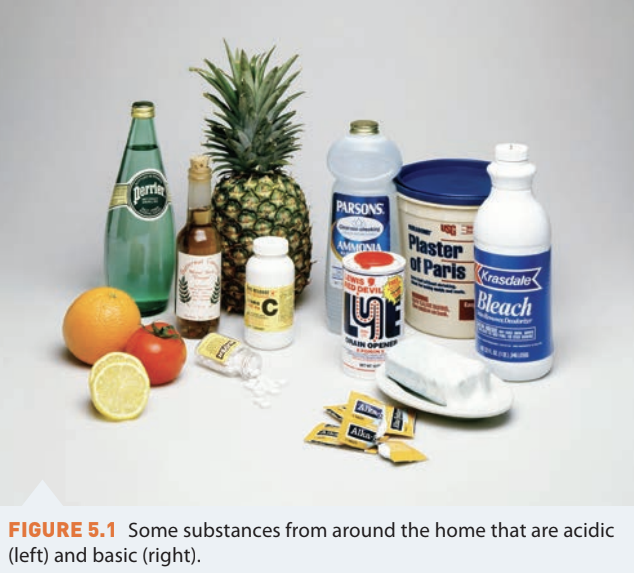
Common acids include:
- Rain (slightly acidic)
- Citrus fruits (citric acid)
- Soft drinks (carbonic acid)
- Vitamin C (ascorbic acid)
- Stomach acid (hydrochloric acid)
Common bases include:
- Ammonia (found in cleaning products)
- Caffeine (in coffee and tea)
- Baking soda
- Antacids
Naming inorganic acids
What are inorganic acids?
Inorganic acids (also called mineral acids) are acids that don't contain carbon chains. The most common examples you'll work with are:
- Hydrochloric acid ()
- Sulfuric acid ()
- Nitric acid ()
- Phosphoric acid ()
These differ from organic acids, which are carbon-based compounds with acidic properties, such as citric acid in fruit or acetic acid in vinegar.
How to name inorganic acids
When we name an inorganic acid with the general formula , we base the name on the anion (negatively charged ion) that forms when the acid dissolves in water.
Important
The compositional name of an inorganic acid is derived from the anion (A) that is formed when the acid, HA, dissociates in water to form and .
The anion can be either:
- Monoatomic: a single atom (like )
- Polyatomic: multiple atoms bonded together (like )
Binary acids (monoatomic anions)
When an acid contains hydrogen bonded to a single other element, we call it a binary acid. To name these acids:
- Start with the prefix "hydro-"
- Take the name of the anion
- Replace the "-ide" ending with "-ic"
- Add the word "acid"
Example
Worked Example: Naming a Binary Acid
Name , which contains the chloride ion ().
Step 1: Identify that this is a binary acid (hydrogen + one other element)
Step 2: Apply the naming rule:
- Start with "hydro-"
- Chloride → Chloric
- Add "acid"
Result: Hydrochloric acid
Other examples:
- → hydrofluoric acid
- → hydrobromic acid
- → hydrosulfuric acid
Oxyacids (polyatomic anions)
Oxyacids are acids that contain oxygen bonded to another element such as sulfur, nitrogen, phosphorus or carbon. The naming rules depend on whether the polyatomic ion ends in "-ate" or "-ite".
Polyatomic ions ending in "-ate"
For acids containing polyatomic ions that end in "-ate":
- Take the name of the polyatomic ion
- Replace "-ate" with "-ic"
- Add the word "acid"
Example
Worked Example: Naming an Oxyacid with -ate
Name , which contains the nitrate ion ().
Step 1: Identify the polyatomic ion ending: nitrate
Step 2: Apply the naming rule:
- Nitrate → Nitric
- Add "acid"
Result: Nitric acid
Other examples:
- (sulfate → sulfuric) → sulfuric acid
- (carbonate → carbonic) → carbonic acid
- (phosphate → phosphoric) → phosphoric acid
Polyatomic ions ending in "-ite"
For acids containing polyatomic ions that end in "-ite":
- Take the name of the polyatomic ion
- Replace "-ite" with "-ous"
- Add the word "acid"
Example
Worked Example: Naming an Oxyacid with -ite
Name , which contains the nitrite ion ().
Step 1: Identify the polyatomic ion ending: nitrite
Step 2: Apply the naming rule:
- Nitrite → Nitrous
- Add "acid"
Result: Nitrous acid
Other examples:
- (sulfite → sulfurous) → sulfurous acid
- (phosphite → phosphorous) → phosphorous acid
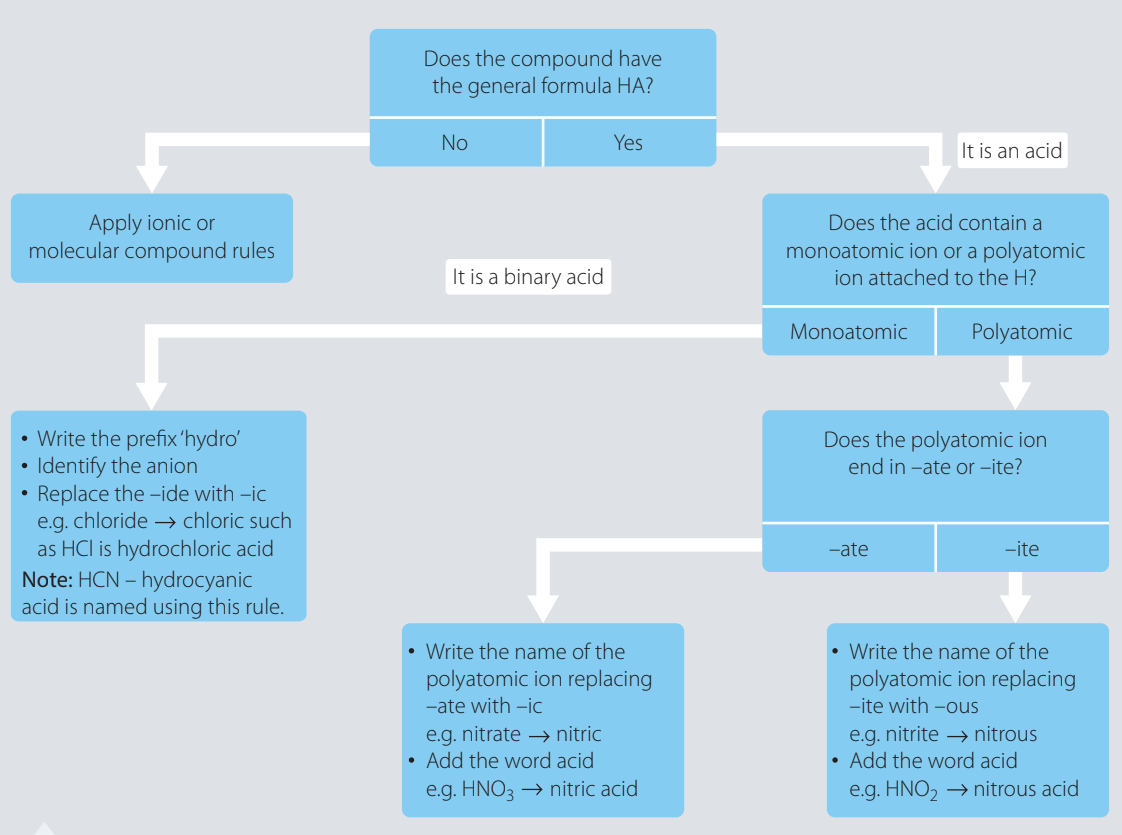
Summary flowchart for naming acids
Note
Memory aid: Remember "ATE to IC, ITE to OUS" for polyatomic ions.
HYDRO for binary acids with HYDROGEN - if you see hydrogen combined with a single element, use the "hydro-" prefix.
Important
Exam tip: Always check if the acid contains a monoatomic or polyatomic anion first, as this determines which naming rule to use.
Naming inorganic bases
What are inorganic bases?
An inorganic base is a substance that contains either the hydroxide ion () or the oxide ion (), or produces hydroxide ions when dissolved in water.
Common inorganic bases include:
- Sodium hydroxide ()
- Barium hydroxide ()
- Magnesium oxide ()
- Iron(III) oxide ()
- Copper(II) hydroxide ()
- Ammonia ()
How to name inorganic bases
Metal hydroxides and oxides
Most inorganic bases are ionic compounds containing metal cations bonded to either hydroxide or oxide ions. We name these bases using the standard ionic compound naming rules:
- Name the metal cation first
- Name the anion second (hydroxide or oxide)
Example
Worked Example: Naming Metal Hydroxides and Oxides
Example 1:
- Metal cation: Sodium
- Anion: Hydroxide
- Name: Sodium hydroxide
Example 2:
- Metal cation: Calcium
- Anion: Hydroxide
- Name: Calcium hydroxide
Example 3:
- Metal cation: Iron(III) - note the Roman numeral for transition metals
- Anion: Oxide
- Name: Iron(III) oxide
Note
For transition metals that can form multiple ions, include the charge in Roman numerals.
Alkalis
Bases that dissolve in water are specifically called alkalis. The most common alkalis are:
- Sodium and potassium hydroxides
- Calcium and barium hydroxides
- Ammonia ()
When ammonia dissolves in water, it produces ammonium () and hydroxide () ions, making it an alkali even though it doesn't contain hydroxide ions in its formula.
Important
Exam tip: All alkalis are bases, but not all bases are alkalis. Only water-soluble bases are called alkalis.
Summary
Key Points to Remember:
-
IUPAC nomenclature provides standardised rules for naming chemical compounds to enable clear scientific communication.
-
Binary acids (containing hydrogen and one other element) are named with the prefix "hydro-", changing the anion name ending to "-ic", and adding "acid" (e.g., = hydrochloric acid).
-
Oxyacids with polyatomic anions are named by converting "-ate" endings to "-ic" and "-ite" endings to "-ous" (e.g., nitrate → nitric acid, nitrite → nitrous acid).
-
Inorganic bases containing hydroxide or oxide ions are named as ionic compounds, using the metal name followed by hydroxide or oxide.
-
Alkalis are the subset of bases that dissolve in water, including common examples like sodium hydroxide, potassium hydroxide and ammonia.