Neutralisation Reactions (HSC SSCE Chemistry): Revision Notes
📚Revision Notes
Neutralisation Reactions
Introduction to neutralisation reactions
When an acid reacts with a base, a neutralisation reaction takes place. This type of reaction produces salt and water as products. You can represent this using a simple net ionic equation:
However, this equation doesn't show the full picture. There's actually another important product formed during neutralisation - heat energy. Understanding the energy changes that occur during neutralisation reactions is crucial for many applications in chemistry.
Note
While the simple ionic equation shows the formation of water, neutralisation reactions are always accompanied by the release of heat energy, making them exothermic processes. This energy release has important practical implications in both everyday life and industrial applications.
Enthalpy of neutralisation
Understanding enthalpy and energy changes
Chemical reactions always involve energy changes. When reactions occur, bonds in the reactants must be broken, and new bonds form to create the products. Breaking bonds requires energy input, while forming new bonds releases energy. The overall energy change depends on the balance between these two processes.
Enthalpy is a measure of the total energy possessed by a substance or group of substances. In chemistry, we're particularly interested in the change in enthalpy, which is commonly called the heat of reaction and given the symbol . This value is measured in kilojoules per mole ().
Important
The Law of Conservation of Energy
Energy cannot be created or destroyed - it can only be changed from one form to another. This fundamental principle applies to all chemical reactions, including neutralisation. The total energy before and after a reaction remains constant, though it may be converted between different forms such as chemical potential energy and heat energy.
The change in enthalpy for a chemical reaction is defined as the energy change per mole of a specified reactant or product when the reaction occurs at constant pressure. We can express this mathematically as:
Since we define as the energy absorbed during a reaction, a positive value indicates energy absorption, while a negative value indicates energy release.
Exothermic reactions
Exothermic reactions are chemical reactions in which the energy of the reactants is greater than the energy of the products. During these reactions, energy is released to the surroundings, usually in the form of heat. Because energy is released, exothermic reactions have negative values.
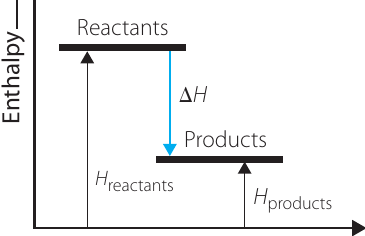
The diagram above shows an enthalpy profile for an exothermic reaction. Notice how the products have lower energy than the reactants, with the difference () being negative, representing the energy released.
Note
Neutralisation Reactions are Exothermic
Neutralisation reactions are typically exothermic, meaning they release heat energy. This is why if you mix an acid with a base, you'll often notice the solution becoming warmer. This heat release can be measured and used to calculate the enthalpy change of the reaction.
Endothermic reactions
In contrast, endothermic reactions have positive values. These are reactions where the energy of the products is greater than the energy of the reactants. Energy must be absorbed from the surroundings for the reaction to proceed.
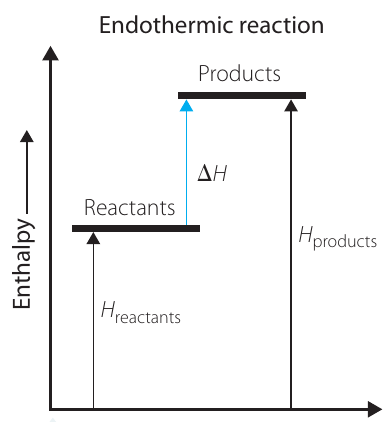
The enthalpy diagram above illustrates an endothermic reaction, where the products have higher energy than the reactants, and is positive.
Standard enthalpy of neutralisation
During a neutralisation reaction, the change in enthalpy depends on several factors, including the concentration of reactants and products in solution, and the pressure of any gases involved. To make meaningful comparisons between different reactions, chemists use standard conditions.
The standard enthalpy of neutralisation is defined as the enthalpy change when solutions of an acid and alkali react together under standard conditions ( or and pressure) to produce exactly 1 mole of water.
Note
The symbol for standard enthalpy change is . For strong acid-strong base neutralisation reactions, the theoretical value is approximately . This remarkably consistent value occurs because all strong acid-strong base neutralisations involve the same fundamental reaction: the combination of hydrogen ions and hydroxide ions to form water.
Measuring enthalpy
Using temperature changes to measure energy
In the laboratory, one of the most practical ways to measure energy changes is by observing temperature changes in water or aqueous solutions. This method relies on the relationship between heat energy and temperature.
The specific heat capacity of water is . This means that joules of energy are needed to increase the temperature of gram of water by kelvin (or ).
The heat capacity equation
The total amount of energy needed to change the temperature of a substance depends on three factors:
- The mass of the substance
- The specific heat capacity of the substance
- The temperature change required
Important
The Heat Capacity Equation
We can express this relationship using the equation:
where:
- = quantity of heat involved, measured in joules ()
- = mass of the substance, measured in grams ()
- = specific heat capacity of the substance, measured in
- = change in temperature (final temperature – initial temperature), measured in kelvin ()
This equation is fundamental to all calorimetry calculations and allows us to determine the heat energy transferred during a reaction by measuring temperature changes.
When interpreting results, remember that if the temperature change is positive, the temperature has increased and the chemical system has lost energy (exothermic). If the temperature change is negative, the temperature has decreased and the system has gained energy (endothermic).
Investigation 5.2: Measuring the enthalpy of neutralisation
Introduction
When a neutralisation reaction occurs, there is a measurable change in enthalpy. The standard enthalpy of neutralisation is the enthalpy change when solutions of an acid and alkali react together under standard conditions to produce exactly 1 mole of water.
In this investigation, you will determine the standard enthalpy of neutralisation for a reaction between aqueous sodium hydroxide solution and hydrochloric acid. You will also explore whether there is a difference in enthalpy when solid sodium hydroxide is used instead of the aqueous solution.
Aim
To determine the enthalpy of neutralisation and the effect of the state of the reactants.
Hypothesis
Students should write their own hypothesis predicting how the enthalpy change might differ between using solid sodium hydroxide versus aqueous sodium hydroxide.
Materials
- measuring cylinder
- to thermometer or temperature probe and data logger
- Spatula
- Electronic balance
- 2 polystyrene cups
- Safety glasses
Risk assessment
| What are the risks in doing this investigation? | How can you manage these risks to stay safe? |
|---|---|
| NaOH is caustic. | Use a spatula to transfer the . |
| HCl is corrosive. | Use safety glasses and personal protective clothing. Dispose of as directed by your teacher to protect from splashing. |
Important
Safety First
Both sodium hydroxide and hydrochloric acid are corrosive substances that can cause chemical burns. Always wear appropriate personal protective equipment including safety glasses and gloves. Handle these chemicals with care and follow your teacher's instructions for safe disposal.
Students should also consider any other risks associated with the investigation and how to manage them appropriately.
Method
Part A
- Pour of into a polystyrene cup.
- Measure the temperature of this solution using the thermometer or temperature probe.
- Accurately weigh out approximately of and add this to the same polystyrene cup.
- Use the thermometer to stir, then record the highest or lowest temperature reached.
Part B
- Pour of into a polystyrene cup.
- Measure the temperature of the NaOH using the thermometer or temperature probe.
- Measure of and record its initial temperature.
- Average the initial temperatures of the NaOH and HCl – this is the initial temperature of this experiment.
- Pour the HCl into the polystyrene cup containing the NaOH, stir and record the highest or lowest temperature reached.
Note
Why Use Polystyrene Cups?
Polystyrene is an excellent insulator that minimises heat loss to the surroundings during the experiment. This helps ensure that the temperature change you measure reflects the actual energy change of the reaction rather than heat lost to the environment.
Results
Part A
Record the following data:
- Volume of HCl used
- Initial temperature of HCl
- Mass of solid NaOH used
- Final temperature of solution
Part B
Record the following data:
- Total volume of solution used
- Initial temperature of solution
- Final temperature of solution
Analysis of results
Assume the heat capacity () of each solution is .
Data for Part A will be used to determine of neutralisation when using solid sodium hydroxide, while data for Part B will be used to determine of neutralisation when using aqueous sodium hydroxide.
For each part, calculate:
- The heat of reaction using
- The number of moles of NaOH and HCl that took part in the reaction
- The number of moles of water produced
- The heat of reaction per mole of water
Example
Worked Example: Calculating Enthalpy of Neutralisation
Suppose in Part B you obtain the following data:
- Total volume of solution =
- Initial temperature =
- Final temperature =
Step 1: Calculate the temperature change
Step 2: Calculate the heat released using
Assuming density of solution is , mass =
Step 3: Calculate moles of water produced Both solutions are and each
Step 4: Calculate enthalpy change per mole
Note: The negative sign indicates energy is released (exothermic).
Discussion
- Compare the heat of reaction per mole of water for Part A and Part B and suggest reasons for any differences between the values obtained.
- The theoretical value for enthalpy changes of neutralisation for reactions between solutions of strong acids and bases is around (of water). Explain any discrepancies in your data.
Note
Expected Differences Between Part A and Part B
Part A involves dissolving solid NaOH in HCl, which combines two processes: dissolving the solid (which releases heat) and neutralisation. Part B involves only neutralisation between two solutions. Therefore, you should expect Part A to release more heat overall than Part B, giving a more negative enthalpy value.
Conclusion
Students should evaluate their hypothesis based on the experimental results obtained.
Extension
Evaluate whether it would be better to clean up an acid spill with a solid or aqueous base, based on the enthalpy differences observed in this investigation.
Applications of neutralisation reactions
Neutralisation reactions play vital roles in our everyday lives, as well as in industrial processes and environmental management. Understanding these applications helps us appreciate the importance of acid-base chemistry.
Neutralisation and me
In our digestive system
In many natural systems, including our bodies, maintaining the correct acid-base balance is crucial for health. This balance is regulated by naturally occurring processes involving neutralisation reactions.
Our stomach produces hydrochloric acid, which serves two important functions: it aids in the digestion of food and kills many harmful micro-organisms that we might swallow. However, when the system is disrupted and too much acid is produced, we experience heartburn or indigestion.
The solution to excess stomach acid is commonly an antacid. Antacids contain bases such as magnesium hydroxide () or aluminium hydroxide (), which neutralise the excess acid through a neutralisation reaction.

Other active ingredients commonly found in antacids include:
- Magnesium oxide
- Magnesium carbonate
- Calcium carbonate
- Sodium hydrogen carbonate
Note
In our digestive tract, the acidic partially digested food from our stomach is neutralised by bile produced by the liver. This neutralisation is necessary because an alkaline environment is needed for the enzymes of the small intestine to work effectively and for nutrients to be absorbed through the intestinal wall.
Protecting our teeth
Many foods and drinks we consume are acidic. For example:
- Apples contain malic acid
- Tea contains tannic acid
- Carbonated drinks contain carbonic acid
Additionally, bacteria in your mouth produce acid when they consume sugar from food. The enamel that forms the outer layer of our teeth is composed of hydroxyapatite (). This enamel is easily damaged by acids through a process called demineralisation.
The acid reacts with the enamel, causing it to break down according to the reaction:
Toothpaste is alkaline and helps neutralise acids in the mouth while removing food particles that would otherwise decay and produce more acid. Typical toothpaste ingredients include:
- Calcium carbonate (mild abrasive)
- Aluminium oxides (mild abrasive)
- Magnesium carbonates (mild abrasive)
These compounds remove food particles and neutralise acids. Many toothpastes also contain fluoride, which strengthens and remineralises tooth enamel by replacing the ions in hydroxyapatite to form fluorhydroxyapatite (), which is more resistant to acid attack.
In cooking
The reaction between an acid and a carbonate or hydrogen carbonate to produce salt, water and carbon dioxide is essential in baking. The carbon dioxide produced forms thousands of tiny bubbles in dough, causing bread, cakes and other baked goods to rise when heated in the oven.
Baking soda is sodium hydrogen carbonate (), which is basic. When combined with acidic ingredients such as buttermilk, lemon juice or sour cream, it reacts to produce carbon dioxide, causing the dough to rise.
Baking powder contains both an acid and a base in dry form. The base is sodium hydrogen carbonate, and the acid is usually tartaric acid (cream of tartar). When mixed with liquids like water or milk, these components react to produce the carbon dioxide needed for rising.
Note
The Chemistry of Baking
The neutralisation reaction in baking is crucial for texture and volume. Too much acid or base will affect the final pH of the product, impacting both taste and texture. Professional bakers carefully balance acidic and basic ingredients to achieve the desired results while ensuring complete neutralisation.
Neutralisation and industry
Agriculture and soil pH
The use of neutralisation is crucial in agriculture because the ability of plants to absorb nutrients from soil is affected by soil pH. While most plants grow well in neutral soil, some prefer acidic conditions (such as azaleas, blueberries, parsley and potato), while others thrive in alkaline conditions (such as lilac, thyme and leek).
If soil is too acidic:
- Add slaked lime (calcium hydroxide) or limestone (calcium carbonate)
- Use organic sources of calcium carbonate such as eggshells or oyster shells
If soil is too alkaline:
- Add substances that act as acids, including gypsum (calcium sulfate) or powdered sulfur
- Use naturally occurring acidic materials such as pine needles, coffee grounds or fresh manure
Fertiliser production
Fertilisers containing ammonium sulfate () or ammonium nitrate () are manufactured using neutralisation reactions between sulfuric acid or nitric acid and ammonia gas ().
Textile industry
Many processes in the textile industry occur under alkaline conditions, and neutralisation is used at the end of these steps. For example, fabric made from natural fibres is difficult to dye because the fibres contain natural oils and waxes. These are removed through a process called scouring, which involves:
- Treating fabric with strong alkali solution of sodium hydroxide (or a mixture of sodium hydroxide and sodium carbonate)
- Boiling the fabric for 1-2 hours
- Rinsing the fabric in cold water with acetic acid to neutralise the sodium hydroxide
Wastewater treatment
Much wastewater from industrial processes is either acidic or alkaline. If released untreated into creeks and rivers, it could cause significant environmental damage. Neutralisation reactions are used to treat this wastewater before disposal.
Important
Environmental Protection Through Neutralisation
Industrial wastewater must be neutralised before release to protect aquatic ecosystems. For example, wastewater from mine drainage contains high levels of acidity due to sulfuric acid produced from the oxidation of pyrite. This acidic water is neutralised with calcium oxide before the land is reclaimed after mining.
Methods for neutralising acidic wastewater:
- Passing acidic water through a limestone (calcium carbonate) bed
- Mixing acid waste with lime (calcium oxide) slurries
- Adding caustic soda (sodium hydroxide) or soda ash (sodium carbonate)
Common neutralising agents for acidic wastes:
- Quicklime ()
- Slaked lime ()
- Caustic soda ()
- Soda ash ()
- Calcium and magnesium oxides (used in slurries due to moderate solubility)
For alkaline wastewater:
Wastewater that is too alkaline is commonly neutralised using sulfuric acid, hydrochloric acid or nitric acid. Among these, sulfuric acid is most widely used.
Managing industrial spills
Industrial spills involving acids and bases must be dealt with quickly due to their corrosive nature. Neutralisation reactions are used for spill management:
- For acid spills: Sodium carbonate or sodium hydrogen carbonate is widely used
- For base spills: Dilute sulfuric acid or hydrochloric acid is used
Hydrangeas and soil pH
Hydrangeas are unique plants because their flower colour changes depending on soil pH. The shrub produces blue flowers when grown in acidic soil and pink or red flowers when grown in neutral to alkaline soils.

Note
Nature's pH Indicator
This colour change demonstrates the principle of neutralisation in nature - the flower colour can be manipulated by changing soil acidity through the addition of acidic or alkaline materials. Gardeners can use this property to control the colour of their hydrangea blooms by adjusting soil pH through neutralisation reactions.
Summary
Summary
Key Points to Remember:
-
Neutralisation reactions produce heat energy as well as salt and water, making them exothermic processes.
-
The standard enthalpy of neutralisation is the energy change when an acid and base react under standard conditions ( and ) to produce exactly 1 mole of water, typically around for strong acid-strong base reactions.
-
The heat energy released during neutralisation can be measured using the equation , where temperature changes in solution are monitored and related to energy changes.
-
Neutralisation reactions have important everyday applications including antacids for heartburn, toothpaste for protecting teeth, and baking powder for cooking.
-
Industrial applications of neutralisation include soil pH management in agriculture, wastewater treatment, fertiliser production, textile processing, and managing chemical spills safely.