Alcohols (HSC SSCE Chemistry): Revision Notes
📚Revision Notes
Fuels From Different Sources
Introduction to fuel sources
Fuels play a fundamental role in modern society, enabling transportation, heating, cooking, and electricity generation. These energy sources have made life more convenient and accessible. However, current fuel use presents several significant challenges:
- Heavy dependence on fossil fuels
- Declining availability of fossil fuel reserves
- Environmental pollution and its consequences
Note
By 2040, experts predict fossil fuel production will drop to approximately 15 million barrels per day—just 20% of current daily consumption. Simultaneously, demand is expected to rise substantially due to population growth and increased industrialisation in developing nations. This widening gap between supply and demand creates an urgent need for alternative fuel sources.
Biofuels, such as ethanol and biodiesel, represent a major alternative to fossil fuels. These renewable energy sources can help supplement and eventually replace our current fossil fuel dependence.
Fossil fuels
What are fossil fuels?
Fossil fuels are non-renewable energy sources formed through geological processes spanning millions of years. They develop from the decomposition of ancient plant and animal matter that has been subjected to heat and pressure deep underground.
The main types of fossil fuels include:
- Coal (solid)
- Crude oil/petroleum (liquid)
- Natural gas (gas)
Note
Because these fuels originate from organic matter that decomposed millions of years ago—rather than from contemporary sources—they are not classified as biofuels. The key distinction is the timeframe: fossil fuels form over millions of years, while biofuels come from recently living organisms.
Uses and issues
Fossil fuel combustion releases substantial quantities of energy. This energy is captured and converted for multiple purposes:
- Generating electricity
- Powering vehicles
- Cooking food
- Heating buildings
Important
Environmental Impact
The primary concern with fossil fuels is carbon dioxide () emission, which contributes to the enhanced greenhouse effect and climate change. These environmental issues have serious consequences for ecosystems and human populations worldwide.
Biofuels
What are biofuels?
Biofuels are renewable fuels derived from contemporary organic sources rather than ancient fossilised material. They come from renewable resources such as:
- Agricultural crops
- Algae
- Animal waste
Biofuels are classified as renewable because they can be continuously produced from these biological sources. The crops used to make biofuels can be replanted and harvested repeatedly, creating a sustainable fuel cycle.
Biofuels in Australia
In Australia, the two main biofuels are:
- Ethanol - primarily used as a fuel additive
- Biodiesel - used in diesel engines
Note
E10 Fuel Composition
Ethanol is commonly available as E10, which is a fuel blend containing:
- 90% unleaded petrol
- 10% ethanol
This blend can be used in most modern vehicles without any modifications.
Ethanol as a biofuel
Production methods
Ethanol can be produced through several methods:
- Fermentation (most common for fuel ethanol)
- Industrial hydration of alkenes
- Hydration of haloalkanes
The fermentation process has become increasingly important for fuel production. Since 2007, Australia has more than tripled its bioethanol production through fermentation.
Source materials for bioethanol
Bioethanol is produced from various agricultural crops, including:
- Corn
- Sorghum
- Wheat
- Sugar cane
It can also be produced from biomass such as vegetable waste.
Controversy
Using crops to produce ethanol raises ethical concerns. Agricultural land devoted to fuel production cannot simultaneously grow food. In some regions, this has contributed to:
- Increased food shortages
- Land clearing to create additional crop-growing areas for ethanol production
These issues highlight the complex balance between energy needs and food security.
Properties and performance
Energy content: Ethanol contains approximately 34% less energy per volume than petrol. This means you get less energy from each litre of ethanol compared to petrol.
Octane rating: Despite lower energy content, ethanol has a higher octane rating than petrol. The octane rating measures how much compression a fuel can withstand before igniting spontaneously. Higher octane ratings indicate better fuel performance.
Higher octane fuels are:
- More efficient
- Burn more cleanly
- Produce fewer emissions
Fuel economy: When all properties are considered, E10 fuel delivers only slightly lower fuel economy than pure unleaded petrol. This means vehicles travel similar distances on a tank of E10 compared to regular petrol.
Environmental benefits
Ethanol combustion releases less carbon dioxide than an equivalent amount of petrol. Additionally, we must consider the carbon cycle:
Example
How the Carbon Cycle Reduces Net CO₂ Emissions
- Growing crops absorb from the atmosphere through photosynthesis
- These crops are harvested and converted to ethanol
- Burning ethanol releases back into the atmosphere
- This was only recently removed from the environment
Because the carbon was recently absorbed, rather than locked away for millions of years, the net carbon dioxide release is significantly reduced.
Estimates suggest ethanol combustion produces 20-50% less net than fossil fuel combustion. The exact reduction depends on:
- Crop types used
- Production methods employed
- Transportation and processing energy
Important
Exam Tip: Total vs Net CO₂
Always distinguish between total released and net released when discussing biofuels. The carbon cycle is crucial for understanding environmental benefits.
- Total CO₂: All carbon dioxide produced during combustion
- Net CO₂: Total emissions minus the carbon recently absorbed from the atmosphere
Biodiesel as a biofuel
Source materials
Biodiesel can be produced from almost any fatty acid source, including oils from:
- Corn
- Palm
- Coconut
- Sunflower
- Peanuts
Most biodiesel currently produced uses waste vegetable oil from restaurants and industrial food producers. Using waste oil:
- Keeps production costs down
- Makes biodiesel financially competitive with fossil fuel diesel
- Reduces waste disposal problems
Understanding fatty acids
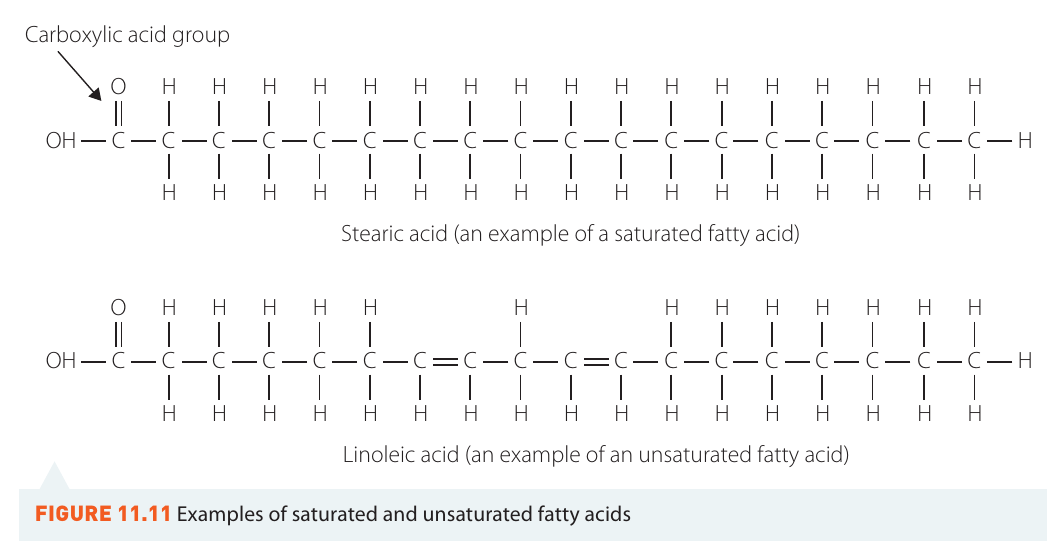
Fatty acids are long-chain carboxylic acids that form the building blocks of fats and oils. They have several key characteristics:
- Chain length: Usually contains an even number of carbon atoms (between 4 and 28)
- Carboxylic acid group: Contains a group at one end
- Saturation: Can be saturated or unsaturated
Note
Types of Fatty Acids
Saturated fatty acids contain only single bonds between carbon atoms. All available bonding positions are occupied by hydrogen atoms.
Unsaturated fatty acids contain one or more carbon-carbon double bonds (). These double bonds create "kinks" in the molecular structure, which affects the physical properties of the fats and oils.
Triglycerides structure
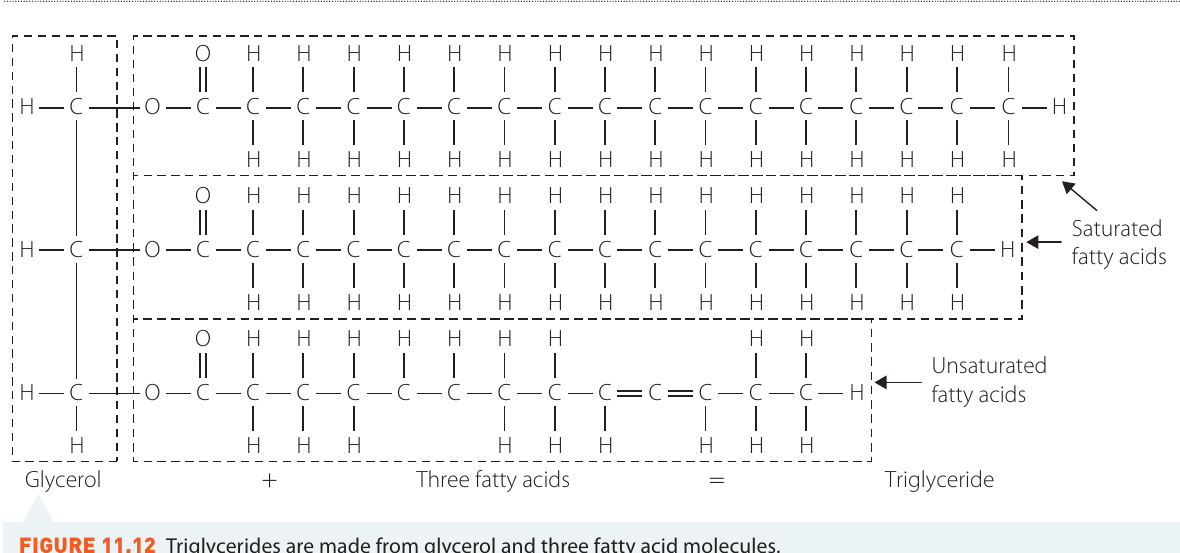
Triglycerides are the chemical form of fats and oils found in plants and animals. Each triglyceride molecule contains:
- One glycerol molecule (the backbone)
- Three fatty acid chains (attached to the glycerol)
Glycerol is an alcohol with three hydroxyl () groups. Its systematic chemical name is 1,2,3-propantriol, reflecting its three-carbon backbone with hydroxyl groups at positions 1, 2, and 3.
The three fatty acid chains in a triglyceride can be:
- All saturated
- All unsaturated
- A mixture of saturated and unsaturated
Diesel vs biodiesel composition
Diesel (petroleum-based) contains a range of alkanes with long hydrocarbon chains containing 8-21 carbon atoms. These are simple hydrocarbons with no functional groups.
Biodiesel is chemically similar to diesel but contains an ester functional group (). This ester group distinguishes biodiesel from petroleum diesel and gives it slightly different properties.
Production process: Transesterification
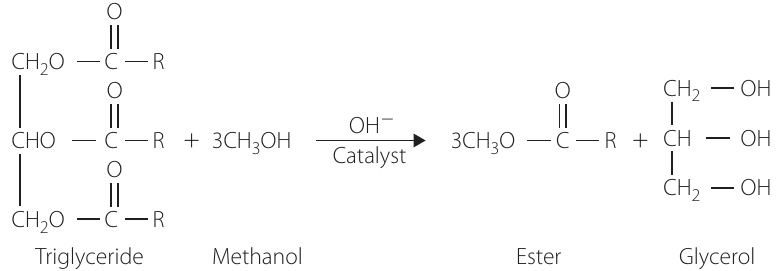
Biodiesel is produced through a chemical process called transesterification. This reaction converts triglycerides into esters (biodiesel) and glycerol.
Example
The Transesterification Reaction
Reactants:
- Triglycerides + short-chain alcohols (methanol or ethanol)
- Catalyst: Hydroxide ion ()
Products:
- Esters (biodiesel) + glycerol
Equation with methanol:
Where represents the fatty acid chain.
Separation of products: Once the reaction completes, the two products are separated by gravity. Glycerol is denser than biodiesel, so it settles to the bottom. The biodiesel floats on top and can be removed, purified, and used as fuel.
Catalysts in biodiesel production
A catalyst increases the reaction rate without being consumed. Three types of catalysts can be used:
- Acids
- Bases
- Enzymes (biological catalysts)
Note
Base Catalysts (most common):
- Usually sodium hydroxide () or potassium hydroxide ()
- Most economical option
- Achieves 98% conversion yield
- Requires only low temperatures
Disadvantages of base catalysts:
- Produces high temperatures (safety risk)
- Forms soap as a by-product (reduces ester yield)
- Makes glycerol purification expensive
Note
Enzyme Catalysts:
- Lipase (an enzyme that breaks down fats)
- Prevents soap formation
- Enables higher biodiesel yield
- More expensive to produce
Properties and performance
Energy content: Biodiesel combustion produces approximately 9% less energy than regular diesel. The exact value varies depending on the fats and oils used in production.
Fuel efficiency: When considering all factors (flash point, viscosity, heating values), there is little practical difference in fuel efficiency between biodiesel and regular diesel. Vehicles travel similar distances on biodiesel compared to petroleum diesel.
Vehicle use and modification
Low percentage blends:
- Biodiesel blends up to 20% can be used without vehicle modification
- No performance or maintenance issues
- Compatible with existing diesel engines
High percentage or pure biodiesel:
- 100% biodiesel requires engine modification
- Once modified, vehicles can run on pure biodiesel without issues
Applications: Biodiesel is increasingly tested and used in:
- Aircraft
- Trains
- Heavy vehicles
- Commercial fleets
Many manufacturers are developing engines specifically designed to accommodate high percentages of biodiesel.
Environmental benefits
Like bioethanol, biodiesel produces less net carbon dioxide than petroleum diesel. The carbon dioxide released during combustion was recently absorbed from the atmosphere through photosynthesis by the plants that produced the oils.
The overall net contribution comes primarily from the production and processing steps, not from combustion itself. This makes biodiesel substantially more environmentally friendly than fossil fuel diesel regarding greenhouse gas emissions.
Comparison of fuel types
Understanding the differences between fossil fuels and biofuels helps evaluate their respective advantages and disadvantages. The table below summarises key properties:
| Property | Fossil Fuels | Biofuels |
|---|---|---|
| Chemical composition | Coal () Natural gas (primarily ) Petrol/diesel (alkane chains of varying length) | Ethanol () Biodiesel (esters of varying chain length) |
| Source | Mining | Ethanol – agricultural crops (sugar cane, wheat, etc.) Biodiesel – fats and oils |
| Enthalpy of combustion () | Natural gas (53.6) Coal (9.8–27.9) Petrol (48) Crude oil (44.9–46.3) Diesel (42.6) | Biodiesel (37.2) Bioethanol (29.6) Values vary depending on source crops |
| Emission of | High net release during both production and use (combustion) | Lower net release during combustion since recently removed from atmosphere through photosynthesis Some release associated with production |
| Vehicle modification required | None | Modification needed for higher percentages of ethanol or biodiesel |
| Running costs | No modifications required Fuel more expensive than biofuels but similar to hydrogen | Ethanol – no modification required for up to 10% Fuel cheaper than regular petrol Biodiesel – no modification for up to 20% Modification required for 100% use Fuel cheaper than regular diesel |
Key comparison points
Energy content: Fossil fuels generally have higher energy content per unit mass than biofuels. Natural gas has the highest (), while bioethanol has the lowest ().
Environmental impact: Biofuels have a significant advantage in net emissions. The carbon cycle means that biofuel combustion releases carbon that was recently absorbed, whereas fossil fuels release carbon that has been locked away for millions of years.
Economic considerations: Biofuels are generally cheaper than their fossil fuel counterparts. However, some vehicle modifications may be required for higher blend percentages, which represents an initial investment cost.
Sustainability: Fossil fuels are finite resources that cannot be renewed on human timescales. Biofuels are renewable and can be produced continuously from agricultural sources.
Practical use: Both fuel types can be used effectively. Biofuels at low blend percentages require no vehicle changes, making them easy to adopt. Higher percentages offer greater environmental benefits but need technical modifications.
Summary
Key Points to Remember:
-
Fossil fuels form over millions of years from ancient organic matter and are non-renewable. They include coal, crude oil, and natural gas.
-
Biofuels are renewable fuels produced from contemporary organic sources like agricultural crops, algae, and animal waste. The main types are ethanol and biodiesel.
-
Ethanol is produced mainly through fermentation of crops and has a higher octane rating than petrol, though lower energy content. E10 fuel contains 10% ethanol and performs similarly to regular petrol.
-
Biodiesel is produced from fatty acids through transesterification, where triglycerides react with methanol or ethanol to form esters and glycerol. It can be used in blends up to 20% without vehicle modification.
-
Environmental benefits: Both ethanol and biodiesel produce 20-50% less net carbon dioxide than fossil fuels because the carbon released was recently absorbed through photosynthesis, not locked away for millions of years.
-
Energy comparison: Fossil fuels have higher energy content () than biofuels, but biofuels are renewable, cheaper, and more environmentally sustainable.