Combustion (HSC SSCE Chemistry): Revision Notes
📚Revision Notes
Combustion
Introduction to alcohol combustion
Alcohols are versatile organic compounds with numerous applications in both everyday life and industry. One increasingly important use is as a fuel additive. When you visit a petrol station, you may notice E10 fuel, which contains ethanol mixed with petrol.
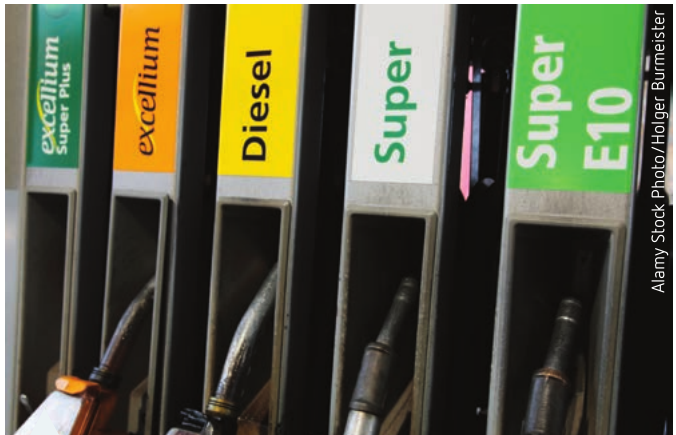
Note
Ethanol offers several key advantages as a fuel additive:
- It burns more cleanly than hydrocarbon fuels alone
- It comes from renewable sources through crop fermentation
- It provides a more affordable fuel option
The combustion of alcohols follows similar patterns to hydrocarbon fuels, releasing energy that can be harnessed for practical purposes.
Complete combustion of alcohols
When alcohols burn in sufficient oxygen, they undergo complete combustion. This reaction produces carbon dioxide gas, liquid water, and releases significant amounts of energy.
For ethanol, the complete combustion reaction is:
This reaction releases approximately 1370 kJ per mole of ethanol burned. All combustion reactions are exothermic, meaning they release heat energy to the surrounding environment.
Incomplete combustion of alcohols
When insufficient oxygen is available, alcohols undergo incomplete combustion. This produces harmful products including carbon monoxide gas and solid carbon (soot), whilst releasing considerably less energy than complete combustion.
For ethanol, incomplete combustion follows this reaction:
Important
Why Incomplete Combustion is Dangerous
The reduced energy output and production of toxic carbon monoxide make incomplete combustion highly undesirable. Soot deposits can also damage equipment and reduce efficiency. Always ensure adequate ventilation and oxygen supply when burning fuels.
Understanding enthalpy of combustion
Enthalpy of combustion () measures the heat energy released when exactly one mole of fuel burns completely in excess oxygen at standard atmospheric pressure. This standardised measurement allows us to compare different fuels fairly.
Note
Key Characteristics of Enthalpy of Combustion:
- Always measured under complete combustion conditions with excess oxygen present
- Water produced must be in liquid form (not steam)
- The value is always negative because combustion reactions release heat
- Expressed in units of
Specific heat capacity and calorimetry
To measure enthalpy of combustion, we use an indirect method based on heating water. The specific heat capacity () of a substance tells us how much energy is needed to raise the temperature of one gram of that substance by one degree Celsius.
For water, the specific heat capacity is:
The heat energy absorbed or released () can be calculated using:
Where:
- = mass of the substance being heated (in grams)
- = specific heat capacity of the substance ()
- = change in temperature (final temperature - initial temperature)
Calorimetry is the scientific process of measuring heat changes during chemical reactions.
Experimental measurement of enthalpy
Because directly measuring the heat from burning fuel is difficult, scientists use an indirect approach based on the law of conservation of energy. A known mass of water is heated by the burning fuel, and we measure the temperature change in the water.
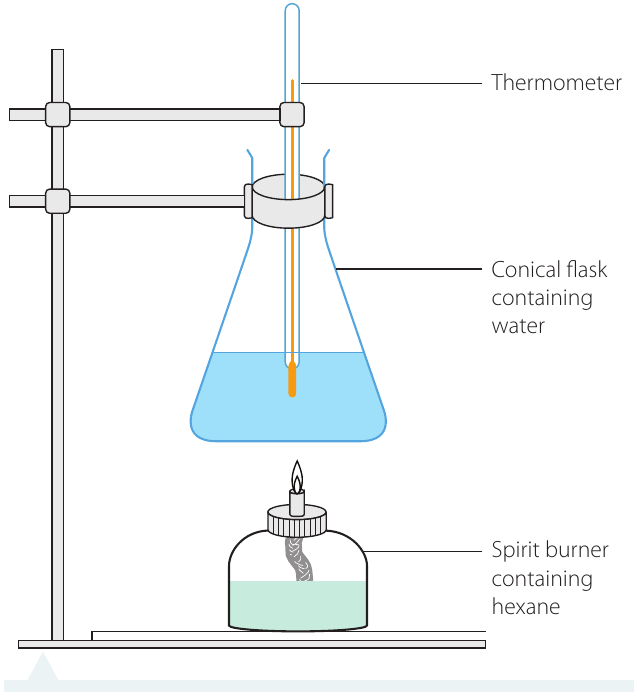
The experimental setup typically includes:
- A spirit burner containing the alcohol fuel
- A conical flask or beaker holding a measured mass of water
- A thermometer to monitor temperature changes
- Clamps and stands to position the glassware safely above the flame
By calculating the heat absorbed by the water, we can determine the heat released by the fuel, since energy cannot be created or destroyed (conservation of energy principle).
Worked example: calculating enthalpy of combustion
Example
Worked Example: Calculating Enthalpy of Combustion of Ethanol
Given information:
- Mass of water:
- Initial water temperature:
- Final water temperature:
- Initial mass of spirit burner + ethanol:
- Final mass of spirit burner + ethanol:
Step 1: Calculate the mass of fuel burned
Step 2: Calculate the temperature change
Step 3: Calculate heat absorbed by water
Using :
By conservation of energy, the heat absorbed by water equals the heat released by the fuel.
Step 4: Calculate moles of ethanol burned
First, find the molar mass of ethanol ():
Then calculate moles:
Step 5: Calculate enthalpy of combustion
Since combustion releases heat, we express this as:
Sources of experimental error
Enthalpy values measured using simple calorimetric experiments are typically very inaccurate, often producing results 80% lower than theoretical values. These are systematic errors that consistently affect results in the same direction.
Important
Major Sources of Error in Calorimetric Experiments:
-
Heat loss to surroundings: Much of the heat from combustion doesn't reach the water. Energy is lost to:
- The air surrounding the apparatus
- Glassware and equipment (beaker, thermometer, clamps)
- The spirit burner itself This results in lower temperature rises and underestimated enthalpy values.
-
Incomplete combustion: The fuel burns in air (approximately oxygen) rather than pure excess oxygen. Incomplete combustion produces less energy per mole and is often evidenced by soot deposits on glassware.
-
Heat loss from water: During the experiment, heat escapes from the water surface to the atmosphere. Using a lid can minimise this loss.
-
Fuel evaporation: Alcohols have low boiling points, so some fuel evaporates from the wick without burning. This evaporated fuel is incorrectly counted as combusted, increasing the calculated moles of fuel and reducing the calculated enthalpy.
Comparing energy values for different fuels
Energy per gram of fuel
In everyday situations, we don't purchase fuel by the mole. For liquid fuels like petrol, we buy litres; for solid fuels, we buy kilograms. Converting enthalpy values to these practical units allows meaningful comparisons.
To calculate heat released per gram:
Example
Worked Example: Calculating Energy per Gram for Ethanol
Given: and
Note: We omit the negative sign when specifically discussing heat released by combustion.
Energy per litre of fuel
To convert to heat released per litre, we must also consider the fuel's density:
Example
Worked Example: Calculating Energy per Litre for Ethanol
Given: , , and density
Step 1: Convert density to :
Step 2: Calculate heat released per litre:
Comparison of different alcohols
The following table compares five different alcohol fuels, showing how energy values differ depending on the measurement units used:
| Fuel | Enthalpy of combustion () | Heat released per gram () | Heat released per litre () |
|---|---|---|---|
| Methanol | |||
| Ethanol | |||
| 1-propanol | |||
| 1-butanol | |||
| 1-pentanol |
Note
Important Observation:
The enthalpy of combustion for 1-pentanol is 4.5 times greater than methanol when measured per mole, but only 1.7 times greater when measured per gram. This demonstrates why comparing fuels in practical units (per gram or per litre) is more meaningful for real-world applications.
Summary
Summary
Key Points to Remember:
-
Complete combustion of alcohols produces carbon dioxide and water, releasing maximum energy. Incomplete combustion produces carbon monoxide and soot, releasing less energy.
-
Enthalpy of combustion () is the heat energy released when one mole of fuel burns completely in excess oxygen at standard pressure. It is always negative for combustion reactions.
-
Calorimetric experiments measure enthalpy indirectly by heating water and measuring temperature changes using . The specific heat capacity of water is 4.18 .
-
Experimental enthalpy values are typically very inaccurate due to systematic errors including heat loss to surroundings, incomplete combustion, evaporation of fuel, and heat loss from water.
-
Fuels can be compared using different units: per mole (chemical comparisons), per gram (mass-based comparisons), or per litre (volume-based comparisons for liquid fuels). The ranking of fuels changes depending on which unit is used.