Dehydration and Substitution with Hydrogen Halides (HSC SSCE Chemistry): Revision Notes
📚Revision Notes
Dehydration and Substitution with Hydrogen Halides
Introduction
Alcohols can undergo two important types of reactions: dehydration and substitution. In dehydration reactions, alcohols lose water molecules to form alkenes. In substitution reactions with hydrogen halides, the hydroxyl group () is replaced by a halogen atom. Understanding these reactions is essential for organic chemistry, as they allow us to convert alcohols into other useful organic compounds.
Note
These two reaction types are fundamental transformations in organic chemistry. Dehydration produces alkenes (compounds with double bonds), while substitution with hydrogen halides creates alkyl halides (organic compounds containing halogens). Both reactions are widely used in synthetic chemistry to prepare different organic compounds from readily available alcohols.
Dehydration of alcohols
When alcohols are heated with concentrated sulfuric acid () or phosphoric acid (), they undergo dehydration. During this process, a water molecule is removed from the alcohol, and an alkene is formed.
Important
Not all acids will cause dehydration of alcohols. Concentrated sulfuric acid and phosphoric acid are specifically used because they are strong dehydrating agents. Other acids may not have the same effect.
Dehydration reaction example
Let's look at the dehydration of 2-butanol:
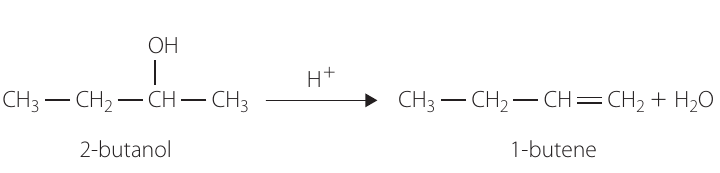
In this reaction, 2-butanol loses a water molecule to form 1-butene. The reaction requires heat and an acid catalyst (indicated by ).
Alternative products
Note
In the example above, it's also possible for 2-butene to form instead of 1-butene. The specific product that forms is not determined by chance. However, the reasons why one product is favoured over another are beyond the scope of the SSCE course. Just remember that multiple products may be possible in dehydration reactions depending on the alcohol's structure.
Alternative dehydration method
There is another way to dehydrate alcohols that doesn't require liquid acids. This method involves passing gaseous ethanol over heated aluminium oxide () powder. In this process:
- The aluminium oxide acts as a catalyst
- The ethanol undergoes cracking (breaking apart)
- Ethene and water vapour are produced
This catalytic method is particularly useful for producing ethene from ethanol on an industrial scale.
Substitution with hydrogen halides (HX)
When alcohols react with a hydrogen halide (), such as hydrogen chloride () or hydrogen bromide (), a substitution reaction takes place. In this reaction, the hydroxyl group () is replaced by a halogen atom (), forming an alkyl halide and water.
General substitution equation
The general equation for this reaction is:
Where:
- represents an alkyl group (hydrocarbon chain)
- represents a halogen (F, Cl, Br, or I)
Example reaction
Example
Worked Example: Substitution of 2-methyl-2-propanol with HCl
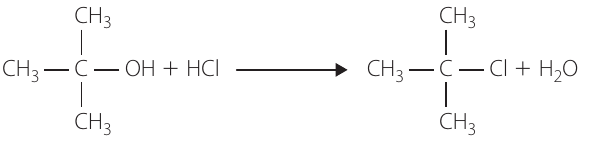
In this reaction:
- 2-methyl-2-propanol (a tertiary alcohol) reacts with
- The hydroxyl group is replaced by a chlorine atom
- The products are 2-chloro-2-methylpropane (an alkyl halide) and water
This demonstrates a typical substitution reaction where the group is completely replaced by a halogen atom.
Classification of alcohols
To understand the reactivity patterns in substitution reactions, we need to classify alcohols. Alcohols are categorised as primary, secondary, or tertiary based on the number of carbon atoms attached to the carbon bearing the group:
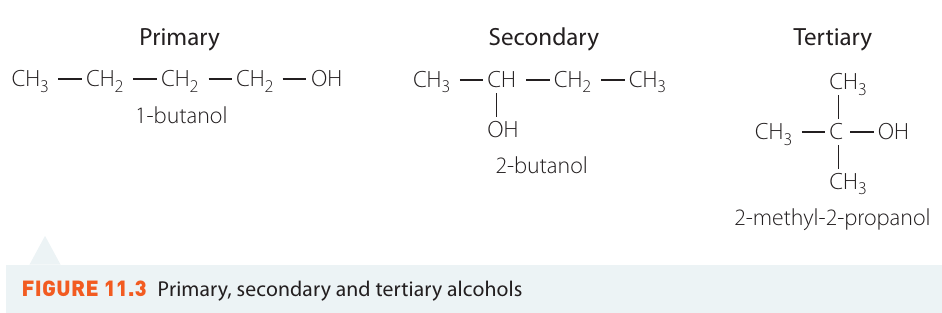
- Primary () alcohol: The carbon with the group is attached to one other carbon (e.g., 1-butanol)
- Secondary () alcohol: The carbon with the group is attached to two other carbons (e.g., 2-butanol)
- Tertiary () alcohol: The carbon with the group is attached to three other carbons (e.g., 2-methyl-2-propanol)
Reactivity of alcohols with hydrogen halides
Important
The reactivity of alcohols in substitution reactions follows a clear pattern:
Tertiary > Secondary > Primary
This means:
- Tertiary alcohols are most reactive and undergo very fast reactions with hydrogen halides
- Secondary alcohols are moderately reactive
- Primary alcohols are least reactive
- Methanol () is particularly difficult to react with hydrogen halides
Exam tip: Remember the reactivity order using "3-2-1": tertiary () alcohols are most reactive, followed by secondary (), then primary ().
Reactivity of hydrogen halides
The reactivity of hydrogen halides in this reaction also follows a pattern based on their position in the halogen group:
HI > HBr > HCl > HF
Note
Understanding Halide Reactivity
- Hydrogen iodide () is the most reactive hydrogen halide
- Reactivity decreases as you move up the halogen group
- Hydrogen fluoride () is very difficult to react with alcohols
Exam tip: Remember "Down and Dangerous" - as you go down the halogen group, the hydrogen halides become more reactive.
Summary
Key Points to Remember:
- Dehydration removes water from alcohols to form alkenes, requiring concentrated or and heat, or alternatively heated catalyst
- Substitution with HX replaces the group with a halogen atom, forming an alkyl halide and water:
- Alcohol reactivity order with HX: tertiary > secondary > primary (methanol is least reactive)
- Hydrogen halide reactivity order: HI > HBr > HCl > HF (increases down the halogen group)
- Multiple products may form in dehydration reactions depending on the alcohol's structure