Oxidation (HSC SSCE Chemistry): Revision Notes
📚Revision Notes
Oxidation
Introduction to oxidation of alcohols
Alcohols can readily undergo oxidation reactions when treated with strong oxidising agents. The specific products formed depend on the type of alcohol being oxidised—whether it's primary, secondary, or tertiary. Understanding how different alcohols behave during oxidation is essential for predicting reaction outcomes and identifying unknown alcohols.
The oxidation process involves the loss of hydrogen atoms from the alcohol molecule. Different types of alcohols have different numbers of hydrogen atoms attached to the carbon bearing the hydroxyl group (), which determines their oxidation behaviour.
Note
The number of hydrogen atoms attached to the carbon bearing the group is the key factor that determines how an alcohol will behave during oxidation. This structural difference explains why primary, secondary, and tertiary alcohols produce different products.
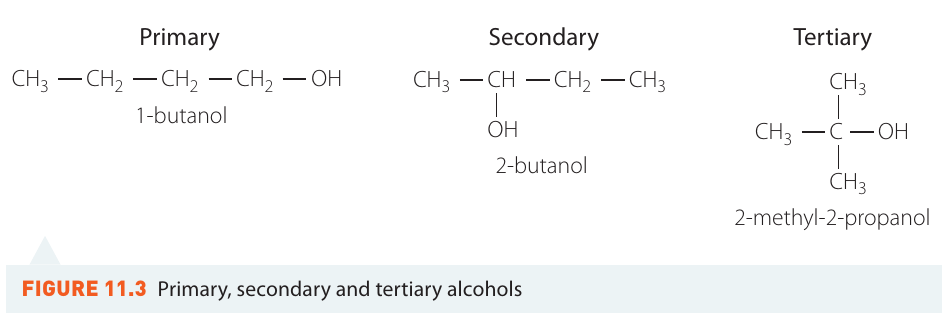
Common oxidising agents
Two main oxidising agents are commonly used to oxidise alcohols in laboratory conditions:
- Acidified permanganate ion solution ()
- Acidified dichromate ion solution ()
Both of these solutions act as strong oxidising agents, meaning they readily accept electrons and become reduced themselves whilst oxidising the alcohol.
Redox half reactions
When these oxidising agents react, they undergo reduction according to the following half equations:
Permanganate reduction:
Dichromate reduction:
Note
These half equations show that the oxidising agents gain electrons (are reduced) whilst the alcohol loses electrons (is oxidised). This is a classic example of a redox reaction where reduction and oxidation occur simultaneously. The acid conditions ( ions) are necessary for these reactions to proceed.
Oxidation of primary alcohols
Primary alcohols undergo a two-step oxidation process. First, they are oxidised to form aldehydes, and these aldehydes can then be further oxidised to form carboxylic acids. This progressive oxidation makes primary alcohols quite versatile in organic synthesis.

The general oxidation pathway shows that a primary alcohol () first loses hydrogen to become an aldehyde (), which can then lose more hydrogen to become a carboxylic acid ().
Example: oxidation of ethanol
Example
Worked Example: Oxidation of Ethanol
Let's examine the oxidation of ethanol () using acidified potassium dichromate as the oxidising agent. This reaction occurs in two stages.
Stage 1: Ethanol to ethanal
Stage 2: Ethanal to ethanoic acid
Overall reaction: Ethanol to ethanoic acid
Adding these two equations together gives the complete oxidation:

Writing oxidation equations
In organic chemistry, these reactions can also be written using structural formulas with reaction conditions shown above the arrow. You should be comfortable writing equations in both full balanced form (as shown above) and in condensed organic notation where only the organic molecules are shown with conditions indicated.
Collecting aldehydes by distillation
Important
An important consideration when oxidising primary alcohols is that aldehydes are easily oxidised further to carboxylic acids. If you want to obtain the aldehyde as your final product, you need to remove it from the reaction mixture as soon as it forms, before it can be oxidised again.
This is achieved using a distillation setup where the aldehyde is removed as it forms.
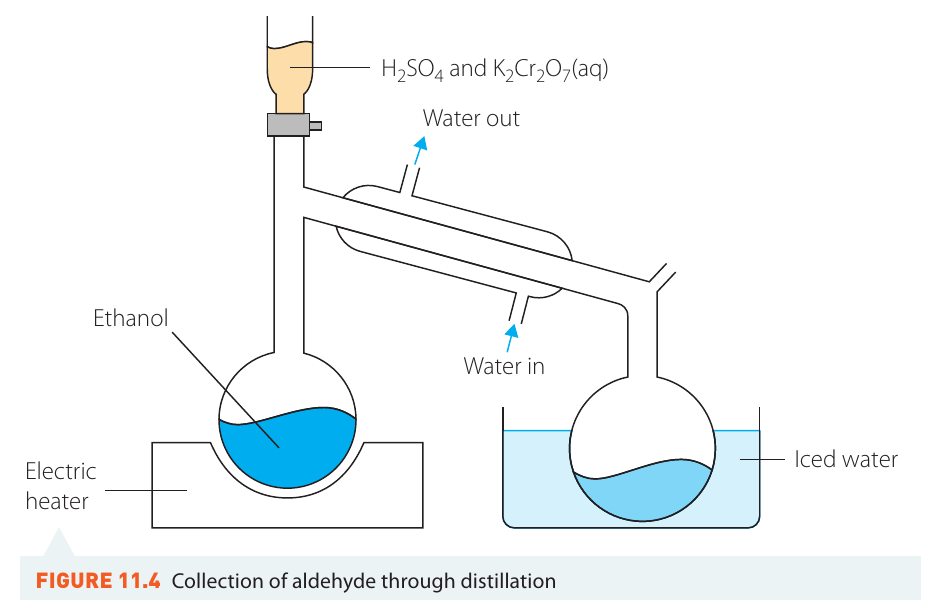
The distillation process works as follows:
- Ethanol is heated in a round-bottom flask using an electric heater until the temperature is just above the boiling point of the aldehyde product (ethanal)
- Acidified dichromate solution is added drop by drop from a funnel at the top
- As each drop of dichromate meets the hot ethanol, oxidation occurs immediately to form ethanal
- Because the mixture temperature is above ethanal's boiling point but below ethanol's boiling point, the ethanal immediately vaporises and rises up through the condenser
- The ethanal vapour is cooled by the water-cooled condenser and collected in a flask sitting in iced water
- Since the ethanal is removed immediately from the oxidising agent, it cannot undergo further oxidation to ethanoic acid
Note
This technique is essential for preparing aldehydes in the laboratory, as leaving the aldehyde in contact with excess oxidising agent will result in complete oxidation to the carboxylic acid.
Oxidation of secondary alcohols
Secondary alcohols undergo oxidation to form ketones. Unlike aldehydes formed from primary alcohols, ketones cannot be oxidised further under normal laboratory conditions. This means the oxidation of a secondary alcohol is a one-step process with the ketone as the final product.
Both acidified permanganate and dichromate ions can oxidise secondary alcohols effectively. The general reaction shows a secondary alcohol being converted to a ketone, with no further oxidation possible.
Example: oxidation of 2-propanol
Example
Worked Example: Oxidation of 2-Propanol
The oxidation of 2-propanol to propanone (acetone) using acidified permanganate is shown below:
The ketone produced (propanone) is stable and will not react further with the oxidising agent, making it straightforward to prepare ketones from secondary alcohols without needing special distillation apparatus.
Oxidation of tertiary alcohols
Tertiary alcohols cannot be oxidised under normal laboratory conditions. Understanding why this occurs requires examining the structural differences between alcohol types.
Why tertiary alcohols resist oxidation
Important
Why Tertiary Alcohols Resist Oxidation
In primary and secondary alcohols, oxidation involves removing a hydrogen atom from the carbon that is bonded to the hydroxyl group. This process requires breaking a carbon-hydrogen () bond, which is relatively easy to break.
However, in tertiary alcohols, the carbon attached to the hydroxyl group has no hydrogen atoms—it is bonded to three other carbon atoms instead. Oxidising a tertiary alcohol would require breaking a carbon-carbon () bond, which needs significantly more energy than breaking a bond.
Under standard oxidation conditions, sufficient energy is not available to break these stronger bonds, so tertiary alcohols remain unreacted.
Extremely harsh conditions (high temperatures and very strong oxidising agents) could potentially break down the carbon skeleton, but this is not a useful synthetic reaction.
Distinguishing types of alcohols using oxidation
The different oxidation behaviours of primary, secondary, and tertiary alcohols provide a practical method for identifying unknown alcohol types in the laboratory. This identification relies on observing colour changes in the oxidising agents used.
Using dichromate ions
When acidified dichromate solution is used as the oxidising agent, a distinctive colour change occurs during oxidation reactions:
- Dichromate ions () are orange in colour
- Chromium(III) ions () formed after reduction are green in colour
Note
Observations:
- Primary alcohols: Orange solution turns green as oxidation proceeds
- Secondary alcohols: Orange solution turns green as oxidation proceeds
- Tertiary alcohols: Solution remains orange—no colour change occurs
It's important to note that the colour change comes from the oxidising agent (dichromate), not from the alcohols themselves, which are all colourless. The appearance of green colour indicates that oxidation has occurred, whilst no colour change shows that the alcohol has not been oxidised.
Using permanganate ions
Acidified permanganate solution can also be used, though it is somewhat less reliable:
- Permanganate ions () are purple in colour
- Manganese(II) ions () formed after reduction are colourless
Under acidic conditions, the purple permanganate solution should turn colourless when it oxidises an alcohol. However, in practice, a brown colour is sometimes seen due to formation of manganese dioxide (), which makes this test less reliable than the dichromate test for classroom use.
Important
Exam tip: The dichromate test is preferred for distinguishing alcohol types because of its clear and consistent colour change from orange to green. Make sure you can explain that the colour change is due to the oxidising agent being reduced, not due to the alcohol itself.
Investigation: oxidation of alcohols
Students can investigate the oxidation of different alcohol types by testing primary, secondary, and tertiary alcohols with both permanganate and dichromate oxidising agents. This practical investigation allows you to observe the colour changes described above and compare how different alcohols behave.
Safety considerations for this investigation:
Important
Laboratory Safety Precautions
When conducting oxidation investigations in the laboratory, several important safety precautions must be followed:
- Sodium dichromate is toxic and should be handled with appropriate personal protective equipment (gloves, safety glasses)
- All chemicals should be used in a fume cupboard to avoid inhaling harmful vapours
- Concentrated sulfuric acid is highly corrosive and should be dispensed by a teacher
- Alcohols are flammable and must be kept away from flames and hot equipment
- Waste materials should be disposed of properly in designated waste containers, not down the sink
The investigation typically involves adding small amounts of acidified oxidising agent to samples of different alcohols in test tubes, warming them gently in a water bath, and observing any colour changes over several minutes.
Remember!
Summary
Key Points to Remember:
-
Primary alcohols oxidise in two stages: first to aldehydes, then to carboxylic acids. Aldehydes can be isolated by distillation if removed immediately as they form.
-
Secondary alcohols oxidise to ketones, which cannot be further oxidised under normal conditions, making this a straightforward one-step process.
-
Tertiary alcohols resist oxidation under standard laboratory conditions because oxidation would require breaking strong bonds rather than weaker bonds.
-
Colour changes with oxidising agents provide a practical test: acidified dichromate changes from orange to green when oxidation occurs, whilst tertiary alcohols cause no colour change.
-
Common oxidising agents include acidified dichromate () and acidified permanganate (), both of which require acidic conditions to function effectively.