Alcohols (HSC SSCE Chemistry): Revision Notes
📚Revision Notes
Alcohols
Introduction to alcohols
Alcohols are a family of organic compounds characterised by the presence of a hydroxyl group (). This hydroxyl group is the functional group that defines alcohols and gives them their distinctive properties.
Note
All alcohols follow the general formula: , where represents any alkyl group (hydrocarbon chain). More specifically, alcohols have the molecular formula .
The simplest alcohol is methanol (), also called methyl alcohol. The next member of the series is ethanol (), also known as ethyl alcohol.

Uses of ethanol
Ethanol is one of the most widely used carbon compounds. Its main applications include:
- Alcoholic beverages (wine, beer, spirits)
- Fuel additive for petrol or as an alternative vehicle fuel
- Solvent in medicines, antiseptics, and household cleaners
- Industrial reactant and solvent for manufacturing plastics, adhesives, pharmaceuticals, and perfumes
Naming alcohols
The naming of alcohols follows similar conventions to alkanes and other hydrocarbons. The process involves these steps:
Step 1: Identify the longest continuous carbon chain. This becomes your parent chain. Use the standard stems (meth-, eth-, prop-, but-, etc.).
Step 2: Remove the final 'e' from the alkane name and add 'ol'. For example:
- Butane becomes butanol
- Ethane becomes ethanol
- Hexane becomes hexanol
Step 3: Number the carbon chain to give the hydroxyl group the lowest possible position number. Place this number before the alcohol name. For example, if the group is on the second carbon of butanol, the name becomes -butanol.
Step 4: Name and number any substituents (branches) using the same rules as for hydrocarbons. List substituents alphabetically in the final name.
Worked example: naming an alcohol
Example
Worked Example: Naming an Alcohol Systematically
Let's name the following alcohol:
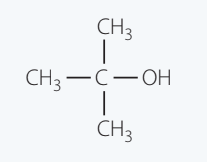
Step 1: Identify the longest chain: three carbons = propane
Step 2: Convert to alcohol: propanol
Step 3: Position the group: -propanol
Step 4: Add substituents: -methyl
Step 5: Combine for the final name: 2-methyl-2-propanol
Isomerism in alcohols
Alcohols exhibit isomerism just like other hydrocarbon families. Isomers are molecules with the same molecular formula but different structural arrangements.
Positional isomers
Positional isomers occur when the carbon skeleton remains the same but the position of the hydroxyl group changes.
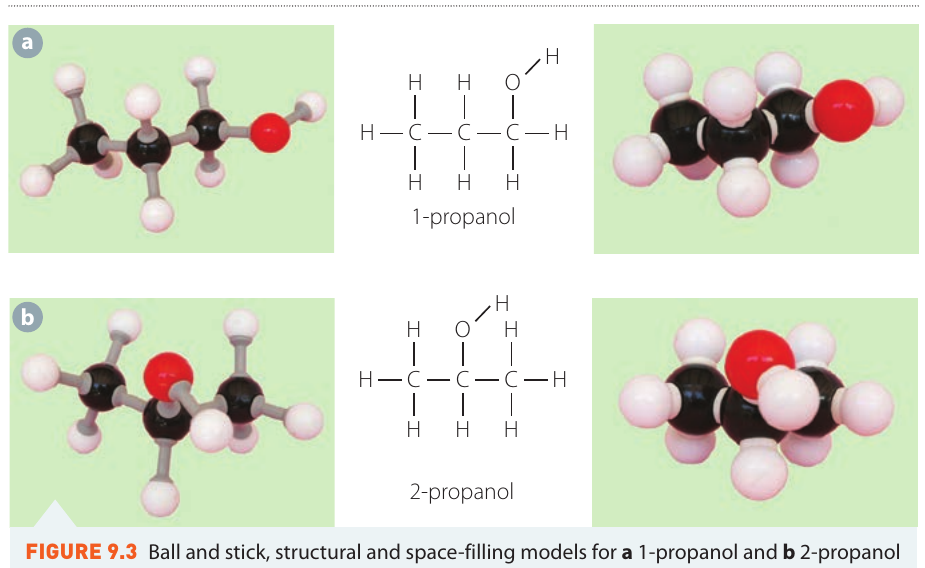
Note
For example, -propanol and -propanol are positional isomers. Both have the molecular formula , but the group is located on different carbon atoms. The only difference is the position of the functional group along the carbon chain.
Chain isomers
Chain isomers result from rearranging the carbon skeleton itself whilst maintaining the same molecular formula.
-methyl--butanol is a chain isomer of -pentanol (the carbon chain has been shortened and branched), whilst -pentanol is a positional isomer of -pentanol (the group has moved position).
Classification of alcohols
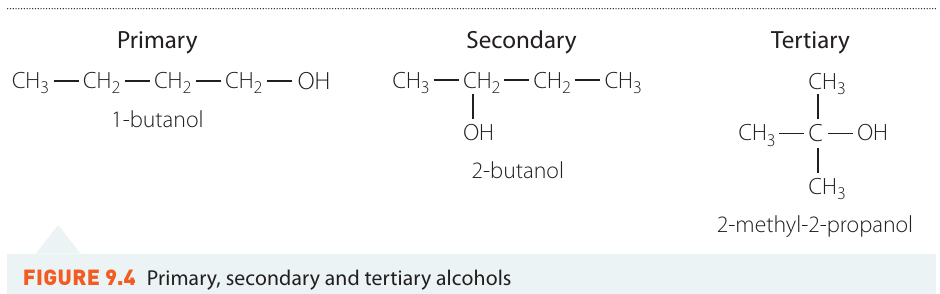
Alcohols can be classified into three types based on how many carbon atoms are attached to the carbon bearing the hydroxyl group.
Primary alcohols
A primary alcohol has only one carbon atom bonded to the carbon that carries the group. The carbon with the hydroxyl group is attached to one other carbon and two hydrogen atoms.
Example: -butanol
Secondary alcohols
A secondary alcohol has two carbon atoms bonded to the carbon that carries the group. The carbon with the hydroxyl group is attached to two other carbons and one hydrogen atom.
Example: -butanol
Tertiary alcohols
A tertiary alcohol has three carbon atoms bonded to the carbon that carries the group. The carbon with the hydroxyl group is attached to three other carbons and no hydrogen atoms.
Example: -methyl--propanol
Important
Understanding Alcohol Classification
These three types of alcohols have different chemical reactivity and physical properties due to the different positions of the hydroxyl group. Understanding this classification is important for predicting alcohol behaviour in reactions and for exam questions about alcohol properties.
Physical properties of alcohols
The hydroxyl group in alcohols contains a highly electronegative oxygen atom, making the and bonds very polar. This polarity, combined with the non-polar hydrocarbon chain, determines the physical properties of alcohols.
Two key factors influence alcohol properties:
- The presence of the group (capable of forming hydrogen bonds)
- The size of the hydrocarbon chain
Boiling points
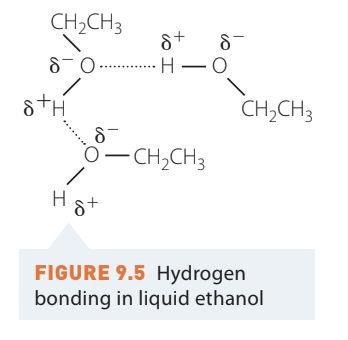
The boiling point of an organic compound depends on the energy needed to overcome intermolecular forces between molecules. Unlike alkanes, alkenes, and alkynes (which only form weak dispersion forces), alcohols can form hydrogen bonds.
Note
Understanding Hydrogen Bonding
Hydrogen bonding occurs when the partially positive hydrogen atom () of one hydroxyl group is attracted to the partially negative oxygen atom () of another hydroxyl group. This forms a strong intermolecular force shown by dotted lines in the diagram.
Hydrogen bonds are much stronger than dispersion forces. This means alcohols have significantly higher boiling points than alkanes, alkenes, and alkynes of similar molecular weight.
Comparison with alkanes
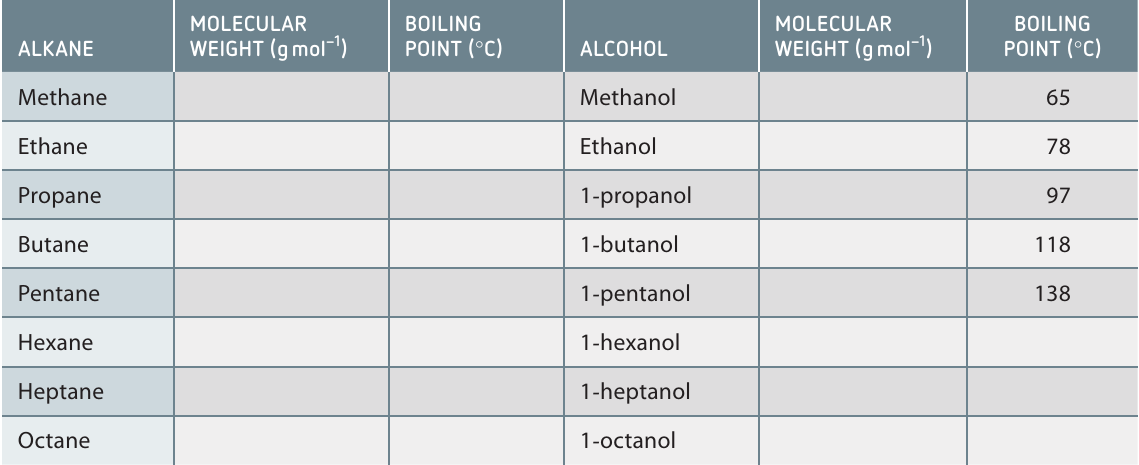
Consider butane and -butanol. Both have similar length carbon chains, so dispersion forces are approximately equal. However, -butanol also forms hydrogen bonds, requiring much more energy to separate the molecules. Therefore, -butanol has a much higher boiling point than butane.
Trend within the alcohol series
As the carbon chain length increases within the alcohol homologous series, the boiling point also increases. This occurs because:
- Larger molecules have more electrons
- More electrons create stronger dispersion forces between hydrocarbon chains
- More energy is needed to overcome these additional forces
Note
The table shows boiling points increasing progressively from methanol () through to -pentanol (). This gradual increase demonstrates the impact of chain length on intermolecular forces.
Solubility in water
Alcohol solubility depends on the balance between:
- The polar hydroxyl group (water-soluble)
- The non-polar hydrocarbon chain (water-insoluble)
The polar group can form hydrogen bonds with water molecules, promoting solubility. The non-polar hydrocarbon chain cannot form hydrogen bonds with water, reducing solubility.
Small alcohols
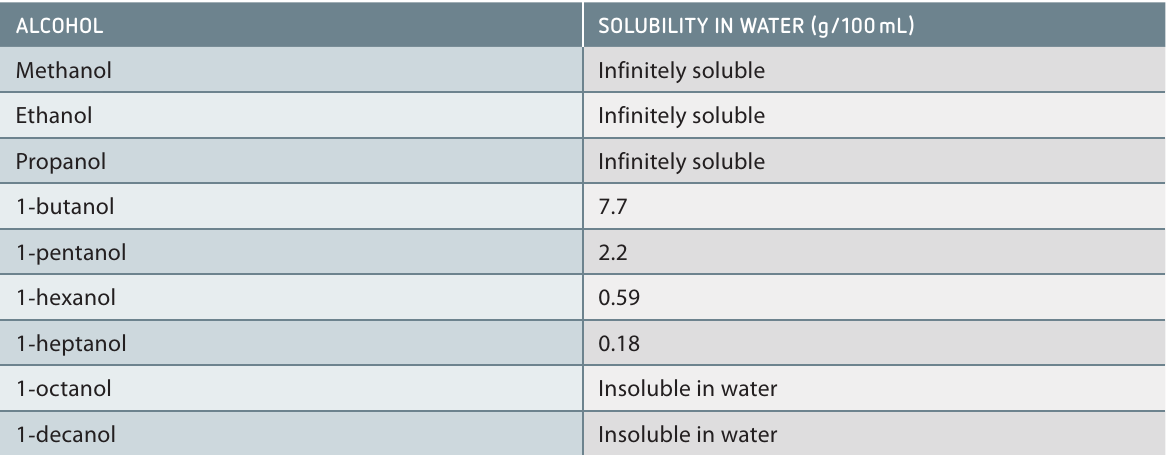
For smaller alcohols like methanol, ethanol, and propanol, the effect of the polar hydroxyl group dominates. These alcohols are infinitely soluble in water.
Larger alcohols
As the hydrocarbon chain increases in size, its non-polar effect begins to outweigh the polar effect of the single hydroxyl group. This makes larger alcohols progressively less soluble:
- -butanol:
- -pentanol:
- -hexanol:
Very large alcohols like -octanol and -decanol become insoluble in water.
Multiple hydroxyl groups
Some large molecules remain water-soluble despite having a large hydrocarbon chain. This occurs when the molecule contains multiple hydroxyl groups, multiplying the effect of the polar functional group.
Example
Worked Example: Glucose Solubility
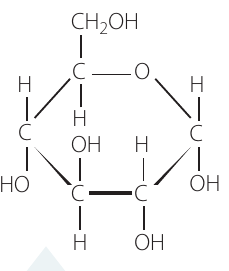
Glucose () is an excellent example. Despite its high molecular mass (), glucose is very soluble in water.
Reason: Glucose contains five hydroxyl groups. The combined effect of these groups outweighs the large hydrocarbon framework, making the molecule highly polar and water-soluble.
Important
Predicting Alcohol Solubility
When predicting solubility, count the number of hydroxyl groups and assess the carbon chain length:
- More groups = more soluble
- Longer carbon chain = less soluble
The balance between these factors determines whether an alcohol will dissolve in water.
Investigation: Solubility of alcohols
Aim
To investigate how alcohol solubility changes with increasing carbon chain length.
Safety considerations
Important
Important Safety Notes
- Wear gloves, safety glasses, and a lab coat at all times
- Work in a fume cupboard or well-ventilated area
- Use small volumes of alcohols
- Keep chemical containers closed when not in use
- Handle organic compounds carefully to avoid skin contact and fume inhalation
Method summary
- Label six test tubes (-) corresponding to the number of carbons in each alcohol
- Add deionised water and two drops of food colouring to each tube
- Add of the appropriate alcohol to each tube
- Observe and photograph any layers that form
- Add another of alcohol and note any changes
Key observations
The investigation reveals that:
- Short-chain alcohols (methanol, ethanol, propanol) mix completely with water
- Medium-chain alcohols show partial solubility
- Long-chain alcohols form separate layers (immiscible)
Note
This pattern demonstrates how increasing hydrocarbon chain length reduces water solubility, as the non-polar portion of the molecule becomes more significant. The visual formation of layers provides clear evidence of the changing solubility trend.
Remember!
Summary
Key Points to Remember:
-
Alcohols contain a hydroxyl functional group () with the general formula
-
Alcohols are named by replacing the 'e' in the alkane name with 'ol', and numbering the position of the group
-
Alcohols are classified as primary, secondary, or tertiary based on how many carbons are attached to the carbon bearing the group
-
Hydrogen bonding between alcohol molecules causes significantly higher boiling points compared to similar-sized alkanes
-
Short-chain alcohols are water-soluble due to hydrogen bonding with water, but solubility decreases as the carbon chain lengthens