Carboxylic Acids (HSC SSCE Chemistry): Revision Notes
📚Revision Notes
Carboxylic Acids
Introduction
Carboxylic acids are important organic compounds found throughout nature and used in many synthetic applications. You'll encounter them in everyday substances and biological systems.
Note
Natural examples of carboxylic acids in everyday life:
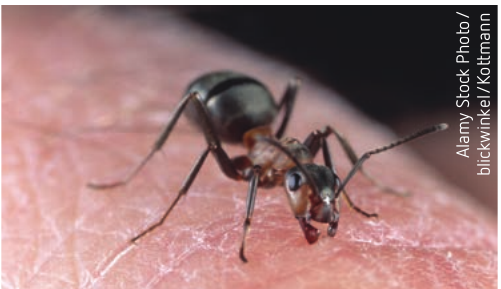
- Methanoic acid (formic acid) - injected by ants when they bite, causing the stinging sensation
- Ethanoic acid (acetic acid) - the main component giving vinegar its sour taste and smell
- Propanoic acid - found in cheese
- Butanoic acid - present in spoiled butter, responsible for its rancid smell
- Citric acid - abundant in citrus fruits like lemons and oranges
- Lactic acid - found in milk and dairy products, also produced in muscles during exercise
Many carboxylic acids have strong, often unpleasant odours, particularly as the carbon chain length increases.
Synthetic applications: Manufacturers use carboxylic acids to produce soap, certain plastics, pharmaceuticals, and herbicides. These compounds serve as important building blocks in chemical industry.
Structure of the carboxyl functional group
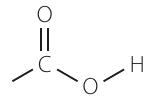
Carboxylic acids are defined by the presence of the carboxyl functional group (-COOH), which must be located at the terminal (end) carbon of the molecule.
Important
Although the carboxyl group appears to contain both a carbonyl (C=O) and a hydroxyl (-OH) group, when these are bonded together in this specific arrangement, they form a single functional group with unique properties. The carboxyl group behaves differently from isolated carbonyl or hydroxyl groups.
The general molecular formula for carboxylic acids is:
where represents the number of carbon atoms in the alkyl chain (not including the carboxyl carbon).
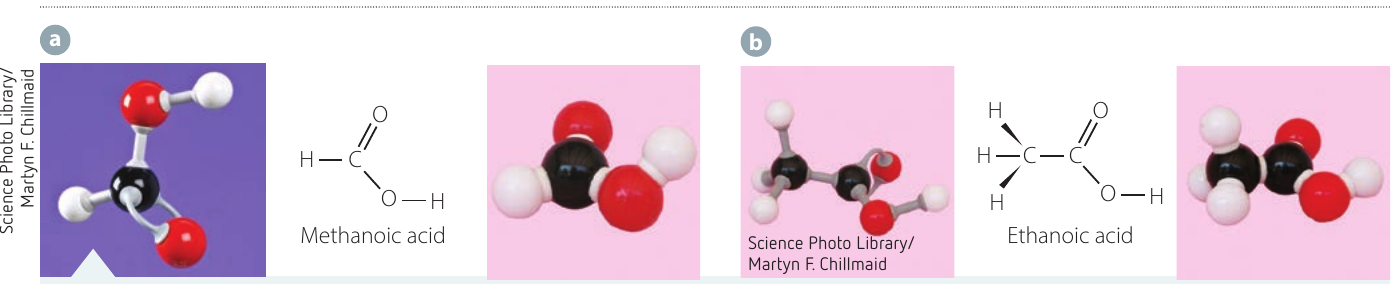
The simplest carboxylic acids are methanoic acid (containing one carbon) and ethanoic acid (containing two carbons). These structures show both the 2D structural formulas and 3D molecular models, helping you visualise the actual shape of these molecules.
Naming carboxylic acids
IUPAC systematic naming
Many carboxylic acids have well-known common names, but it's essential to understand the IUPAC systematic naming rules:
Step 1: Identify the longest carbon chain containing the -COOH group. This forms the parent chain.
Step 2: Replace the 'e' ending of the parent alkane name with 'oic acid'. For example:
- Ethane becomes ethanoic acid
- Propane becomes propanoic acid
- Butane becomes butanoic acid
Step 3: Number the carbon atoms starting from the carboxyl carbon. The carboxyl carbon is always carbon 1, so you don't need to include this number in the name.
Step 4: Name and number any alkyl branches or substituents using the same rules as for branched alkanes.
Example
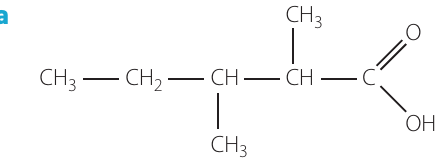
Example: Naming a branched carboxylic acid
This structure shows 2,3-dimethylpentanoic acid.
- The parent chain has five carbons (pentanoic acid)
- There are methyl groups attached at positions 2 and 3
- The carboxyl carbon is automatically position 1
Common names
Several carboxylic acids have common names that remain widely used:
Note
Common names you should know:
| IUPAC Name | Common Name |
|---|---|
| Methanoic acid | Formic acid |
| Ethanoic acid | Acetic acid |
| Propanoic acid | Propionic acid |
| Butanoic acid | Butyric acid |
You should be familiar with both naming systems, as both appear in chemistry texts, food labels, and scientific literature.
Physical properties
Intermolecular forces
The carboxyl group's structure gives carboxylic acids very strong intermolecular forces. Understanding these forces helps explain their physical properties.
Types of intermolecular forces in carboxylic acids:
- Dispersion forces - form between the hydrocarbon chains of molecules
- Dipole-dipole forces - form due to the highly polar carbonyl (C=O) part of the functional group
- Hydrogen bonding - occurs between the hydroxyl (-OH) part of one molecule and the carbonyl oxygen of another molecule
Important
The presence of both the carbonyl and hydroxyl groups in close proximity makes the entire carboxyl group extremely polar, leading to stronger intermolecular forces than in alcohols, aldehydes, or ketones.
Boiling points
Carboxylic acids have the highest boiling points among organic compounds of similar molecular mass. This occurs because they form the strongest intermolecular forces.
Example
Comparison of boiling points:
Ethanoic acid (molecular mass 60) has a boiling point of 118°C, whilst 1-propanol (molecular mass 60) has a boiling point of only 97.2°C, despite having a similar molecular mass.
The stronger intermolecular forces in carboxylic acids require more energy to overcome during boiling.
Within the carboxylic acid family, boiling points increase as the carbon chain lengthens. This pattern occurs because longer chains have more surface area, allowing more dispersion forces to form between molecules.
Dimer formation
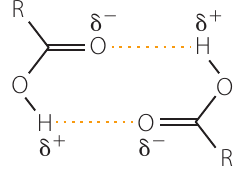
Under certain conditions, pure carboxylic acid molecules form structures called dimers.
Note
Understanding dimer formation:
In a dimer, two carboxylic acid molecules bond together through two hydrogen bonds. One hydrogen bond forms between the carbonyl oxygen (C=O) of one molecule and the hydroxyl hydrogen (O-H) of another molecule, whilst a second hydrogen bond forms in the opposite direction.
This double hydrogen bonding significantly increases the intermolecular forces and raises the boiling point even further.
The carbonyl group can participate in hydrogen bonding in carboxylic acids because the carbonyl and hydroxyl groups interact with each other within the carboxyl functional group. This interaction gives the functional group unique properties that wouldn't occur if these groups were separate.
Solubility
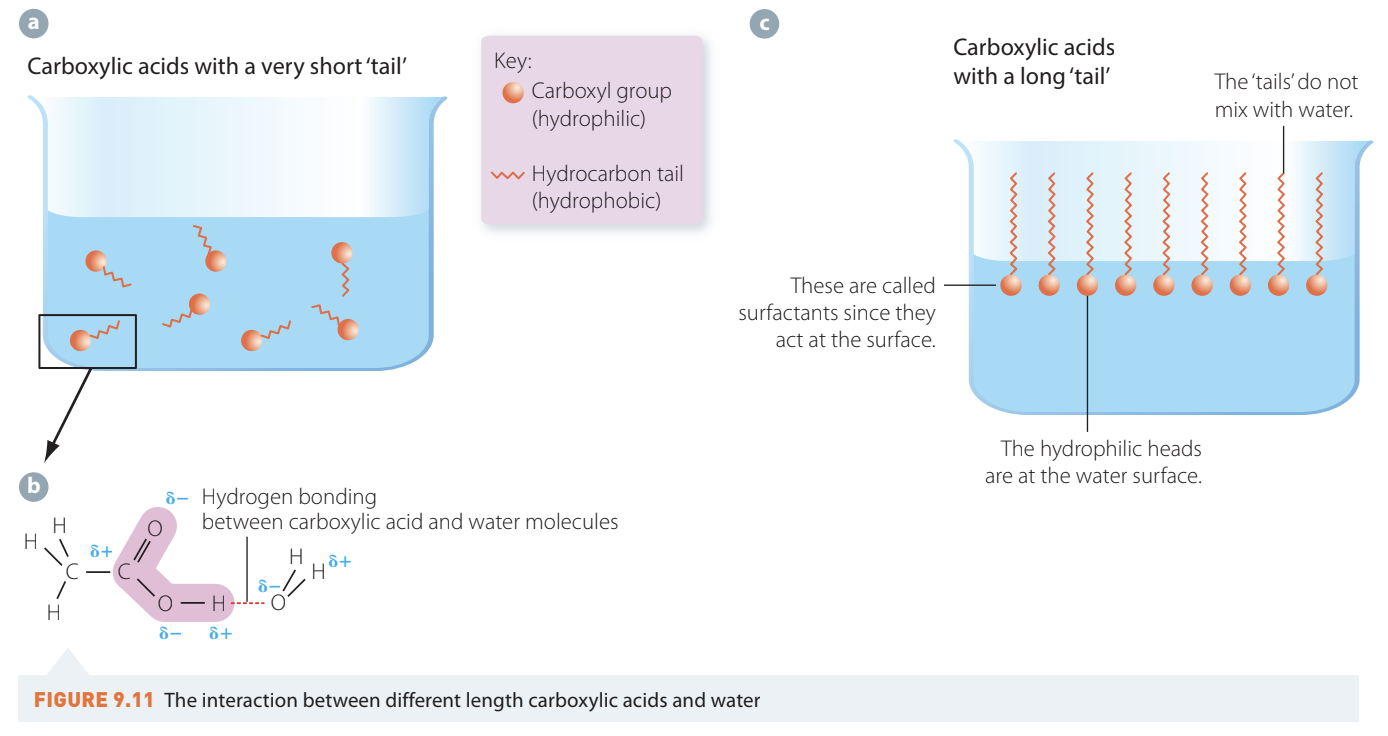
The solubility of carboxylic acids in water varies dramatically with chain length, following a clear pattern.
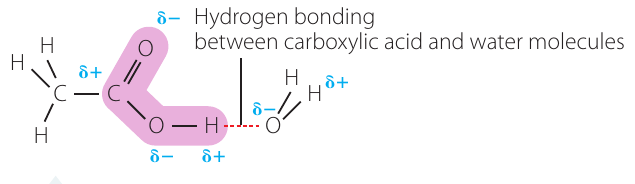
Small carboxylic acids like methanoic acid and ethanoic acid are highly soluble in water, even infinitely soluble. The carboxyl group forms strong hydrogen bonds with water molecules, as shown in the diagram. The partial positive charge () on the hydroxyl hydrogen attracts the partial negative charge () on water's oxygen, whilst the partial negative charge on the carbonyl oxygen attracts water's hydrogen atoms.
For small acids, the short hydrocarbon chain (which is non-polar) has minimal effect, so the polar carboxyl group dominates the molecule's behaviour, making it water-soluble.
Note
Large carboxylic acids as surfactants:
As the carbon chain lengthens, the non-polar hydrocarbon portion becomes more significant. Large carboxylic acids aren't soluble in water. Instead, they act as surfactants - molecules that concentrate at the water's surface.
The hydrophilic (water-loving) carboxyl head remains in contact with water whilst the hydrophobic (water-repelling) hydrocarbon tail extends away from the water. You'll study surfactant behaviour in more detail in later modules.
Property comparison
This table compares three compounds with similar molecular masses but different functional groups:
| Name | Molecular Weight | Boiling Point (°C) | Solubility (g/100mL) |
|---|---|---|---|
| Butanoic acid | 88.1 | 163 | Infinite |
| 1-pentanol | 88.1 | 137 | 2.3 |
| Pentanal | 86.1 | 103 | Slight |
Important
Key observations from the comparison:
- Butanoic acid has the highest boiling point because the carboxyl group forms the strongest intermolecular forces (including dimers)
- Butanoic acid is infinitely soluble, whilst 1-pentanol is only slightly soluble, and pentanal is barely soluble at all
- The carboxyl group's ability to form hydrogen bonds makes carboxylic acids more polar than comparable alcohols or aldehydes
Chemical properties
Monoprotic nature
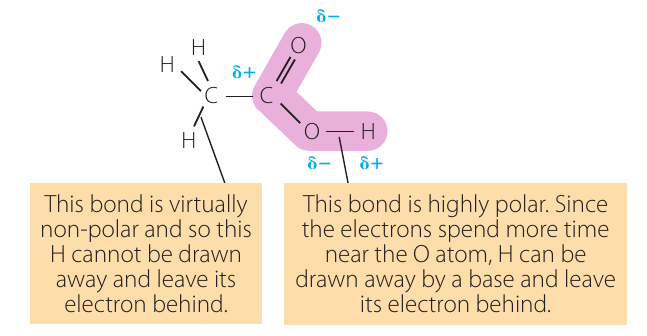
Carboxylic acids are classified as monoprotic acids, meaning each molecule can donate only one proton (hydrogen ion, H⁺) to a base.
Important
Why only one hydrogen is acidic:
The carbon-hydrogen bonds in the hydrocarbon chain are virtually non-polar because carbon and hydrogen have similar electronegativities. These hydrogen atoms cannot be removed by a base because the electrons are shared relatively equally.
However, the oxygen-hydrogen bond in the carboxyl group is highly polar. Oxygen is much more electronegative than hydrogen, so the bonding electrons spend more time near the oxygen atom. This creates a partial positive charge () on the hydrogen, making it acidic.
A base can attract this hydrogen away, and the electrons remain with the oxygen, forming an O⁻ ion.
Therefore, only the hydrogen in the -COOH group is acidic and can react with bases.
Weak acid behaviour
Carboxylic acids are weak acids, meaning they only partially ionise in aqueous solution. When dissolved in water, most carboxylic acid molecules remain intact, with only a small fraction releasing hydrogen ions.
Note
Ionisation percentages vary:
- Citric acid ionises approximately 8.6%
- Ethanoic acid ionises only about 1.3%
Despite being weak acids, carboxylic acids still exhibit all typical acid properties:
- They turn blue litmus paper red
- They react with metals to produce hydrogen gas
- They react with bases to form salts and water
- They react with carbonates to produce carbon dioxide
Effect of substitution on acid strength
The strength of a carboxylic acid can be increased by substituting electronegative atoms onto the carbon chain, particularly halogens (fluorine, chlorine, bromine, iodine).
When highly electronegative atoms like chlorine are attached to the carbon chain, they attract electrons strongly. This electron-withdrawing effect weakens the oxygen-hydrogen bond in the carboxyl group, making it easier for the hydrogen to be removed as H⁺.
Important
Key pattern: As the number of electronegative substituents increases, the acid strength increases proportionally.
Example
Example: Effect of chlorine substitution on acid strength
- Ethanoic acid (no substituents) - weak acid
- Chloroethanoic acid (one chlorine) - stronger acid
- Dichloroethanoic acid (two chlorines) - much stronger acid (almost 3000 times stronger than ethanoic acid)
This effect occurs because the electronegative atoms pull electron density away from the -OH bond, making the oxygen-hydrogen bond more polar and the hydrogen more easily removed.
Remember!
Summary
Key Points to Remember:
-
Carboxylic acids contain the carboxyl functional group (-COOH) which combines carbonyl (C=O) and hydroxyl (-OH) groups into one functional unit, always located at the terminal carbon.
-
They have the highest boiling points among comparable organic compounds due to strong hydrogen bonding and dimer formation (two hydrogen bonds between paired molecules).
-
Small carboxylic acids are highly water-soluble because the polar carboxyl group forms hydrogen bonds with water, but large carboxylic acids act as surfactants, with hydrophilic heads in water and hydrophobic tails extending outward.
-
Carboxylic acids are weak, monoprotic acids - they partially ionise in solution and can donate only one proton (the hydrogen from the -COOH group, not from the carbon chain).
-
Acid strength increases with electronegative substituents - adding halogens to the carbon chain increases acid strength by weakening the O-H bond and making it easier to release H⁺ ions.