Benzene (HSC SSCE Chemistry): Revision Notes
📚Revision Notes
Benzene
What are aromatic compounds?
Aromatic compounds get their name from their strong smell or aroma. Many of these substances were first discovered in plant oils, though today most aromatic hydrocarbons come from coal tar.
What makes a compound aromatic? All aromatic compounds share a special structural feature - they contain one or more rings of carbon atoms bonded together in a unique way. These rings have delocalised electrons, which are electrons that aren't locked into specific bonds. Instead, these electrons can move freely around the structure.
Important
Key Definition: Delocalised Electrons
Delocalised electrons are electrons that are not contained within bonds but are free to move about a structure or material.
This electron movement changes how aromatic compounds behave compared to other organic molecules. The presence of delocalised electrons gives aromatic compounds their distinctive properties.
Benzene structure and formula
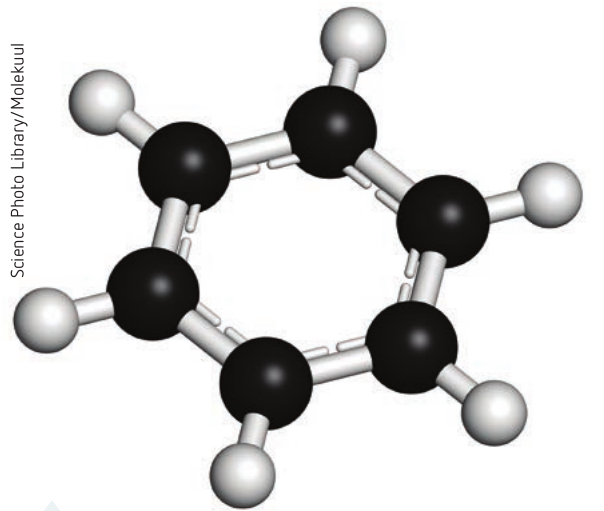
Benzene is the simplest aromatic compound and serves as the parent molecule for the entire aromatic hydrocarbon family. It's a colourless liquid with the molecular formula .
Since benzene contains fewer hydrogen atoms than a saturated hydrocarbon with six carbons would have, it's classified as an unsaturated molecule.
The benzene molecule has a flat, hexagonal (six-sided) structure. All the carbon atoms in the ring are positioned at equal angles to each other, with each bond angle measuring exactly .
Note
The flat, symmetrical structure of benzene is crucial to understanding its unique properties. The equal spacing of carbon atoms creates a perfectly regular hexagon with uniform bond angles throughout.
Bonding in benzene
Early chemists noticed that benzene's formula suggested it should contain alternating single and double bonds. Based on this idea, they expected benzene to react like alkenes and undergo typical addition reactions. However, benzene's actual behaviour proved very different from other double-bonded hydrocarbons.
Further research revealed something surprising: all the carbon-carbon bonds in benzene have the same length. This bond length sits somewhere between the length of a single bond and a double bond. This discovery was puzzling until scientists understood what was really happening.
Important
Why Benzene Behaves Differently
The answer lies in how the electrons are arranged. Rather than being fixed in alternating single and double bonds, the electrons from what would be the double bonds spread out evenly around the entire ring. This creates a cloud of delocalised electrons that exists both above and below the plane of the carbon ring.
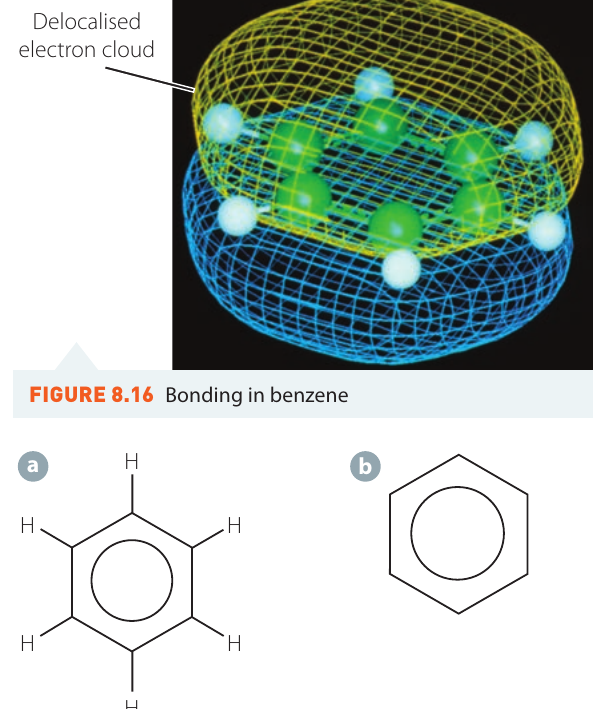
Think of it like this: instead of electrons being locked in place between two specific carbon atoms, they form a continuous electron cloud that wraps around the whole benzene ring. This is similar to how electrons behave in metals, where they can move freely throughout the structure.
Representing benzene
Chemists use two main ways to draw benzene in structural formulas:
- A hexagon with all six hydrogen atoms shown explicitly around the ring
- A simplified hexagon with a circle inside (the circle represents the delocalised electron cloud)
Note
Both representations are correct and widely used. The circle notation is often preferred because it clearly shows that the electrons are delocalised rather than in fixed double bonds.
Stability of benzene
The cyclic delocalisation of electrons makes benzene extremely stable. This stability is the key to understanding benzene's chemistry.
Because the delocalised electron system is so stable, benzene strongly resists reactions that would break up or disrupt the ring structure. Reactions that would destroy the delocalised electron cloud are energetically unfavourable.
Important
Benzene's Unique Reactivity
This explains why benzene doesn't undergo the same addition reactions as alkenes, even though its formula suggests it should be unsaturated. Instead, benzene tends to undergo substitution reactions that preserve the stable ring structure intact.
When benzene does undergo reactions that disrupt its ring, these reactions only occur under much more extreme conditions - higher temperatures and more vigorous reaction conditions than would be needed for similar reactions with alkenes.
Remember!
Summary
Key Points to Remember:
- Aromatic compounds are molecules containing carbon rings with delocalised electrons that give them special properties
- Benzene () is the simplest aromatic compound with a flat, hexagonal structure where all bond angles are
- Delocalised electrons in benzene form a cloud above and below the ring rather than being fixed in specific bonds
- All carbon-carbon bonds in benzene are the same length (between single and double bond length) due to electron delocalisation
- Benzene's stability comes from its delocalised electrons, making it prefer reactions that preserve the ring structure rather than break it up