Isomers (HSC SSCE Chemistry): Revision Notes
📚Revision Notes
Isomers
What are isomers?
When two or more compounds share identical molecular formulas but have different structural arrangements, we call them structural isomers. This is an important concept in organic chemistry because it shows that atoms can be arranged in multiple ways to create distinct compounds with different properties.
Note
The key difference between isomers lies in their structural formula rather than their molecular formula. While the molecular formula tells us how many of each type of atom is present, the structural formula shows us how these atoms are connected and arranged in space.
In hydrocarbon chemistry, structural isomers can form in several ways:
- Changing the position of double or triple bonds
- Moving substituents (like halogen atoms) to different carbon positions
- Rearranging the carbon backbone into different shapes
Types of structural isomers
Positional isomers
Positional isomers occur when functional groups or bonds occupy different positions on the same parent carbon chain. The basic carbon skeleton stays the same, but important features like double bonds or attached atoms move to different locations.
Positional isomers with double bonds
Consider the molecule butene, which has the molecular formula . The double bond can be positioned between different carbon atoms, creating distinct isomers:
- 1-butene: The double bond sits between carbon 1 and carbon 2 (at the end of the chain)
- 2-butene: The double bond sits between carbon 2 and carbon 3 (in the middle of the chain)
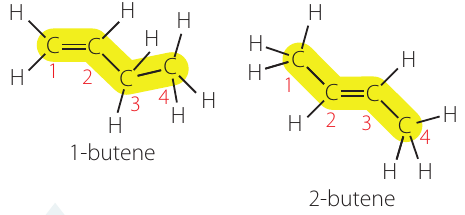
Even though both molecules contain four carbon atoms and eight hydrogen atoms, their different double bond positions give them different chemical properties.
Positional isomers with substituents
Positional isomers also form when we attach substituents (like halogen atoms) to different positions on the parent chain. The chloropropane example demonstrates this clearly:
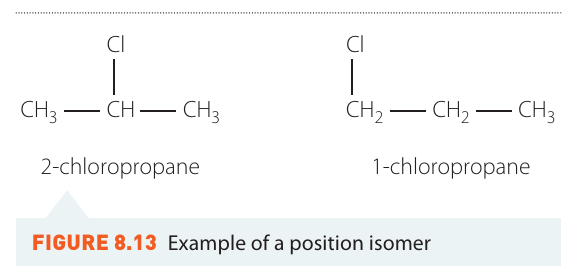
Both 2-chloropropane and 1-chloropropane have the molecular formula , but the chlorine atom attaches to different carbon atoms. In 2-chloropropane, the chlorine bonds to the middle carbon, while in 1-chloropropane, it bonds to an end carbon. This change in substituent position creates two distinct compounds.
Important
Exam tip: When identifying positional isomers, always number the carbon chain to show clearly where the functional group or substituent is located. This helps you name the compound correctly and distinguish between different isomers.
Chain isomers
Chain isomers involve reorganizing the carbon backbone itself. Rather than moving functional groups around, we change the arrangement of the carbon atoms from a straight chain to a branched structure (or vice versa).
Example
Worked Example: Chain Isomers with C₄H₁₀
A classic example uses the molecular formula :
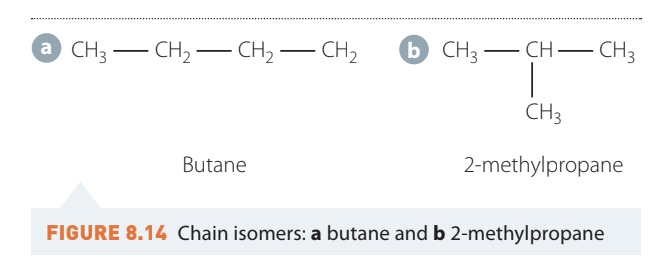
- Butane: A straight-chain molecule where all four carbon atoms connect in a single line
- 2-methylpropane: A branched molecule where three carbons form the main chain and one carbon branches off the second carbon
Both compounds contain exactly four carbon atoms and ten hydrogen atoms, but their different carbon skeletons give them different physical and chemical properties. This represents chain isomerism, where the molecular formula remains constant but the carbon framework changes.
Important
Key point: Chain isomers have the same molecular formula but different carbon backbone arrangements. One will be straight-chain while the other(s) will be branched.
Remember!
Summary
Key Points to Remember:
- Structural isomers have the same molecular formula but different structural arrangements of atoms.
- Positional isomers keep the same carbon backbone but move functional groups or bonds to different positions along the chain.
- Chain isomers rearrange the carbon skeleton itself, creating straight-chain versus branched structures with the same molecular formula.