Addition Polymers (HSC SSCE Chemistry): Revision Notes
📚Revision Notes
Addition Polymers
What are addition polymers?
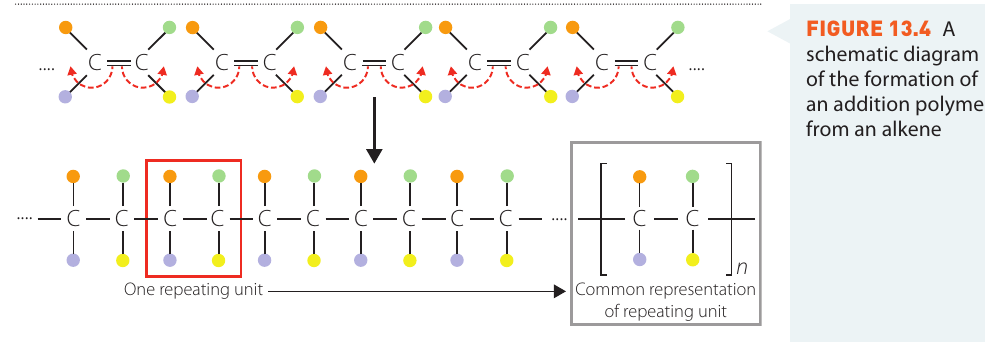
Addition polymers are large molecules formed by joining together many small monomer units without the loss of any atoms. This process is called addition polymerisation, which is a type of addition reaction where carbon-carbon double bonds are broken to allow monomers to link together.
For addition polymerisation to occur, the monomer must contain a double bond between two carbon atoms (C=C). When this double bond breaks, each carbon atom has an available electron to form new single bonds with adjacent monomers. The resulting polymer chains can contain anywhere from to over monomer units.
Note
Essential Requirements for Addition Polymerisation:
- Addition polymerisation involves breaking C=C double bonds in monomers
- Monomers join together without losing any atoms
- Polymer chains are very long, containing thousands of repeating units
- Requires specific conditions: catalysts, high temperature, and pressure
General mechanism of addition polymerisation
The general process shows how alkene monomers join together. Each coloured substituent group (shown as circles in the diagram above) can represent hydrogen atoms or different functional groups. The double bond opens up, and new single bonds form between adjacent monomers to create a long chain.
The general equation for addition polymerisation can be written as:
where represents hydrogen or a substituent group (such as chlorine, a benzene ring, or an alkyl group), and is the number of repeating units.
Polyethylene: polymers from ethylene
Polyethylene (also called polyethene) is one of the most common and important addition polymers. It forms when ethylene (ethene) monomers join together through addition polymerisation.
Formation of polyethylene
The polymerisation reaction can be represented as:
During polymerisation:
- One bond in each C=C double bond breaks under the influence of a catalyst
- This occurs at high temperature and pressure
- Each carbon atom now has one unpaired electron available for bonding
- New covalent bonds form between carbon atoms on adjacent ethylene molecules
- This creates long chains of repeating —CH₂—CH₂— units

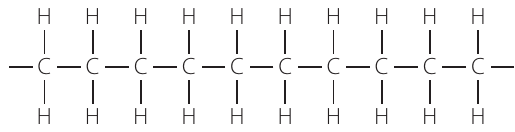
The polymer structure is often written in abbreviated form:
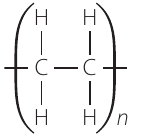
where represents the number of monomer units in the polymer chain.
Two types of polyethylene: LDPE and HDPE
There are two main types of polyethylene with different properties due to differences in their molecular structure: low-density polyethylene (LDPE) and high-density polyethylene (HDPE).
Low-density polyethylene (LDPE)
Production conditions:
- Gas phase process
- High temperature:
- Very high pressure: – atmospheres
- Requires an initiator to start the reaction
Structure:
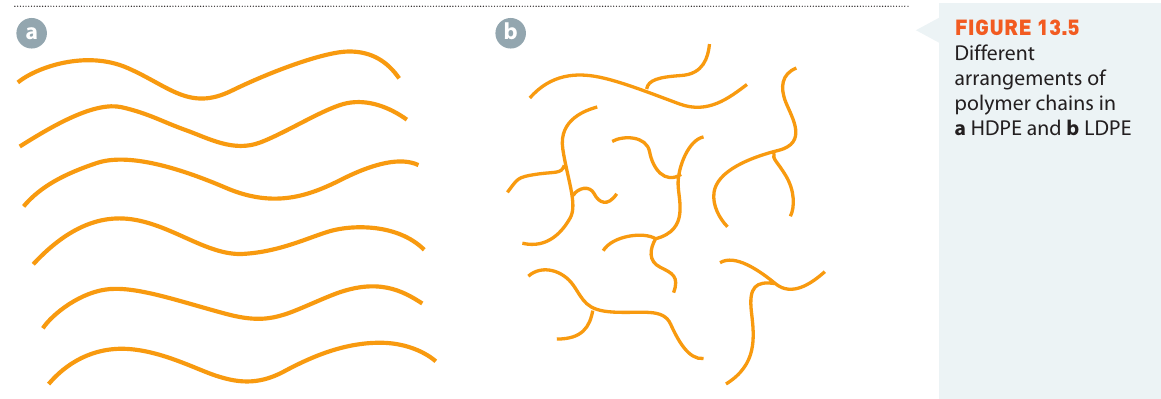
The significant chain branching distinguishes LDPE from HDPE. Some hydrogen atoms are replaced by alkyl groups, and these branches prevent polymer chains from packing closely together. This creates much empty space between chains, resulting in an amorphous (disordered) structure with weaker dispersion forces between chains due to greater separation.
Properties:
- Low density ()
- Low melting point ()
- Soft and flexible
- Transparent
- Low tensile strength ()
- – crystalline regions
- Impermeable to water vapour
- Unreactive towards acids and bases
Common uses:
- Plastic bags and shopping bags
- Plastic food wraps and cling film
- Soft toys
- Wire and cable insulation
- Lamination film for juice and milk cartons
High-density polyethylene (HDPE)
Production conditions:
- Ziegler-Natta process
- Lower temperature:
- Much lower pressure: only a few atmospheres
- Uses a catalyst mixture (titanium(III) chloride and trialkylaluminium compound)
Structure:
HDPE consists of unbranched (linear) polymer chains that pack closely together in an orderly arrangement. This creates less empty space and a crystalline (ordered) structure with stronger dispersion forces between chains due to closer packing.
Properties:
- Higher density ()
- Higher melting point ()
- Denser and tougher
- More rigid and less flexible
- Opaque (not transparent)
- Greater tensile strength ()
- – crystalline regions
- Impermeable to water vapour
- Unreactive towards acids and bases
Common uses:
- Detergent bottles and containers
- Milk and water jugs
- Fuel tanks for vehicles
- Bottle caps
- Food storage containers
- Kitchen utensils
- 3D printer filament
- Medical equipment and plastic surgery applications
Comparing LDPE and HDPE properties
| Property | LDPE | HDPE |
|---|---|---|
| Melting point | ||
| Density | ||
| Tensile strength | ||
| Crystalline regions | – | – |
| Structure | Branched, amorphous | Linear, crystalline |
| Bonding | Weak dispersion forces | Strong dispersion forces |
| Flexibility | Soft, flexible | Rigid, tough |
Important
Exam tip: Remember that HDPE has higher values for all physical properties because its linear chains pack more closely together, creating stronger intermolecular forces.
Understanding crystalline and amorphous structures
Polymer chains can be arranged in two different ways that fundamentally affect their properties:
Crystalline regions:
Polymer chains packed closely together in regular, ordered patterns create stronger intermolecular forces between adjacent chains. The chains cannot move easily past each other, resulting in stronger, more rigid, less flexible material.
Amorphous regions:
Polymer chains arranged randomly with greater separation between chains have weaker intermolecular forces. The chains can move more easily past each other, resulting in softer, more flexible material.
Note
Most polymers contain both crystalline and amorphous regions. A single polymer chain can be involved in both types of regions along its length. The proportion of crystalline versus amorphous regions determines the overall properties of the polymer.
Other addition polymers
Many different addition polymers can be made by substituting hydrogen atoms in ethylene with different functional groups. Ethylene can be converted into various useful monomers, which then undergo addition polymerisation.
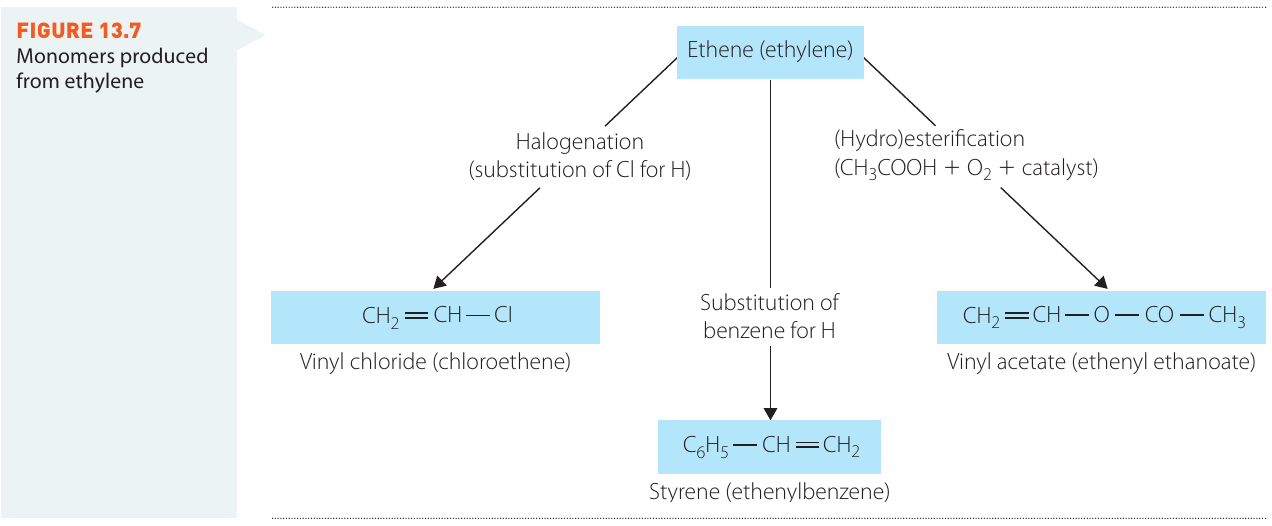
Naming polymers
Polymers are named by adding the prefix 'poly' before the monomer name:
- Ethylene → polyethylene
- Styrene → polystyrene
- Propylene → polypropylene
Note
Brackets are used in the name when:
- The monomer name contains more than one word: poly(vinyl chloride)
- The monomer name begins with a number: poly(1-chloroethene)
Polytetrafluoroethylene (PTFE or Teflon)
Monomer: Tetrafluoroethylene (CF₂=CF₂)
In this monomer, all hydrogen atoms have been replaced by fluorine atoms.
Structure:
The polymer contains repeating —CF₂—CF₂— units with all hydrogen atoms replaced by fluorine.
Manufacturing:
- Not made by simple substitution
- Complex process involving chloroform, fluorospar, and sulfuric acid
- Some steps require temperatures around
Properties:
PTFE exhibits remarkable properties due to its unique structure:
- Very strong and tough (due to polar C—F bonds and dipole-dipole interactions)
- Non-stick surface (has third-lowest coefficient of friction of any solid)
- Resistant to dispersion forces
- Chemically inert
- Excellent electrical insulator
Uses:
- Non-stick coating on cookware and frying pans
- High-grade electrical insulation for aerospace and computer wiring ( of production)
- Pipe thread sealant
- Stain-resistant treatment for carpets and fabrics
- Artificial body parts in medical applications
Note
Interesting fact: PTFE is the only known surface that geckos cannot stick to!
Poly(vinyl chloride) (PVC)
Monomer: Vinyl chloride (chloroethene): CH₂=CH—Cl
Polymerisation equation:
Structure:
- Chlorine atoms orientated randomly along the polymer chain
- Mainly amorphous structure (like LDPE)
- Chlorine atoms stick out from the chain
- Large size of chlorine prevents close packing
Bonding:
Chlorine is highly electronegative, which creates polar C—Cl bonds (Cl slightly negative, C slightly positive). Dipole-dipole interactions between chains add to dispersion forces, resulting in stronger intermolecular forces than polyethylene.
Properties:
- Hard and rigid (despite being amorphous)
- Strong due to dipole-dipole interactions
- Can be made flexible by adding plasticisers
- Cheapest and most widely used polymer after polyethylene
Plasticisers:
Plasticisers are small molecules inserted between polymer chains that:
- Force chains further apart
- Weaken intermolecular forces between chains
- Make the polymer more flexible
- The more plasticiser added, the more flexible the polymer becomes
Uses:
- Electrical insulation for wiring
- Garden hoses
- Drainage and sewerage pipes
- Household guttering and downpipes
- Window frames
Polystyrene (PS)
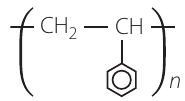
Monomer: Styrene (ethenylbenzene): C₆H₅—CH=CH₂
This monomer has a phenyl group (benzene ring) substituted for one hydrogen atom in ethylene.
Polymerisation:

Structure:
- Phenyl (benzene) rings orientated randomly along the chain
- Mainly amorphous structure
- Large benzene rings stick out from the chain
- Prevents close packing of chains
Bonding:
The phenyl ring is symmetrical (no polar bonds), so there are only weak dispersion forces between chains. However, the large ring groups restrict chain movement.
Properties:
- Clear and transparent
- Hard and brittle
- Readily softened and moulded when heated
- Becomes rigid when cooled
- Can be expanded into foam
Uses:
- Car battery cases
- Tool handles
- Modern furniture
- Disposable drink cups (both foam and clear)
- Foam packing material
- Protective packaging
Polypropylene (PP)
Monomer: Propene (propylene): CH₃—CH=CH₂
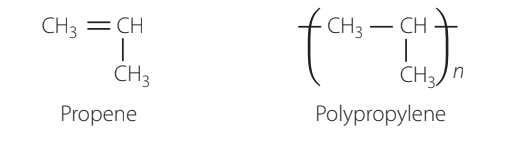
Tacticity:
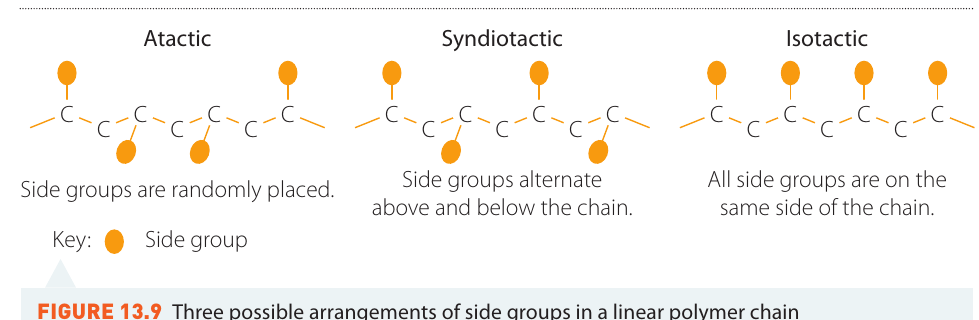
Polypropylene can exist in three different forms depending on the spatial arrangement of the —CH₃ (methyl) groups along the polymer chain. This property is called tacticity.
1. Atactic polypropylene:
In this form, methyl groups are randomly placed on either side of the chain. The chains cannot pack closely together, resulting in weaker intermolecular forces. This produces a soft rubbery polymer with lower melting point that is considered a waste product with limited uses: mainly roofing materials and sealants.
2. Syndiotactic polypropylene:
Here, methyl groups alternate regularly above and below the chain. This regular arrangement allows fairly close packing and intermediate intermolecular forces. The polymer is somewhat softer than isotactic form but still tough, with a clear appearance and stability to gamma radiation. Uses include packaging, medical tubing, bags and pouches.
3. Isotactic polypropylene:
In this most valuable form, all methyl groups are on the same side of the chain. The most regular arrangement allows closest packing and maximum dispersion forces between chains. The chains curl into regular spirals (not zigzag like polyethylene), producing the strongest and hardest form. This is the most commonly manufactured form with excellent resistance to stress, cracking and chemical reactions. Uses include crates, ropes, car bumpers, household goods, moulded chairs, and carpets.
Important
Important note: Isotactic and syndiotactic forms are called stereoregular polymers and are semicrystalline.
Important
Exam tip: Remember "ASI" for tacticity:
- Atactic = random arrangement
- Syndiotactic = alternating sides
- Isotactic = same side
Common addition polymers summary
The table below summarises the most important addition polymers, their monomers, and common uses:
| Polymer | Monomer name and structure | Common uses |
|---|---|---|
| Polyethylene | Ethene (ethylene): CH₂=CH₂ | LDPE: Plastic bags, soft toys, plastic wrap HDPE: Kitchen utensils, containers, rigid toys, rubbish bins |
| Polypropylene (PP) | Propene (propylene): CH₂=CH—CH₃ | Car bumpers, rope and twine, household goods, moulded chairs, carpets |
| Poly(vinyl chloride) (PVC) | Vinyl chloride (chloroethene): CH₂=CH—Cl | Electrical insulation, garden hoses, drainage pipes, guttering |
| Polytetrafluoroethylene (PTFE/Teflon) | Tetrafluoroethene: F₂C=CF₂ | Non-stick cookware, high-grade electrical insulation, pipe sealant |
| Polystyrene (PS) | Styrene (phenylethene): C₆H₅—CH=CH₂ | Battery cases, tool handles, furniture, disposable cups, foam packaging |
| Polyacrylonitrile (acrylics) | Acrylonitrile (cyanoethene): CH₂=CH—C≡N | Wool substitute in clothing, blankets, soft furnishings, carpet |
| Poly(vinyl acetate) (PVA) | Vinyl acetate (ethenyl ethanoate): CH₂=CH—O—CO—CH₃ | Vinyl coatings on fabrics, paint, adhesives |
Copolymers
A copolymer is a polymer made from two or more different monomers. Mixing different monomers during polymerisation can create polymers with new and useful properties that neither monomer would produce alone.
Example
Example: High-impact polystyrene
When butadiene monomer is copolymerised with styrene:
- Impact strength improves considerably
- Product can be used for battery cases and shoe heels
- Properties are different from regular polystyrene
Example
Example: Synthetic rubber
Synthetic rubber is the most widely used copolymer:
- Made from styrene and butadiene monomers
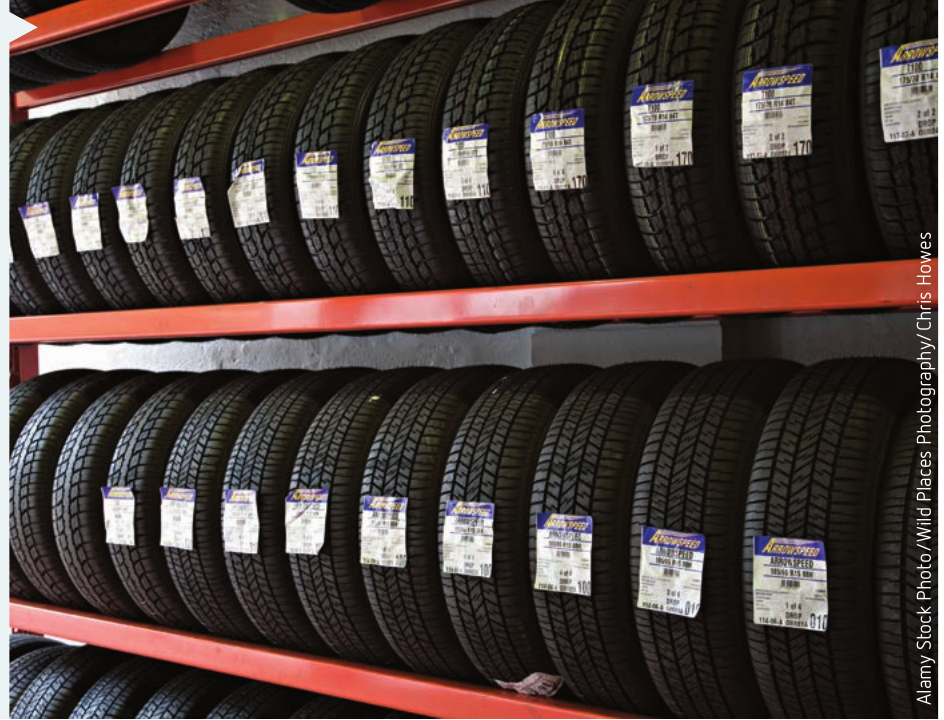
- Used extensively in car tyres (mixed with natural rubber)
- Has undergone further modifications to polymer chains
Summary
Key Points to Remember:
- Addition polymers form without losing atoms – the monomers simply join together by opening their carbon-carbon double bonds
- LDPE is branched, flexible, and has low density due to loose packing of chains, while HDPE is linear, rigid, and has high density due to close packing
- Crystalline regions are ordered and strong; amorphous regions are disordered and flexible
- Substituting different groups for hydrogen atoms in ethylene creates polymers with different properties: Cl gives PVC (strong dipole-dipole forces), F gives PTFE (non-stick), benzene ring gives polystyrene (clear and brittle)
- Tacticity matters for polypropylene: isotactic (all groups same side) is strongest, atactic (random) is weakest
- Copolymers combine two or more monomers to create materials with improved or specialized properties