Relating Properties, Uses, and Structure (HSC SSCE Chemistry): Revision Notes
📚Revision Notes
Relating Properties, Uses, and Structure
Introduction to polymer structure and properties
When choosing polymers for specific applications, it is essential to understand how their properties relate to their intended use. The characteristics of a polymer depend directly on the structure of its molecules and the types of bonding present within and between the chains.
Understanding the relationship between structure and properties allows manufacturers and scientists to design polymers that meet specific requirements. For example, a polymer used for food packaging needs different properties compared to one used for car parts or medical equipment.
Key structural features affecting polymer properties
Six main structural features determine how a polymer will behave and what properties it will exhibit:
- Crystallinity: The degree of ordered arrangement in the polymer chains
- Branching: The extent of side chains extending from the main polymer backbone
- Chain length: The average number of monomer units in each polymer molecule
- Side groups: The atoms or groups attached to the carbon backbone
- Cross-linking: The formation of bonds between separate polymer chains
- Stability and biodegradability: The polymer's resistance to breakdown
Note
Each of these features can be controlled during the manufacturing process to create polymers with desired properties for specific applications. This control gives chemists and engineers powerful tools for designing materials tailored to specific needs.
Crystallinity
Polymer molecules in linear chains, such as those found in polyethylene, have the ability to flex and twist. Because of this molecular movement, some molecules become tangled together whilst others align in ordered arrangements. The result is a polymer containing two distinct types of regions: crystalline areas and amorphous areas.
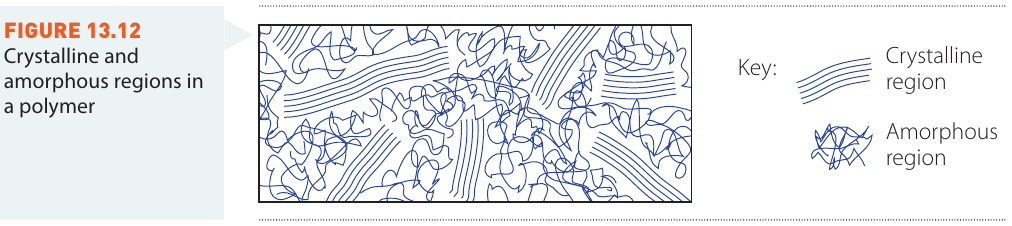
Crystalline regions
In crystalline regions, polymer chains arrange themselves in an orderly, parallel fashion. This close packing brings the chains nearer to each other, which strengthens the intermolecular forces (such as van der Waals forces) between them. When chains are held together more strongly, several important properties emerge:
- Rigidity: The polymer becomes stiffer and less flexible
- Higher softening and melting points: More energy is required to overcome the stronger intermolecular forces
- Greater density: Closer packing means more mass per unit volume
- Opaque appearance: Light cannot pass through the ordered structure easily
- Chemical resistance: The tight structure resists penetration by air, moisture and other chemicals
- Impermeability: Substances cannot easily pass through crystalline regions
Amorphous regions
In amorphous regions, the polymer chains exist in a tangled, disordered state with no regular pattern. The random arrangement creates larger gaps between the chains, which weakens the intermolecular forces. This leads to contrasting properties:
- Flexibility: The polymer can bend and deform more easily
- Lower softening and melting points: Less energy is needed to overcome weaker intermolecular forces
- Transparency: Light can pass through the irregular structure
- Lower density: Larger gaps between chains mean less mass per unit volume
- Permeability: Water, air and chemicals can penetrate through the gaps
Controlling crystallinity
The degree of crystallinity in a polymer determines its overall properties. In commercial polymer production, manufacturers can control the percentage of crystalline and amorphous regions by adjusting factors such as cooling rate, pressure, and the presence of additives. This allows them to fine-tune the properties of the resulting polymer to match specific requirements.
Example
Practical Application: Selecting Polymers Based on Crystallinity
A polymer with high crystallinity might be chosen for applications requiring rigidity and chemical resistance, such as:
- Storage containers for chemicals
- Structural components in machinery
- Rigid pipes and fittings
A polymer with more amorphous regions would be better suited for flexible applications where transparency is important, such as:
- Food wrap and packaging films
- Transparent bottles
- Flexible tubing
Branching
The extent of branching in polymer chains significantly affects how closely the chains can pack together. This packing behaviour directly influences whether the polymer will be predominantly crystalline or amorphous.
Polymer chains with little or no branching can nestle closely together, much like straight pieces of spaghetti lying parallel to each other. This close packing promotes the formation of crystalline regions. As a result, polymers with low chain branching tend to exhibit:
- Higher crystallinity
- Greater density
- Reduced transparency
- Less flexibility
- Higher strength
In contrast, highly branched polymers resemble tangled twigs with many protruding side branches. These branches prevent the main chains from packing closely together, creating more space between molecules. This leads to predominantly amorphous structures with:
- Lower crystallinity
- Increased transparency
- Greater flexibility
- Lower density
- Enhanced permeability
Important
Creating highly branched polymer structures requires more extreme reaction conditions during synthesis because covalent bonds within the polymer chain must be broken to insert branches. This makes branching a carefully controlled aspect of polymer manufacturing.
Chain length
The length of polymer chains is determined by the conditions and proportions of chemicals used during the polymerisation process. Because each batch of polymer contains chains of varying lengths, scientists refer to the average molecular weight rather than a specific chain length. This average reflects the typical number of monomer units that combine to form one polymer molecule.
Effect on physical properties
For a given type of polymer, longer chains and more uniform chain lengths result in:
- Higher melting points: Longer chains have more contact points between molecules, creating stronger overall intermolecular attractions
- Increased hardness: The polymer becomes more resistant to deformation and scratching
Effect on manufacturing processes
Chain length significantly affects how the polymer behaves when softened for manufacturing. The flow characteristics, or viscosity, of melted polymer directly impact production methods:
Note
Very long chains: Create highly viscous (thick) melts that are difficult to extrude through nozzles and dies. The material resists flowing, making processing challenging.
Very short chains: Produce melts with low viscosity that flow too easily. Extruded products may sag or droop as they exit the machine before solidifying. Short chains also cannot withstand moulding processes that involve blowing the polymer into shape using pressurised gases at high temperatures, as the material lacks sufficient strength.
Manufacturers must carefully control chain length to balance processability with the desired final properties of the product.
Side groups
The nature of side groups attached to the polymer's carbon backbone provides another method for modifying polymer properties. When a larger side group is incorporated into a linear polymer chain, it reduces the chain's flexibility and makes the material stiffer.
The mechanism behind this change is straightforward: bulky side groups restrict the ability of the polymer chains to move freely. They act like obstacles that prevent the chains from "flopping around" or rotating easily. This restriction of molecular motion translates into increased stiffness and rigidity in the bulk material.
Examples of side group effects
Example
Comparing Side Group Effects on Flexibility
Polyethylene: Contains only hydrogen atoms as side groups. These small atoms allow maximum chain flexibility, resulting in a relatively flexible plastic.
Poly(vinyl chloride) (PVC): Formed by replacing one hydrogen atom on each carbon with a chlorine atom. Chlorine is significantly larger than hydrogen, so its presence restricts chain movement. This makes PVC stiffer and more rigid than polyethylene.
Polystyrene: Contains benzene rings (phenyl groups) as side groups. These large, bulky ring structures severely restrict chain mobility, producing a hard, rigid material that is also quite brittle.
The ability to control stiffness through side group selection allows polymer chemists to design materials ranging from flexible films to rigid structural components, all based on the same basic polymer backbone structure.
Cross-linking
Cross-linking is a process that fundamentally changes polymer structure by creating bonds between separate linear polymer chains. These bonds link the chains together, forming a more rigid two-dimensional or three-dimensional network structure. Unlike the weak intermolecular forces that normally hold polymer chains together, cross-links typically involve strong covalent bonds or ionic bonds.
Effects of cross-linking
The degree of cross-linking directly determines the mechanical properties of the polymer:
- Light cross-linking: A few cross-links create a network that is more rigid than uncross-linked polymer but still retains some flexibility
- Heavy cross-linking: Extensive cross-linking produces highly rigid, hard materials that cannot be easily deformed
- Very heavy cross-linking: Creates extremely hard materials that may become brittle
Vulcanisation: An important example
A classic example of cross-linking is the vulcanisation of natural rubber. Natural rubber consists of long polymer chains that can slide past each other easily, making the material soft and not particularly elastic. When natural rubber is heated with sulfur, sulfur atoms form covalent bonds (S—S bonds) between adjacent polymer chains.
Example
Vulcanisation Process and Effects
When natural rubber undergoes vulcanisation:
Process: Natural rubber is heated with sulfur, which forms S—S bonds between adjacent polymer chains.
Property Changes: This cross-linking process transforms the properties dramatically:
- The material becomes harder and more durable
- Elasticity improves significantly - the material can stretch and return to its original shape
- Heat resistance increases
- The rubber becomes more resistant to chemical degradation
Applications: Vulcanised rubber revolutionised many industries by providing a material that combined flexibility with durability, making it ideal for tyres, hoses, and many other applications.
Important
Manufacturing consideration: An important practical consequence of cross-linking is that heavily cross-linked polymers cannot be recycled through melting and remoulding. The covalent bonds between chains are permanent and do not break when heated, meaning the material will decompose rather than soften if heated to high temperatures.
Stability and biodegradability
The stability of polymers - their resistance to breakdown - depends on the strength of the bonds within the polymer structure. Most synthetic polymers contain predominantly strong covalent C—C (carbon-carbon) and C—H (carbon-hydrogen) bonds. These robust bonds make the polymers highly stable and resistant to degradation.
Polymer stability
This stability means that most synthetic polymers, unlike natural polymers such as cellulose or proteins, are not biodegradable. They do not break down readily through biological processes or environmental exposure. Whilst this stability is advantageous during use - the material maintains its properties over long periods - it creates environmental challenges when the polymer becomes waste.
Polymers with weaker bonds: PVC example
Not all synthetic polymers are equally stable. Poly(vinyl chloride) (PVC) contains C—Cl (carbon-chlorine) bonds, which are weaker than C—H bonds. Ultraviolet light from sunlight has sufficient energy to break these C—Cl bonds. When PVC is exposed to sunlight for extended periods, it undergoes photodegradation:
- The polymer chains break apart
- The material becomes brittle and develops cracks
- Physical properties deteriorate significantly
Note
To prevent this degradation, manufacturers add special chemical compounds called stabilisers to PVC products. These additives protect the polymer from UV light damage, allowing PVC products to be used outdoors without rapid deterioration.
Increasing biodegradability
To address environmental concerns about non-biodegradable plastics, chemists have developed strategies to increase polymer biodegradability. One effective approach involves copolymerisation - incorporating segments of natural, biodegradable polymers (such as starch) into synthetic polymer chains.
This creates a copolymer structure where natural polymer segments are vulnerable to biological breakdown. When microorganisms attack and break down the natural segments, the entire polymer chain fragments into many smaller pieces. These smaller segments may then degrade further or at least break down into pieces that are less problematic in the environment than large polymer objects.
Summary
Key Points to Remember:
-
Crystalline regions have ordered, closely-packed chains with strong intermolecular forces, resulting in rigidity, higher melting points, opacity, greater density, and impermeability.
-
Amorphous regions contain tangled, disordered chains with weak intermolecular forces, leading to flexibility, lower melting points, transparency, lower density, and permeability to substances.
-
Branching affects how closely chains pack together - low branching produces more crystalline, denser, less flexible polymers, whilst high branching creates more amorphous, flexible polymers.
-
Chain length influences melting point, hardness, and manufacturing processes - longer chains with uniform length produce harder polymers with higher melting points, but very long chains are difficult to process whilst very short chains lack strength.
-
Side groups determine flexibility - larger side groups restrict chain movement, creating stiffer, more rigid polymers (as seen in PVC and polystyrene compared to polyethylene).
-
Cross-linking creates covalent or ionic bonds between polymer chains, forming rigid networks - greater cross-linking produces harder, more rigid materials but prevents recycling through melting.