Esters (HSC SSCE Chemistry): Revision Notes
📚Revision Notes
Esters
What are esters?
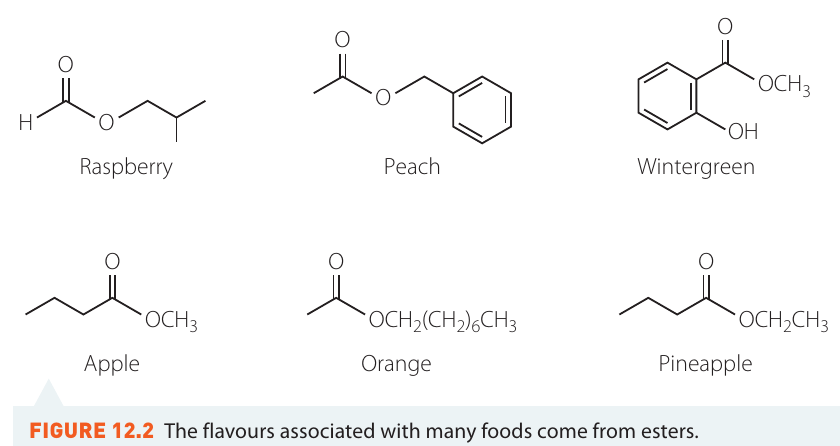
Esters are an important class of organic compounds found widely in biological systems and used extensively in industry. They possess distinctive fruity aromas and contribute to the flavours and fragrances of many fruits and flowers. Natural esters include solid animal fats and both animal and vegetable oils.
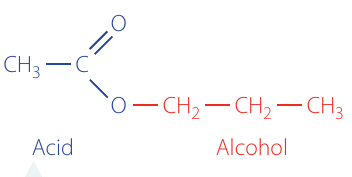
The general structure of an ester features a carbonyl group () bonded to an oxygen atom, which is attached to an alkyl group. The general formula for an ester is:
where and represent alkyl groups.
Note
Esters have a similar structure to carboxylic acids, except an alkyl group replaces the hydrogen atom attached to the oxygen. The ester group is also called an ester link because it joins the alcohol and carboxylic acid components.
Industrial and natural importance
Beyond their natural occurrence, esters have significant industrial applications. They can be synthesised easily and are produced synthetically as artificial flavourings and colourings. Several billion kilograms of polyesters are manufactured annually for products including fabrics and plastic bottles. Many esters also serve as solvents in industry - for example, ethyl ethanoate is commonly found in nail polish remover.
Naming esters
The systematic naming of esters follows a two-part system based on their molecular structure:
First part - the alkyl group
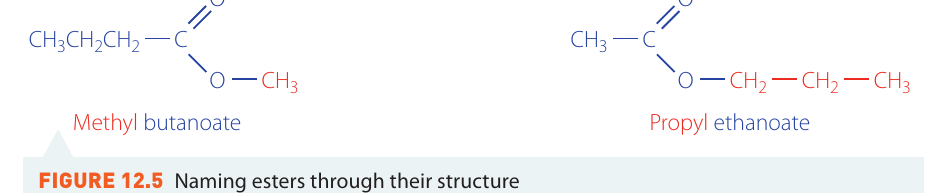
The first word identifies the alkyl group directly attached to the oxygen atom of the ester group. This portion originally came from the alcohol molecule. It uses the standard alkyl naming convention:
- One carbon = methyl
- Two carbons = ethyl
- Three carbons = propyl
- Four carbons = butyl
- Six carbons = hexyl
Second part - the carboxylate
The second word derives from the carboxylic acid component. This is the hydrocarbon chain on the other side of the ester link. Remember to include the carbon that forms part of the ester group when counting. The naming changes the acid suffix from -oic acid to -oate.
Note
For example, if the acid component contains two carbons, it becomes ethanoate (from ethanoic acid).
Worked example
Example
Worked Example: Naming an Ester
Consider an ester with three carbons in the alkyl group attached to oxygen, and two carbons in the acid component.
Step 1: Identify the alkyl group Three carbons = propyl
Step 2: Identify the carboxylate Two carbons = ethanoate
Answer: This ester is named propyl ethanoate
Properties of esters
Physical state and boiling points
The presence of and bonds makes the ester group polar. However, esters tend to exist as liquids at room temperature, with boiling points much lower than carboxylic acids of similar molecular mass. This difference occurs because the primary intermolecular forces in esters are dipole-dipole forces, which are weaker than the hydrogen bonding present in carboxylic acids and alcohols.
| Name | Molecular Mass (g/mol) | Boiling Point (°C) | Solubility in Water (g/100g water) |
|---|---|---|---|
| Methyl methanoate | 60 | 32 | 24 |
| Methyl ethanoate | 74 | 57 | 6.7 |
| Methyl propanoate | 88 | 80 | 7.3 |
| Ethyl ethanoate | 88 | 77 | 7.5 |
| Propyl ethanoate | 102 | 102 | 2 |
Solubility
Most esters show limited solubility in water due to two factors:
- Lack of hydrogen bonding - esters cannot form hydrogen bonds as effectively as carboxylic acids or alcohols
- Large hydrophobic alkyl groups - these non-polar regions repel water molecules
Note
However, esters dissolve readily in organic solvents, making them useful as industrial solvents.
Functional group isomerism
Carboxylic acids and esters are functional group isomers - they share the same molecular formula but possess different functional groups.
Important
For example, propanoic acid and methyl ethanoate both have the molecular formula :
- Propanoic acid:
- Methyl ethanoate:
This relationship is similar to how aldehydes and ketones are functional group isomers.
Preparing esters
The esterification reaction
Esters form through a reaction between an alcohol and a carboxylic acid:

This reaction produces a water molecule as a by-product. Reactions where functional groups from two molecules join together and release a small molecule are called condensation reactions.
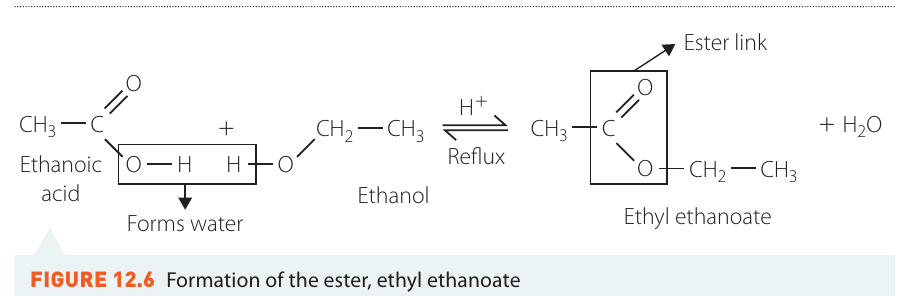
Example reaction
Example
Worked Example: Formation of Ethyl Ethanoate
The formation of ethyl ethanoate from ethanoic acid and ethanol:
Conditions for preparation
Ester formation is naturally very slow - it can take months or years in nature. Laboratory preparation requires specific conditions to accelerate the reaction:
Catalyst
Adding concentrated sulfuric acid acts as a catalyst, significantly speeding up the reaction and allowing it to occur within a reasonable timeframe.
Heating
The mixture must be heated to increase the reaction rate. However, conventional heating in an open container would cause loss of reactants because organic chemicals used in ester formation are volatile and evaporate easily, even at low temperatures.
Reflux
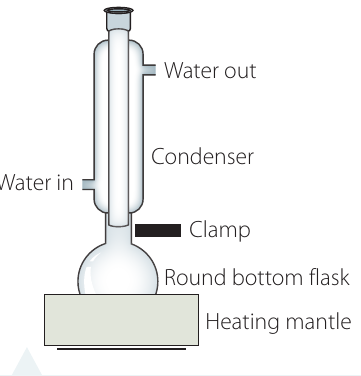
A process called reflux solves the evaporation problem. The reflux apparatus consists of:

Note
Reflux involves heating reactants for an extended period without losing any material. As the reaction mixture heats up, volatile components evaporate and rise into a vertical condenser. The condenser cools these gases, causing them to condense back into liquid form and return to the reaction flask. Laboratory refluxing typically takes 20 minutes to several hours, and this process maximises the final yield since no reaction mixture escapes.
Safety considerations
Important
Heating organic chemicals for extended periods poses safety risks:
- Organic chemicals can be highly flammable
- They evaporate easily
- Some risk of chemicals escaping exists
Therefore, avoid using naked flames from Bunsen burners. Instead, use a heating mantle, which provides flameless heating.
Excess reagent
Adding one reagent in excess drives the equilibrium reaction towards product formation. According to Le Chatelier's principle, this results in a higher percentage yield of ester.
Purifying esters
After refluxing for approximately 30 minutes, the flask contains a mixture of substances. Because esterification is an equilibrium reaction, both reactants and products remain present, along with the catalyst.
| Organic Components | Inorganic Components |
|---|---|
| Ester (product) - not soluble in water | Water (reaction product and from solutions added) |
| Carboxylic acid (leftover reactant) - small acids are water soluble, larger ones are not | Sulfuric acid (present as and ions) - soluble in water through ion-dipole bonds |
| Alcohol (leftover reactant) - short-chain alcohols are water soluble, long-chain alcohols are not |
Purification process
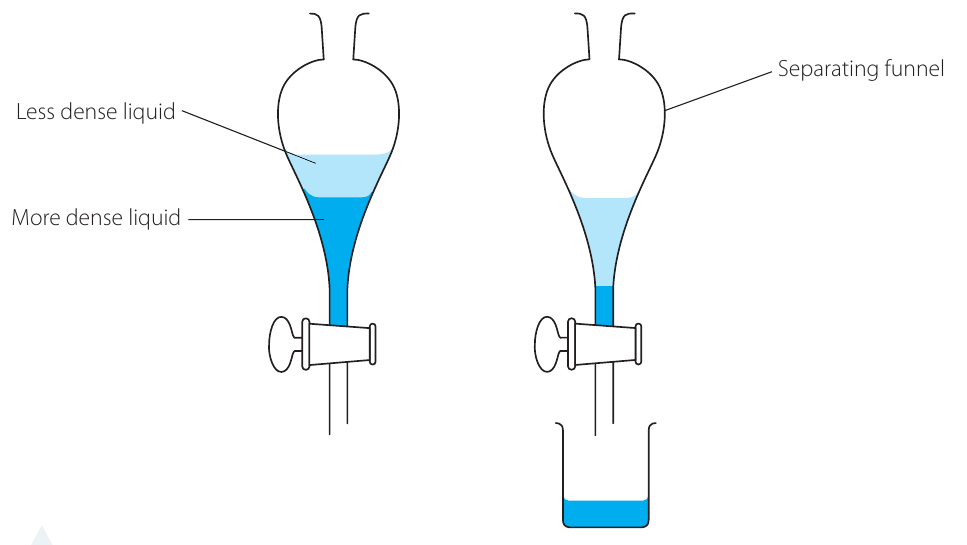
A separating funnel is the key piece of equipment for purification. It separates immiscible liquids (liquids that don't dissolve in each other) which form distinct layers, with the less dense layer on top. Opening the stopcock at the base allows the denser component to drain into a collection vessel, leaving the less dense component in the funnel.
Step 1: Washing with water
Pour the entire reaction mixture into a separating funnel and add water. After standing, the mixture separates into two layers:
Organic layer
- Contains the ester
- May also contain alcohol and carboxylic acid if they have long chains
- Usually less dense than water, forming the top layer
- Check which layer is organic by adding 1-2 drops of water - water drops pass through the organic layer and dissolve in the aqueous layer
Aqueous layer
- Contains water, sulfuric acid
- Contains any soluble short-chain alcohol and carboxylic acid molecules
- Usually forms the bottom layer
Note
Separate the layers and discard the aqueous layer.
Step 2: Addition of sodium carbonate
Add sodium carbonate () or sodium hydrogen carbonate to remove any remaining carboxylic acid. Any insoluble carboxylic acid reacts with carbonate ions to produce a carboxylate ion () and carbon dioxide gas:
Important
The carbon dioxide gas escapes from the top of the separating funnel. Important: Do not stopper the funnel during this step, or gas pressure will build up inside.
The insoluble carboxylic acid converts to a soluble carboxylate ion. This ion dissolves despite its large hydrocarbon chain because it can form ion-dipole bonds with water molecules.
Add water to the separating funnel. It separates again into aqueous and organic layers. Separate the layers and discard the aqueous layer.
Step 3: Distillation
Different components in the mixture have different boiling points. Distillation exploits these differences to isolate the pure ester. By knowing the boiling points of the carboxylic acid, ester, and alcohol, you can collect the ester at its specific boiling point temperature, producing a pure final product.
Remember!
Summary
Key Points to Remember:
- Esters have the general formula and form through condensation reactions between alcohols and carboxylic acids
- Esters are named using a two-part system: first the alkyl group from the alcohol, then the carboxylate name from the acid (changing -oic acid to -oate)
- Esters are functional group isomers of carboxylic acids with the same molecular formula but different functional groups
- Ester formation requires reflux (extended heating with a condenser), concentrated sulfuric acid as a catalyst, and often an excess reagent to drive the equilibrium forward
- Purification involves three steps: washing with water to separate polar and non-polar components, adding sodium carbonate to remove carboxylic acid, and distillation to isolate the pure ester based on boiling point differences