Flow Charts for Chemical Synthesis (HSC SSCE Chemistry): Revision Notes
📚Revision Notes
Flow Charts for Chemical Synthesis
What is a flow chart in chemistry?
A flow chart is a visual diagram that represents the step-by-step process of producing a chemical in industry. These diagrams are essential tools for understanding chemical manufacturing because they clearly show how materials move through different stages of production.
Note
When analyzing a chemical flow chart, you should be able to identify several important features:
- The different steps or stages in the manufacturing process
- Raw materials that are used (substances found in nature in a usable form)
- Where energy is required to drive reactions forward
- Where energy can be recycled from exothermic reactions to other parts of the plant
- Where chemical recycling occurs to improve efficiency and reduce waste
Understanding flow charts helps you see the bigger picture of how theoretical chemistry concepts are applied in real industrial processes.
The Haber process: a detailed example
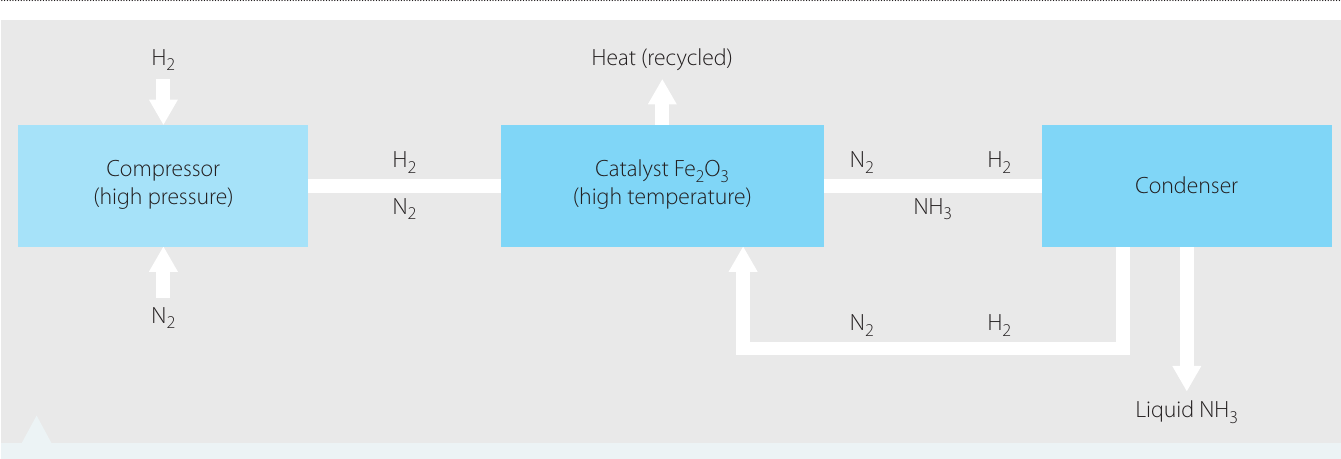
The production of ammonia through the Haber process provides an excellent example of how flow charts work in practice. Let's examine this process step by step.
Starting materials and preparation
The chemicals required for ammonia production are nitrogen () and hydrogen (). An important point to note is that while nitrogen makes up approximately of Earth's atmosphere, and hydrogen can be obtained from various sources, these gases are not considered raw materials in their pure form. They must either be purchased or converted from actual raw materials like natural gas and air.
The compression stage
The first step involves feeding the nitrogen and hydrogen gases into a compressor. This equipment increases the pressure of the gases significantly. Why is high pressure important? When gases are compressed, their molecules are forced closer together, which increases the frequency of collisions between reactant molecules. This results in a faster rate of reaction, making the process more efficient.
The catalyst stage
After compression, the gases are passed over an iron(III) oxide () catalyst at high temperature. The catalyst plays a crucial role by lowering the activation energy of the reaction. This means the reaction can proceed faster without needing extremely high temperatures.
Important
Why not just use very high temperatures?
The answer relates to Le Chatelier's principle: the ammonia formation reaction is exothermic, so high temperatures actually shift the equilibrium position backwards, reducing the yield of ammonia. The catalyst provides a way to increase the reaction rate without this disadvantage.
At this stage, the following equilibrium reaction occurs:
Because this is an equilibrium reaction, the mixture leaving the catalyst chamber contains all three substances: unreacted nitrogen, unreacted hydrogen, and the product ammonia. Not all the reactants convert to products, which is why recycling becomes important.
Energy considerations
Notice that the enthalpy change () is negative, indicating an exothermic reaction. This means heat energy is released during ammonia formation. Rather than wasting this thermal energy, industrial plants recycle it to run other parts of the facility, such as machinery or heating other reaction vessels. This recycling of energy makes the process more economical and environmentally sustainable.
The separation stage
The mixture of three gases then enters a condenser, where it is cooled. Here's where intermolecular forces become important:
Note
Intermolecular Forces and Separation
- Ammonia has a relatively high boiling point because ammonia molecules can form hydrogen bonds with each other (the N-H bonds are polar, and nitrogen has a lone pair of electrons)
- Nitrogen and hydrogen have much lower boiling points because they only have weak dispersion forces between their molecules
When the mixture is cooled in the condenser, the ammonia condenses into a liquid and can be collected as the product. The nitrogen and hydrogen remain as gases and are recycled back to the beginning of the process, where they can react again. This recycling is essential for making the process economically viable, as it means unreacted starting materials aren't wasted.
How to construct a flow chart
Creating your own flow chart helps you understand chemical processes more deeply. Here's a systematic approach using methanol production as an example.
Note
Steps for Constructing a Flow Chart
Step 1: Identify the structures and processes
First, you need to work out what equipment or stages are involved. For methanol production, these include:
- Reactor 1 (where natural gas reacts with steam)
- Air separation unit (to extract oxygen)
- Reactor 2 (where further reactions occur)
- Methanol generator
- Distillation mechanism
Step 2: Determine the correct order
Work out the logical sequence. Which structure feeds into which? For methanol:
- Natural gas and water enter Reactor 1
- Air enters the air separation unit separately
- Outputs from Reactor 1 and the air separation unit feed into Reactor 2
- Products from Reactor 2 enter the methanol generator
- Finally, the mixture undergoes distillation for purification
Step 3: Create boxes and arrows
Arrange each structure or process within a box on your page. Draw arrows to show the direction of flow between structures. The arrows represent the movement of chemicals through the plant.
Step 4: Label the flows
Between each box, write the chemical formulae of the substances moving along that pathway. This includes:
- Starting materials being fed in
- Intermediate products moving between stages
- Waste products being removed
- The final product
The methanol production process
Let's examine a complete industrial process to practice reading and creating flow charts.
Raw materials and initial reactions
The starting materials are natural gas (mainly ), water, and air. In Reactor 1, natural gas reacts with steam at approximately :
Note
Notice the first reaction is endothermic (positive ), meaning it requires energy input. The second reaction is exothermic.
Air separation
Simultaneously, air is processed in an air separation unit. This extracts oxygen from the air, which is needed for the next stage. Air is approximately oxygen, but for industrial reactions, pure oxygen is often more efficient than using air directly.
Secondary reactions
In Reactor 2, oxygen from the air separation unit reacts with methane at :
This produces more carbon monoxide and hydrogen, which are the key reactants for methanol synthesis.
Methanol formation
The carbon monoxide and hydrogen then enter the methanol generator operating at :
This exothermic reaction produces liquid methanol.
Purification
Finally, the mixture flows into a large distillation apparatus for purification. Distillation separates substances based on their different boiling points. Water is removed as a waste product during this stage, and pure methanol is collected.
Key concepts for flow chart analysis
Raw materials vs intermediate chemicals
Raw materials are substances found in nature that can be used directly in the process. Examples include:
- Natural gas (contains methane)
- Air (contains oxygen and nitrogen)
- Water
Important
If a chemical needs to be purchased or manufactured before use, it's not technically a raw material.
Products and by-products
Main products are the desired chemicals you're trying to manufacture (ammonia or methanol in our examples).
By-products are additional substances produced that aren't the main goal but have commercial value and can be sold.
Waste products have no monetary value or may be hazardous and need disposal.
Recycling opportunities
Flow charts should help you identify where recycling can occur:
Note
Types of Recycling in Industrial Processes
- Chemical recycling: Unreacted starting materials can be fed back into earlier stages (like the nitrogen and hydrogen in the Haber process)
- Energy recycling: Heat from exothermic reactions can be used elsewhere in the plant
Recycling improves the economic viability and environmental sustainability of industrial processes.
Summary
Summary
Key Points to Remember:
-
Flow charts are visual diagrams showing the step-by-step movement of chemicals through an industrial production process.
-
Key features to identify include: raw materials, where energy is required or released, recycling points for chemicals and energy, and waste products.
-
The Haber process produces ammonia using nitrogen and hydrogen under high pressure with an iron oxide catalyst. The equilibrium reaction is ().
-
Ammonia condenses in the separator because it has hydrogen bonding (higher boiling point), while nitrogen and hydrogen remain gaseous due to only having dispersion forces.
-
When constructing flow charts, follow these steps: identify all structures and processes, arrange them in logical order, draw boxes and connecting arrows, and label all chemical flows between stages.
-
Understanding flow charts helps you connect theoretical chemistry concepts to real-world industrial applications and shows how principles like Le Chatelier's principle, catalysis, and intermolecular forces are used in practice.