Covalent Network Solids and Metallic Bonding (HSC SSCE Chemistry): Revision Notes
📚Revision Notes
Covalent Network Solids and Metallic Bonding
Introduction to solid structures
When studying the properties and structure of matter, it's important to understand that there are four main types of solids:
- Molecular solids (held together by intermolecular forces)
- Ionic solids (held together by electrostatic forces)
- Covalent network solids (held together by continuous covalent bonding)
- Metallic solids (held together by delocalised electrons)
Note
This note focuses on the last two types: covalent network solids and metallic solids. These structures demonstrate unique bonding arrangements that explain their distinctive physical properties.
Covalent network solids
What are covalent network solids?
Covalent network solids (also called covalent lattices) are materials where covalent bonds extend continuously throughout the entire crystal structure. Unlike molecular compounds, there are no individual molecules that can be identified in these substances.
The term lattice refers to an infinite, orderly three-dimensional arrangement of particles. Just as we can describe ionic compounds as ionic lattices, we describe these structures as covalent lattices because of their repeating, interconnected pattern.
Key characteristics
In covalent network solids:
- Atoms are bonded to neighbouring atoms through strong covalent bonds
- These bonds continue in all directions throughout the crystal
- There are no recognisable individual molecules
- The chemical formula represents the ratio of atoms present (empirical formula)
Example 1: Diamond
Example
Worked Example: Diamond Structure
Diamond is a pure form of carbon that demonstrates covalent network structure perfectly. Looking at the periodic table, we know that carbon forms four covalent bonds. In diamond, each carbon atom bonds to four other carbon atoms, creating a three-dimensional network that extends throughout the entire crystal.
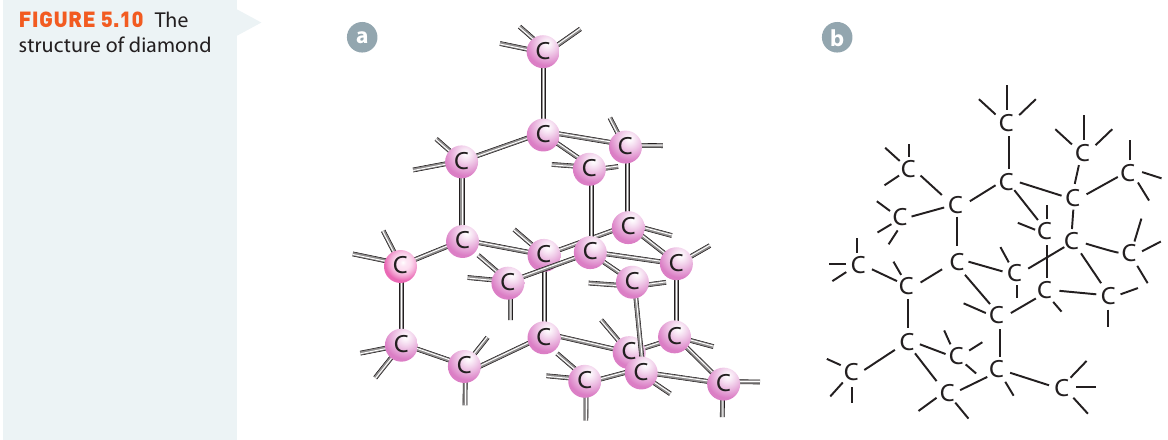
The diagram shows two ways of representing diamond's structure:
- Part (a) shows an expanded view with atoms as spheres connected by lines representing bonds
- Part (b) shows the simplified structure that chemists typically draw, where each line represents a covalent bond
Remember that in the actual crystal, the atoms overlap one another - the lines showing bonds have no physical reality but help us visualise the structure. Literally billions of atoms are connected this way in even a small diamond crystal.
Example 2: Silica (quartz)
Example
Worked Example: Silica Structure
Silica, with the chemical formula , provides another example of a covalent network solid. From the periodic table, we can predict the bonding:
- Silicon forms four covalent bonds
- Oxygen forms two covalent bonds
In silica's structure, each silicon atom bonds covalently to four oxygen atoms, and each oxygen atom bonds to two silicon atoms. This creates an infinite three-dimensional network of covalent bonds.
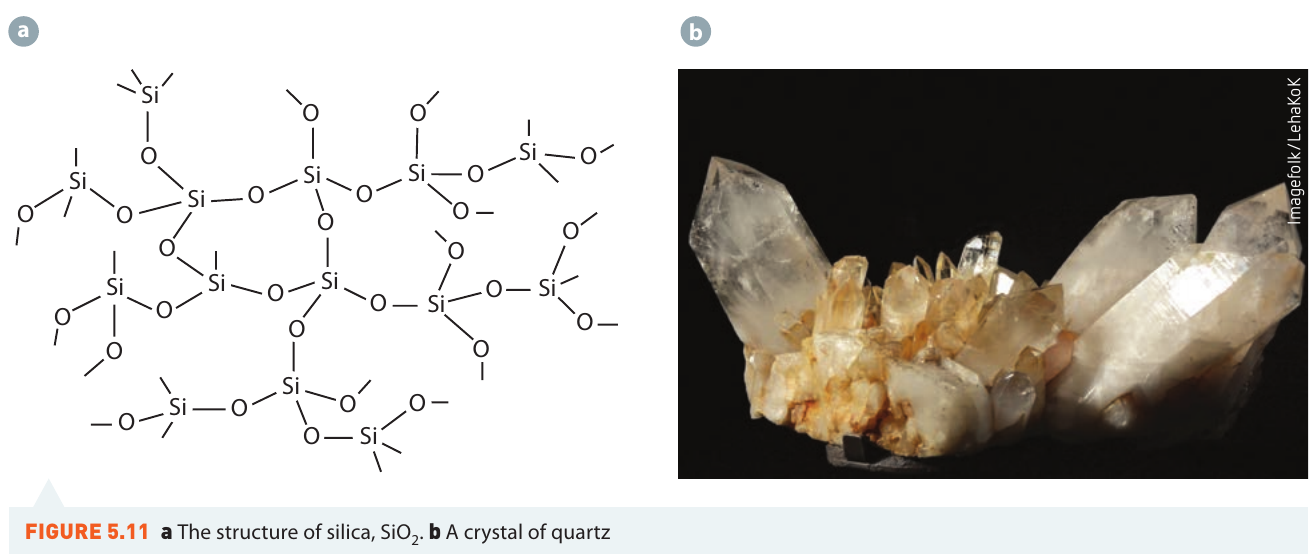
The chemical formula represents the ratio of atoms in the compound (two oxygen atoms for every silicon atom), making it an empirical formula.
Properties of covalent network solids
High melting points
Covalent network solids have extremely high melting points, typically well above . This is because:
- Melting requires breaking the crystal into smaller pieces that can move freely
- This means breaking many strong covalent bonds throughout the structure
- Breaking these bonds requires enormous amounts of energy
- Therefore, very high temperatures are needed
Important
The high melting points of covalent network solids are a direct consequence of the extensive network of strong covalent bonds. Unlike molecular solids where only weak intermolecular forces need to be overcome, melting a covalent network requires breaking actual covalent bonds throughout the entire structure.
Electrical conductivity
With one notable exception (graphite, discussed elsewhere), covalent network solids do not conduct electricity. This is because:
- They contain no ions that could carry charge
- All electrons are either held by individual atoms or shared between pairs of atoms
- No electrons are free to move through the structure
- Without mobile charge carriers, electricity cannot flow
Hardness
Covalent network solids are extremely hard and brittle. When subjected to stress, they shatter rather than deform.
Metallic bonding
Structure of metals
With the exception of mercury (which is liquid at room temperature), all metals are solids. They share several characteristic properties:
- Relatively high melting points
- Fairly hard
- Excellent conductors of electricity
- Malleable (can be hammered into sheets)
- Ductile (can be drawn into wires)
These properties all arise from a common structure known as metallic bonding or metallic structure.
What is metallic bonding?
Metallic bonding consists of an orderly three-dimensional array of positive ions held together by a mobile 'sea' of delocalised electrons.
Note
The Metallic Bonding Process:
Here's what happens in a metal:
- Valence electrons break away from their parent atoms
- This leaves behind positive ions arranged in an orderly pattern
- The free electrons, now delocalised (no longer belonging to particular atoms), move randomly throughout the structure
- These mobile electrons are shared by numerous positive ions
- Strong electrostatic attraction between the delocalised electrons and positive ions holds the metal together
Properties explained by metallic bonding
Electrical conductivity
Metals are excellent conductors of electricity because:
- The delocalised electrons can move freely throughout the lattice
- When a voltage is applied, these electrons flow in one direction
- Electric current in a metal wire is simply a flow of these delocalised electrons
Malleability and ductility
Metals have unique mechanical properties that distinguish them from other types of solids. While ionic and covalent lattices are hard but brittle (they shatter when struck), metals are both hard and workable - they can be shaped without breaking.
Malleability is the ability to be hammered or rolled into thin sheets.
Ductility is the ability to be drawn into wires.
Important
Why Metals Don't Shatter:
These properties arise because:
- When force is applied to a metal, the orderly array of positive ions can slide over one another
- The mobile electrons quickly adjust to the new arrangement
- The electrons continue to provide bonding that holds the structure together
- The metal deforms but doesn't break
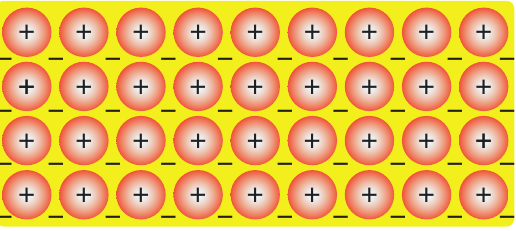
This contrasts sharply with ionic and covalent lattices. When these materials are sheared, the rigid bonding arrangements break, causing the material to shatter. The flexibility of metallic bonding allows metals to change shape while maintaining their structural integrity.
Comparison of solid types
Understanding the different types of solids and their properties helps us predict how materials will behave. The key properties used to distinguish between solid types are:
- Melting and boiling points
- Electrical conductivity
- Hardness
- Malleability and ductility (collectively called workability)
Here's a comprehensive comparison:
| Property | Molecular Solids | Metallic Solids | Ionic Lattice Solids | Covalent Lattice Solids |
|---|---|---|---|---|
| Melting and boiling points | Low | Variable | High | High |
| Conduct electricity? | No | Yes | As solid: No Molten: Yes | No |
| Hardness and/or workability | Soft | Variable hardness; malleable and ductile | Hard and brittle | Hard and brittle |
| Forces holding particles together | Intermolecular forces | Delocalised electrons (metallic bonding) | Electrostatic forces | Covalent bonding throughout the crystal |
Note
Exam Tip: Identifying Unknown Solids
When asked to identify an unknown solid, use these properties systematically:
- Check if it conducts electricity as a solid (indicates metal or graphite)
- Check its melting point (high suggests ionic or covalent lattice; low suggests molecular)
- Test its mechanical properties (malleable/ductile suggests metal; brittle suggests ionic or covalent lattice; soft suggests molecular)
Summary
Summary
Key Points to Remember:
-
Covalent network solids feature continuous covalent bonding throughout the entire crystal structure, with no individual molecules. Examples include diamond and silica ().
-
Covalent lattices have extremely high melting points (typically above ) because melting requires breaking many strong covalent bonds throughout the structure.
-
Metallic bonding consists of positive ions arranged in an orderly array, held together by a mobile 'sea' of delocalised electrons that are shared throughout the structure.
-
Metals conduct electricity because their delocalised electrons can move freely through the lattice, allowing current to flow when a voltage is applied.
-
Malleability and ductility (the ability to be shaped without breaking) are unique properties of metals that arise because delocalised electrons can adjust to new arrangements of positive ions when the metal is deformed, maintaining the bonding throughout.