Drawing Electron-Dot Structures (HSC SSCE Chemistry): Revision Notes
📚Revision Notes
Drawing Electron-Dot Structures
Introduction to electron-dot structures
Note
What are electron-dot structures?
Electron-dot structures (also called Lewis structures) are diagrams that show the valence electrons of atoms in a molecule or compound. These structures help us understand how atoms bond together and why compounds have specific formulas.
By following a systematic approach, you can draw electron-dot structures for any compound containing two elements. This skill is fundamental to understanding chemical bonding and predicting the properties of compounds.
The five-step process
When drawing electron-dot structures for compounds with two elements, you need to follow five key steps. These steps will help you determine whether the compound is ionic or covalent, and how to represent the bonding correctly.
Step 1: Determine valence electrons
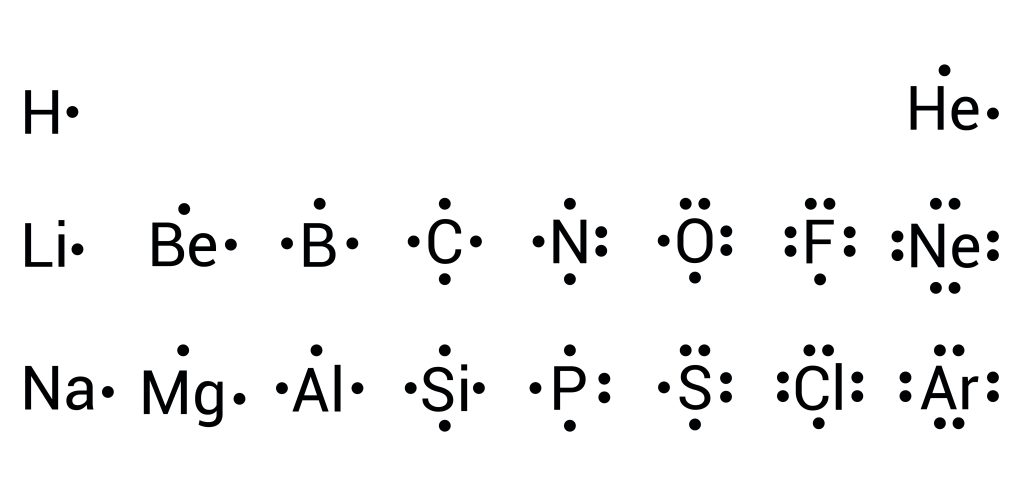
The first step is to work out how many valence electrons each atom has. You can find this by looking at the group number of each element on the periodic table. Once you know the number of valence electrons, draw that many dots around the element's symbol.
Note
Key point: Valence electrons are the electrons in the outermost shell of an atom - these are the electrons involved in bonding.
For example:
- Lithium () is in Group 1, so it has 1 valence electron
- Sulfur () is in Group 16, so it has 6 valence electrons
- Oxygen () is in Group 16, so it has 6 valence electrons
- Chlorine () is in Group 17, so it has 7 valence electrons
Step 2: Determine electron requirements for noble gas configuration
Next, work out how many electrons each atom needs to gain or lose to achieve a noble gas configuration. Noble gases have full outer electron shells, which makes them very stable. Atoms bond with other atoms to try to achieve this stable configuration.
Ask yourself:
- Does this atom need to lose electrons to become like the nearest noble gas?
- Does this atom need to gain electrons to become like the nearest noble gas?
For example:
- Lithium needs to lose to become like helium ()
- Sulfur needs to gain to become like argon ()
- Oxygen needs to gain to become like neon ()
- Chlorine needs to gain to become like argon ()
Step 3: Decide if the compound is ionic or covalent
Important
The Key Decision Point
Now you can classify the type of bonding in your compound based on electron behavior:
-
Ionic bonding occurs when one atom wants to lose electrons and the other wants to gain electrons. This typically happens between metals and non-metals.
-
Covalent bonding occurs when both atoms want to gain electrons. This typically happens between non-metals.
Remember: If one atom wants to gain electrons while the other wants to lose them, the compound will be ionic; if both want to gain electrons, then the compound will be covalent.
This decision point determines which path you follow next (Step 4 for ionic compounds or Step 5 for covalent compounds).
Step 4: Drawing ionic compounds
If your compound is ionic, follow these sub-steps to complete your electron-dot structure:
a) Calculate atom ratios
Work out how many atoms of each element are needed so that the total number of electrons lost equals the total number gained. This ensures the compound is electrically neutral overall.
b) Show electron transfer
Draw the atomic symbols and show the electrons being transferred from the metal atoms to the non-metal atom. Use arrows or positioning to indicate which electrons have moved.
c) Add charges
Put the appropriate charges on each ion. Remember that each electron lost produces one positive charge and each electron gained produces one negative charge.
d) Write the formula
If asked, write the chemical formula for the compound.
Example
Worked Example: Lithium Sulfide ()
Let's apply the ionic bonding steps to lithium and sulfur:
Step a) Calculate atom ratios:
- Each loses 1 electron
- Each gains 2 electrons
- Therefore, you need 2 Li atoms for every 1 S atom to balance the electron transfer
Step b) Show electron transfer: Draw the atomic symbols and show the two electrons from the two lithium atoms being transferred to the sulfur atom.
Step c) Add charges:
- Each has lost one electron →
- has gained two electrons →
Step d) Write the formula: The chemical formula is
Step 5: Drawing covalent compounds
If your compound is covalent, follow these sub-steps to complete your electron-dot structure:
a) Calculate atom ratios
Work out how many atoms of each element are needed for all atoms to achieve a noble gas configuration through sharing electrons.
b) Pair up electrons
Draw the electron-dot structure by pairing up electrons between atoms. Each pair of shared electrons represents a covalent bond. Make sure each atom achieves a noble gas configuration (usually 8 electrons around it, called the octet rule).
c) Draw the structural formula
If a structural formula is required, replace each shared pair of electrons (each bonding pair) with a dash.
d) Write the molecular formula
If a molecular formula is required, write it showing the number of each type of atom.
Example
Worked Example: Dichlorine Monoxide ()
Let's apply the covalent bonding steps to oxygen and chlorine:
Step a) Calculate atom ratios:
- Oxygen needs to gain 2 electrons, so it needs to share with two chlorine atoms
- Each chlorine needs to gain 1 electron, so each needs to share with one oxygen
- Therefore, you need 2 Cl atoms for every 1 O atom
Step b) Pair up electrons: Draw the electron-dot structure by pairing electrons between the oxygen and each chlorine atom. Make sure the oxygen ends up with 8 electrons around it (including the shared pairs), and each chlorine also has 8 electrons.
Step c) Draw the structural formula: Replace each shared pair with a dash:
Step d) Write the molecular formula: The molecular formula is
Important points about electron-dot structures
Note
Noble gas configuration: Most atoms follow the octet rule, meaning they want 8 electrons in their outer shell (like the noble gases neon and argon). Hydrogen and helium are exceptions - they only need 2 electrons to be stable.
Important
Exceptions to the octet rule
Some atoms can have fewer than 8 electrons (like boron in ) or more than 8 electrons (like phosphorus in or sulfur in ). However, for SSCE-level chemistry, you can generally assume atoms follow the octet rule unless specifically told otherwise.
The key difference between ionic and covalent bonding is whether electrons are transferred (ionic) or shared (covalent). Metals typically lose electrons and form positive ions, while non-metals gain or share electrons.
Exam tips
Note
Tips for Success
- Always start by determining valence electrons - this is the foundation for everything else
- Use the group number as a shortcut to find valence electrons
- Remember that the sum of electrons lost must equal electrons gained in ionic compounds
- In covalent compounds, count carefully to ensure each atom has the right number of electrons around it
- Practice with examples from different groups of the periodic table
- Double-check your work by counting electrons at each step
Remember!
Summary
Key Points to Remember:
- Electron-dot structures show valence electrons as dots around element symbols and help visualize how atoms bond together.
- Step 1: Determine valence electrons using group numbers and draw them as dots.
- Step 2: Work out if atoms need to gain or lose electrons to achieve noble gas stability.
- Step 3: Classify as ionic (one loses, one gains) or covalent (both gain through sharing).
- For ionic compounds: Calculate ratios, show electron transfer, add charges, and write the formula.
- For covalent compounds: Calculate ratios, pair electrons, draw structural formulas using dashes, and write molecular formulas.