Catalysts (HSC SSCE Chemistry): Revision Notes
📚Revision Notes
Catalysts
How catalysts work
Catalysts are substances that speed up chemical reactions without being permanently consumed or changed themselves. They function by offering an alternative reaction pathway that requires less activation energy than the uncatalysed reaction.
This lower activation energy means that more reactant particles have sufficient energy to react at any given temperature, significantly increasing the reaction rate. Catalysts are especially valuable when the uncatalysed reaction has extremely high activation energy and would otherwise proceed very slowly.
Note
The key benefit of catalysts is that they increase reaction rates without being used up in the process. This means even small amounts of catalyst can facilitate the conversion of large quantities of reactants.
Energy profiles for catalysed reactions
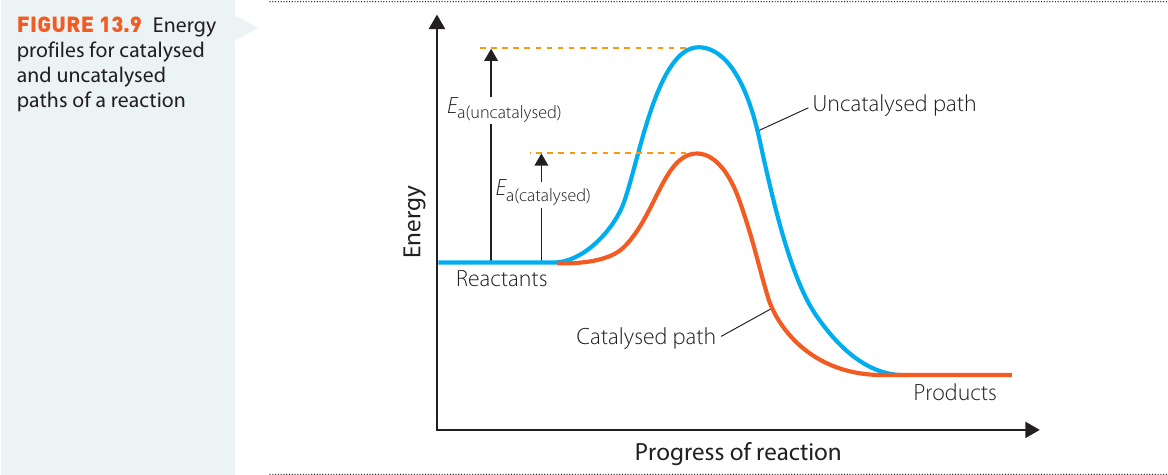
The diagram below illustrates how a catalyst affects the energy profile of a reaction:
Note
The blue curve shows the uncatalysed pathway with its higher activation energy ((uncatalysed)), whilst the orange curve shows the catalysed pathway with lower activation energy ((catalysed)). Notice that both pathways start at the same energy level (reactants) and end at the same energy level (products).
The catalyst does not change the overall energy change of the reaction - it only provides an easier route for the reaction to follow.
Types of catalysis
Homogeneous catalysis
In homogeneous catalysis, the catalyst exists in the same phase (solid, liquid, or gas) as the reactants. The catalyst participates in intermediate reactions but is regenerated by the end of the overall process, meaning there is no net consumption of the catalyst.
Example
Example: Oxidation of sulfur dioxide
The direct oxidation of sulfur dioxide to sulfur trioxide is extremely slow due to very high activation energy:
However, when nitrogen dioxide () is present as a catalyst, the following two reactions occur much more rapidly because both have relatively low activation energies:
When you combine these reactions (multiply the first equation by 2 and add to the second), you get the same overall result as the direct reaction. The key point is that is consumed in the first step but regenerated in the second step, so there is no overall consumption of the catalyst.
Heterogeneous catalysis
In heterogeneous catalysis, the catalyst is in a different phase from the reactants. Most commonly, the catalyst is a solid whilst the reactants are gases or in solution. This type of catalysis works through a surface mechanism.
Important
The mechanism involves three key steps:
-
Adsorption: Reactant particles (molecules or ions) attach themselves to the catalyst surface. This is called adsorption (note: not absorption). When particles adsorb onto the surface, some of their chemical bonds are broken or weakened.
-
Reaction: The adsorbed particles can now react more easily because their bonds are already weakened. In some reactions, gaseous or dissolved particles collide with these adsorbed particles. In other reactions, both reactants adsorb onto neighbouring sites on the catalyst surface and react with each other.
-
Desorption: The product particles detach from the catalyst surface, leaving it free to catalyse more reactions.
Memory aid: Think "Stick, React, Release" for the three steps!
Example
Example: Hydrogenation of ethylene
The reaction between ethylene and hydrogen to form ethane occurs on the surface of nickel metal:
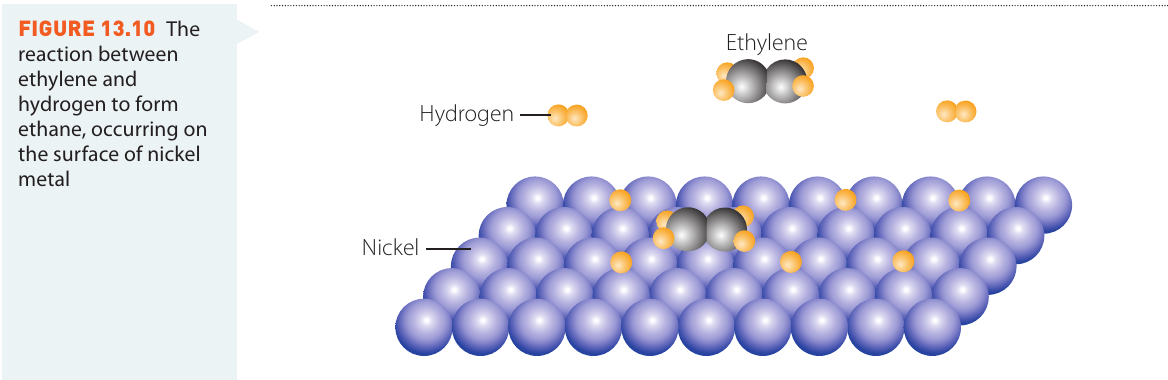
Hydrogen molecules adsorb onto the nickel surface as individual atoms. These hydrogen atoms then attach to carbon atoms in neighbouring ethylene molecules () that are also adsorbed on the surface. This forms ethane molecules (), which then desorb from the catalyst surface.
Catalytic converters in cars
A practical application of heterogeneous catalysis is found in the catalytic exhausts (catalytic converters) of modern cars. These devices use two different metal catalysts to remove harmful pollutants from exhaust gases.
Note
Two catalysts working together:
- Rhodium: catalyses the reaction between carbon monoxide and nitric oxide to form carbon dioxide and nitrogen gas
- Platinum: catalyses the oxidation of carbon monoxide and unburnt hydrocarbons (petrol) to carbon dioxide
Together, these catalysts remove three major pollutants from car exhaust: carbon monoxide, unreacted hydrocarbons, and nitric oxide.

The catalysts are deposited as very thin films on the surfaces of a ceramic honeycomb-shaped block. This structure provides an enormous surface area for the catalytic reactions to occur, making the process highly efficient.
Biological catalysts (enzymes)
Enzymes are biological catalysts found in all living organisms. They are proteins that facilitate essential chemical reactions in living cells. Without enzymes, these vital reactions would proceed far too slowly to sustain life.
Key characteristics of enzymes
- Specificity: Each enzyme catalyses only one particular reaction. Living organisms contain many different enzymes, each with its own specific function.
- Efficiency: Enzymes are extraordinarily efficient catalysts. Even small concentrations can increase reaction rates by factors of (one thousand times) to (one million times). Ordinary chemical catalysts are nowhere near this efficient.
Important
Enzymes are far more efficient than ordinary chemical catalysts. This extraordinary efficiency is what makes life possible - biological reactions need to occur rapidly at body temperature, and only enzymes can achieve this level of catalytic activity.
Examples of enzymes
- Amylase: Found in saliva, this enzyme catalyses the breakdown of starch molecules into the disaccharide maltose. This begins the process of digesting carbohydrates as soon as food enters your mouth.
- Lipase: Present in the stomach, lipase catalyses the decomposition of fats into glycerol and fatty acids, helping with fat digestion.
- Multiple enzymes: A whole set of enzymes works together to catalyse the reaction between glucose and oxygen, releasing the energy that cells and organisms need to function.
Without their specific enzymes, each of these biological reactions would proceed extremely slowly or not at all, making life impossible.
Summary
Key Points to Remember:
-
Catalysts lower activation energy by providing an alternative reaction pathway, speeding up reactions without being consumed.
-
Homogeneous catalysis occurs when the catalyst is in the same phase as the reactants, participating in intermediate steps but being regenerated overall.
-
Heterogeneous catalysis involves a solid catalyst with reactants in a different phase, working through adsorption, reaction, and desorption on the catalyst surface.
-
Enzymes are biological catalysts (proteins) that are highly specific and can accelerate reactions by factors of to - far more efficient than ordinary chemical catalysts.
-
Catalytic converters in cars use platinum and rhodium to remove harmful pollutants from exhaust gases through heterogeneous catalysis.