Temperature and Activation Energy (HSC SSCE Chemistry): Revision Notes
📚Revision Notes
Temperature and Activation Energy
What is activation energy?
When chemists study how quickly reactions occur, they often measure the reaction rate at different temperatures. Through these measurements, they can determine an important property called the activation energy, represented by the symbol . This value tells us how sensitive a particular reaction is to temperature changes.
Think of activation energy as the minimum energy hurdle that reactants must overcome to successfully transform into products. Different reactions have different activation energy values, which explains why some reactions speed up dramatically when heated while others show only modest increases in rate.
Note
The activation energy of a reaction is determined experimentally by measuring reaction rates at various temperatures. This systematic approach allows chemists to quantify exactly how much energy is needed to initiate a specific reaction.
How temperature affects reactions with different activation energies
Reactions with larger activation energies show a much stronger response to temperature increases compared to reactions with smaller activation energies. This relationship is beautifully demonstrated when we compare reactions that proceed at similar speeds at room temperature but behave quite differently as temperature rises.
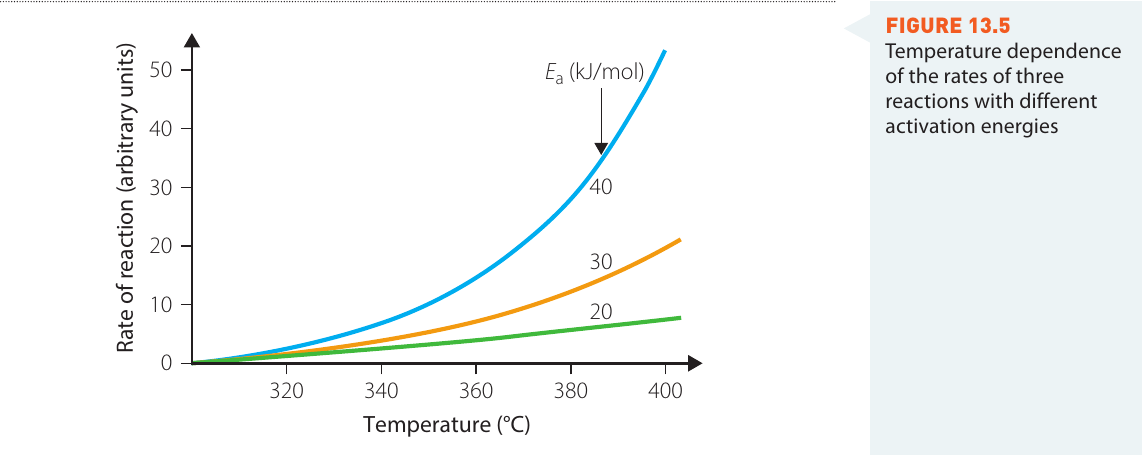
The graph above shows three different reactions, each with a different activation energy (, , and kJ/mol). Notice how all three reactions have similar rates around , but as temperature increases, their behaviours diverge significantly. The reaction with kJ/mol (blue curve) shows the steepest increase in rate with temperature, whilst the reaction with kJ/mol (green curve) shows the most gradual increase.
Important
Key Relationship: The higher the activation energy, the more dramatically the reaction rate responds to temperature changes. This is why reactions with high activation energies are particularly sensitive to temperature, making temperature control crucial in many industrial chemical processes.
This pattern reveals a fundamental principle that helps chemists predict and control reaction behaviour in both laboratory and industrial settings.
Understanding the energy barrier
Activation energy represents an energy barrier that stands between reactants and products. Picture this barrier as a hill that reactant particles must climb before they can transform into products. The height of this hill determines how difficult the transformation will be.
When reactant particles collide with sufficient kinetic energy, they can climb to the top of this energy barrier and then "roll down" the other side, emerging as product molecules. However, if the colliding particles lack sufficient energy, they only make it partway up the hill before sliding back down. In this case, the particles simply bounce apart, remaining as unreacted reactants.
Note
Visualising the Energy Barrier
Energy diagrams help visualise this concept. These diagrams show energy on the vertical axis and the progress of the reaction on the horizontal axis. The reactants start at one energy level, must rise to a peak (the activation energy), and then descend to the products' energy level. The vertical distance from the reactants' energy level to the peak represents the activation energy .
The relationship is straightforward: higher activation energy means a taller barrier. A taller barrier is more difficult to overcome, resulting in fewer successful reactions per unit time. This explains why reactions with high activation energies proceed more slowly at any given temperature compared to reactions with lower activation energies.
Why activation energy matters for reaction rates
Understanding activation energy helps chemists predict and control reaction behaviour. At a given temperature, only a fraction of colliding particles possess enough kinetic energy to overcome the activation energy barrier. Reactions with higher activation energies require more energetic collisions, making successful reactions less frequent.
This concept also explains why increasing temperature speeds up reactions. Higher temperatures mean particles move faster on average, giving more particles sufficient energy to overcome the activation energy barrier. For reactions with high activation energies, this temperature increase is particularly effective because it dramatically increases the proportion of particles with enough energy to react.
Important
Exam Tip: When asked to explain why increasing temperature speeds up a reaction, remember to mention that higher temperature increases the kinetic energy of particles, allowing more collisions to exceed the activation energy threshold.
Connection to collision theory
The concept of activation energy connects directly to collision theory. For a reaction to occur, particles must not only collide, but they must collide with sufficient energy to overcome the activation energy barrier. Additionally, particles must be correctly oriented during collision. The activation energy represents the minimum energy requirement that must be met for a collision to result in a successful reaction.
Note
Collision theory helps explain why not all collisions between reactant particles lead to products. Two key conditions must be met: the particles must have enough energy (exceeding ) and they must be properly oriented during the collision.
Summary
Summary
Key Points to Remember:
- Activation energy () is the minimum energy barrier that reactants must overcome to form products
- Reactions with higher activation energies show greater sensitivity to temperature changes - their rates increase more dramatically when heated
- Activation energy acts as an energy hill - particles need sufficient kinetic energy to climb over it and form products
- At any given temperature, only particles with energy exceeding can successfully react
- Higher barriers mean slower reactions because fewer collisions have sufficient energy to overcome the activation energy