Acid-Base and Acid-Carbonate Reactions (HSC SSCE Chemistry): Revision Notes
📚Revision Notes
Acid-Base and Acid-Carbonate Reactions
Introduction to acids and bases
Acids and bases are important chemical substances found in both household products and industrial processes. Understanding their properties and reactions is fundamental to chemistry. In this topic, we explore how these substances behave, how they react with each other, and their practical applications.
Note
Acid-base chemistry is one of the most fundamental topics in chemistry, with applications ranging from everyday household products to complex industrial processes. The reactions you'll learn about here form the basis for understanding many chemical processes.

What are acids?
An acid is a substance that produces hydrogen ions () when dissolved in solution. However, hydrogen ions do not exist freely in aqueous solution. Instead, they attach to water molecules to form hydronium ions (). For convenience, we often write in equations, but it's important to remember the actual form is .
Note
The hydronium ion () is the actual form of hydrogen ions in aqueous solution. When an acid dissolves in water, the ion immediately bonds with a water molecule. While we write in equations for simplicity, always remember that hydronium ions are what's really present in the solution.
Common acids
The most frequently encountered acids in chemistry include:
- Hydrochloric acid () - found in stomach acid and used in industry
- Sulfuric acid () - used in car batteries and fertiliser production
- Nitric acid () - used in fertilisers and explosives
- Phosphoric acid () - found in soft drinks
- Acetic acid () - the main component of vinegar
- Carbonic acid () - forms when carbon dioxide dissolves in water
Everyday household substances containing acids include vinegar (approximately 6% acetic acid), lemons (containing citric acid), vitamin C, and aspirin.
Properties of acids
Acids share several characteristic properties that arise from the presence of hydrogen ions:
- Sour taste - although you should never taste chemicals in a laboratory setting
- Electrical conductivity - acids conduct electricity when dissolved in water due to the presence of ions
- Litmus test - acids change blue litmus paper to red
Important
Laboratory Safety: Never taste chemicals in a laboratory setting, even if they might taste sour! Always follow proper safety protocols when handling any chemical substances.
A useful memory aid for litmus testing is BAR: Blue in Acid goes Red.
What are bases?
A base is a substance that contains the hydroxide ion (), the oxide ion (), or produces the hydroxide ion when dissolved in solution. Metallic oxides and hydroxides are ionic compounds that contain these ions, making them bases.
Common bases
Frequently encountered bases include:
- Sodium hydroxide () - used in drain cleaners and soap making
- Barium hydroxide ()
- Magnesium oxide () - used in antacids
- Iron(III) oxide () - rust
- Copper hydroxide ()
- Ammonia () - used in cleaning products
Alkalis
Alkalis are bases that dissolve in water. Not all bases are alkalis because some are insoluble. For example:
- Sodium hydroxide and potassium hydroxide are both bases and alkalis (soluble)
- Magnesium oxide and copper hydroxide are bases but not alkalis (insoluble)
Note
Understanding the Difference:
All alkalis are bases, but not all bases are alkalis. The key distinction is solubility in water:
- Bases = compounds containing or producing or ions
- Alkalis = bases that are soluble in water
Think of alkalis as a subset of bases.
Common household alkalis include sodium hydroxide (found in oven cleaners), sodium carbonate (washing soda), and magnesium hydroxide (found in antacids and toothpaste).
Properties of alkalis
Alkalis have distinct properties that help identify them:
- Soapy feel - they feel slippery to touch
- Bitter taste - though students should never taste chemicals
- Electrical conductivity - like acids, they conduct electricity in solution due to ions
- Litmus test - alkalis turn red litmus paper blue (the opposite of acids)
Important
Laboratory Safety: Never taste chemicals or touch them with bare hands in a laboratory setting! Alkalis can be corrosive and cause chemical burns. Always wear appropriate protective equipment.
Neutralisation reactions
When an acid reacts with a base, they undergo a neutralisation reaction. This type of reaction produces ionic compounds called salts, typically along with water.
The general equation for neutralisation is:
A salt can be defined in two ways:
- An ionic compound formed when a base reacts with an acid
- A compound formed when the hydrogen ion of an acid is replaced by a metal ion
Examples of neutralisation reactions
Example
Example 1: Acid-Alkali Neutralisation
Sodium hydroxide (an alkali) reacts with hydrochloric acid to form sodium chloride and water:
This is a classic neutralisation producing common table salt and water.
Example
Example 2: Acid-Base Neutralisation
Nitric acid reacts with iron(III) oxide (a base) to form iron(III) nitrate and water:
Notice how the coefficients are balanced to ensure equal numbers of each type of atom on both sides.
Example
Example 3: Exception to the Rule
Sulfuric acid reacts with ammonia (an alkali) to form ammonium sulfate:
This reaction doesn't produce water, showing that while most neutralisation reactions produce water, some exceptions exist.
Ionic equations for neutralisation
In aqueous acid solutions, hydrogen ions () are present along with their corresponding anions (such as , , or ). During neutralisation, bases react specifically with these hydrogen ions. The anions remain unchanged in solution and are called spectator ions because they don't participate in the actual reaction.
For the reaction between hydrochloric acid and sodium hydroxide, we can write a complete ionic equation:
Since both and are spectator ions, the net ionic equation is:
Note
This net ionic equation represents the fundamental neutralisation process for many acid-alkali reactions. Regardless of which specific acid and alkali react, the essential process is the combination of hydrogen ions and hydroxide ions to form water.
Example
Worked Example: Calcium Hydroxide and Nitric Acid
Let's work through the complete process of writing ionic equations for this neutralisation reaction.
Step 1: Write the complete formula equation
Step 2: Write the complete ionic equation
Separate all aqueous ionic compounds into their constituent ions:
Step 3: Identify and remove spectator ions
and appear on both sides unchanged, so they are spectator ions.
Step 4: Write the net ionic equation
Notice this is the same net ionic equation as for other acid-alkali reactions!
Preparing salts
Salts can be prepared through neutralisation reactions. For example, to prepare zinc sulfate, we would react zinc hydroxide with sulfuric acid:
Naming salts from acids
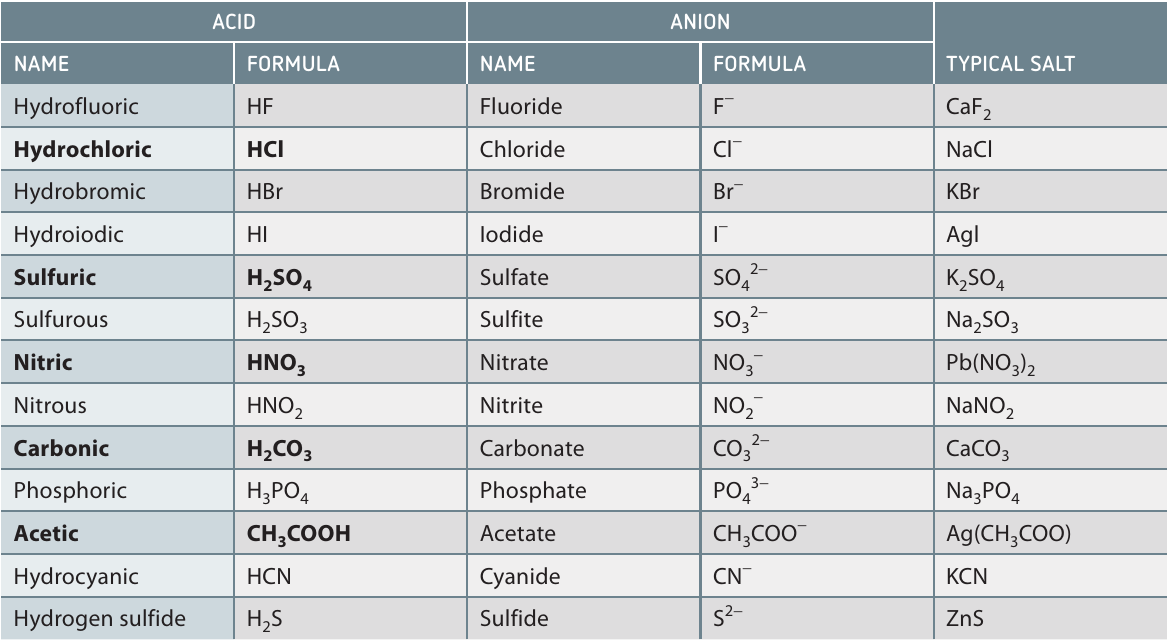
Understanding how to name salts and predict their formulae is an essential skill in chemistry. The relationship between acids and the salts they form follows predictable patterns.
Naming patterns
The metal ion (or cation) is named first, followed by the anion name derived from the acid:
Hydrohalic acids (hydrochloric, hydrobromic, hydroiodic) form salts called halides:
- Hydrochloric acid () forms chlorides (e.g., magnesium chloride, )
- Hydrobromic acid () forms bromides (e.g., potassium bromide, )
- Hydroiodic acid () forms iodides (e.g., silver iodide, )
Oxyacids have oxygen attached to elements like sulfur, nitrogen, phosphorus, or carbon. When an oxyacid name ends in '-ic', the salt name ends in '-ate':
- Sulfuric acid () forms sulfates (e.g., aluminium sulfate, )
- Nitric acid () forms nitrates (e.g., lead nitrate, )
- Carbonic acid () forms carbonates (e.g., potassium carbonate, )
- Phosphoric acid () forms phosphates (e.g., sodium phosphate, )
- Acetic acid () forms acetates (e.g., silver acetate, )
Anions formed from oxyacids are called oxyanions.
Determining salt formulae
To work out the formula of a salt, you need to:
- Identify the acid and determine the charge on its anion (from the number of ions it loses)
- Identify the charge on the metal ion (cation)
- Combine them in a ratio where total positive charges equal total negative charges
Example
Worked Example 1: Calcium Nitrate
Step 1: Determine the anion charge
- Nitric acid is
- It loses one ion
- Therefore, the nitrate ion is (charge of )
Step 2: Determine the cation charge
- Calcium is in Group 2
- Group 2 elements form ions with charge
- Therefore, calcium forms ions
Step 3: Balance the charges
- One ion has a charge of
- To balance this, we need two ions (each )
- Total: from calcium, from two nitrates
Formula:
Example
Worked Example 2: Iron(III) Sulfate
Step 1: Determine the anion charge
- Sulfuric acid is
- It loses two ions
- Therefore, the sulfate ion is (charge of )
Step 2: Determine the cation charge
- Iron(III) indicates the iron has a charge
- Therefore, we have ions
Step 3: Balance the charges
- Two ions provide a total charge of
- Three ions provide a total charge of
- This gives us a balanced formula
Formula:
Acid-carbonate reactions
Carbonates are salts of carbonic acid (). When carbonates react with acids, they produce three products: a salt, carbon dioxide gas, and water. This is a characteristic reaction that makes carbonates easy to identify.
General pattern of acid-carbonate reactions
The general equation for these reactions is:
Note
The production of carbon dioxide gas is the key identifying feature of acid-carbonate reactions. You'll see bubbling or fizzing as the gas is released, which is why carbonates "fizz" when acids are added to them.
Examples of acid-carbonate reactions
Example
Example 1: Copper Carbonate with Sulfuric Acid
Green copper carbonate reacts with sulfuric acid to produce blue copper sulfate solution, along with carbon dioxide gas and water.
Example
Example 2: Potassium Carbonate with Hydrochloric Acid
Note that two molecules of hydrochloric acid are needed to react with one formula unit of potassium carbonate.
Example
Example 3: Silver Carbonate with Nitric Acid
Silver carbonate reacts with nitric acid to form soluble silver nitrate, releasing carbon dioxide and forming water.
Ionic equations for acid-carbonate reactions
In all these reactions, the hydrogen ion from the acid reacts with the carbonate. We can write partial ionic equations to show this:
Whether the carbonate is in solution or solid form, it's the carbonate ion reacting with hydrogen ions. The general net ionic equation is:
Important
This net ionic equation applies to carbonates of all metals, whether they're soluble or insoluble. This universal equation shows that the fundamental chemistry is the same regardless of which metal carbonate is used.
Test for carbon dioxide
The production of carbon dioxide in acid-carbonate reactions provides a useful test for identifying carbon dioxide gas in the laboratory.
Limewater test: The standard test involves bubbling the gas through clear limewater (calcium hydroxide solution). If carbon dioxide is present, the solution turns milky white due to the formation of insoluble calcium carbonate:
Note
The insoluble calcium carbonate forms as very fine particles that remain suspended in the solution, giving it a characteristic milky appearance. This is a reliable and easy test to perform in the laboratory and is the standard method for confirming the presence of carbon dioxide.
Real-world application: cycad fruit processing
Aboriginal and Torres Strait Islander Peoples have used chemical processes for thousands of years, long before formal chemistry was established as a science. One fascinating example is the processing of cycad fruit to make it safe for consumption.
The challenge
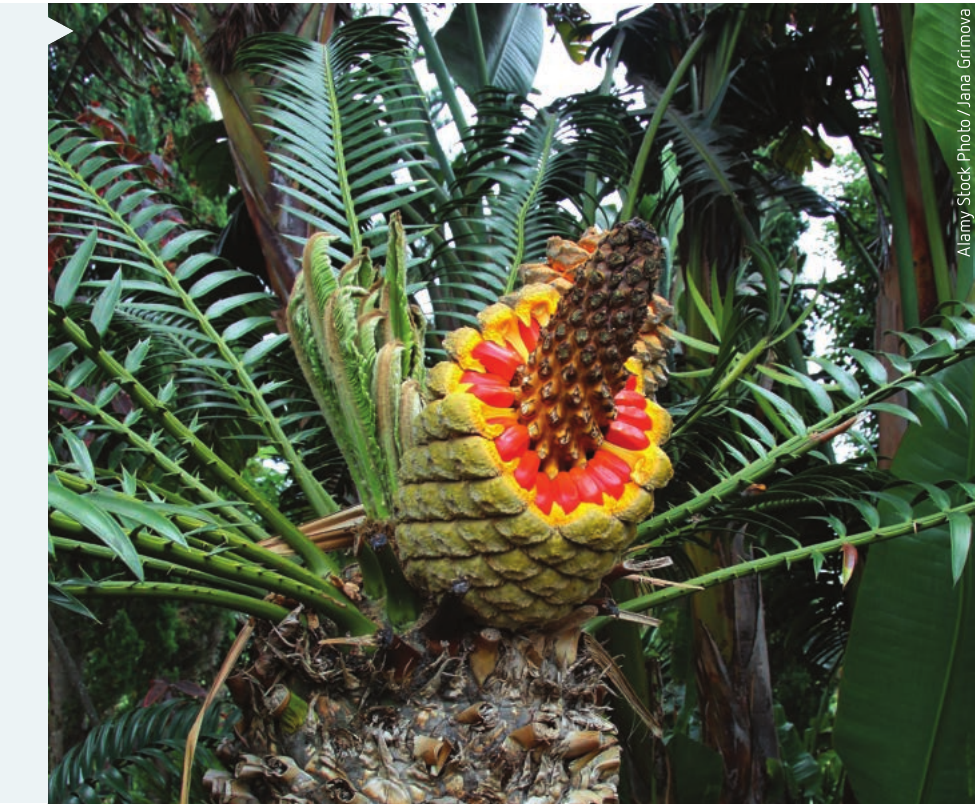
Cycads are a type of palm that grows commonly in northern and north-eastern Australia. Whilst cycad fruit has been a traditional food source for Indigenous peoples for millennia, the fruit as harvested is poisonous and requires careful treatment to become edible.
Traditional processing methods
Indigenous peoples developed several sophisticated methods to detoxify cycad fruit, involving both physical and chemical processes:
Note
Method 1 - Leaching
The fruit is cut up and placed in coarse mesh bags, then soaked in running water for 3-5 days. During this time, toxic materials dissolve and are washed away (leached out), leaving behind insoluble starchy material that is safe to eat. This is primarily a physical separation process.
Note
Method 2 - Heat Treatment and Leaching
The cut-up fruit is first heated to decompose the toxins through chemical reactions. A much shorter leaching time in water then removes any remaining toxic material. This combines chemical decomposition with physical removal.
Note
Method 3 - Fermentation
The fruit is immersed in a container or pit of water for several days. During this period, fermentation reactions (chemical reactions involving microorganisms) destroy the toxins. The seeds are then washed and ready to use. This relies primarily on chemical transformation.
Final preparation
After treatment, the seeds are typically ground into a meal and baked on hot stones to create a type of flat bread. This bread is nutritious, though relatively bland in flavour.
Significance
This development of effective chemical processes in ancient times demonstrates sophisticated understanding of chemistry principles, even without formal scientific knowledge. Similar trial-and-error chemical processes were developed by many cultures throughout history, including methods for extracting metals and creating alloys like copper, bronze, and iron.
Important
Modern chemistry allows us to understand these traditional processes scientifically and to predict outcomes more quickly and accurately. However, the foundational knowledge often comes from these ancient practices, demonstrating that chemistry has been practiced for millennia, long before it was formally recognized as a science.
Summary
Summary
Key Points to Remember:
-
Acids produce hydrogen ions () in solution, which actually exist as hydronium ions (). They turn blue litmus red (BAR - Blue in Acid goes Red).
-
Bases contain hydroxide () or oxide () ions, or produce hydroxide ions in solution. Alkalis are bases that dissolve in water.
-
Neutralisation reactions occur when acids and bases react to form salts and usually water. The net ionic equation for many acid-alkali reactions is:
-
Salt naming: When oxyacids ending in '-ic' form salts, the salt name ends in '-ate' (e.g., sulfuric acid → sulfate, nitric acid → nitrate).
-
Acid-carbonate reactions always produce carbon dioxide gas, which can be tested using limewater. The general net ionic equation is: