Dispute Resolution (HSC SSCE Economics): Revision Notes
📚Revision Notes
Dispute Resolution
Introduction to dispute resolution
Dispute resolution is a critical function of any industrial relations system. Alongside determining wages and working conditions, an effective system must provide mechanisms to resolve conflicts between employers and employees when they arise. These conflicts, known as industrial disputes, can emerge from disagreements over various workplace issues and may lead to industrial action that disrupts normal business operations.
The goal of dispute resolution processes is to settle conflicts quickly, fairly and efficiently. This matters because unresolved disputes can cause serious economic consequences, including reduced productivity, lower output, declining profits and damaged customer relationships. A well-functioning dispute resolution framework benefits both workers and employers by minimizing disruption while ensuring fair outcomes.
Note
Effective dispute resolution is just as important as wage determination in maintaining a functioning industrial relations system. Without proper mechanisms to resolve conflicts, workplace disagreements can escalate into costly disruptions that harm businesses, workers, and the broader economy.
What are industrial disputes?
Important
Definition of Industrial Dispute
An industrial dispute occurs when employers or employees take action to disrupt the production process in order to highlight a disagreement between employers and employees.
Disputes typically arise from disagreements over several key issues:
- Changes to wages or salary levels
- Modifications to working conditions
- Business restructuring or organizational changes
- Specific employer actions that employees consider unfair or unjust, such as dismissals
Types of industrial action
When disputes escalate, they may result in various forms of industrial action:
Strikes occur when employees withdraw their labour and refuse to work. This is the most visible form of industrial action and completely halts production during the strike period.
Work bans involve employees refusing to undertake specific aspects of their work while continuing other duties. This selective action allows workers to maintain some income while still applying pressure on employers.
Lockouts represent employer-initiated action where employers refuse to give employees access to their workplace. This prevents workers from performing their duties even if they wish to do so.
Consequences of industrial action
Industrial action creates significant costs for businesses and the broader economy. Productivity falls when workers are not at their posts or are performing limited duties. Output declines as production slows or stops entirely. Profits suffer both from lost production and from potential damage to customer relationships if service is interrupted.
Important
Economic Impact of Industrial Disputes
Industrial action leads to:
- Reduced productivity across affected workplaces
- Lower output as production slows or halts
- Declining profits from both lost production and damaged customer relationships
- Broader economic costs when disputes affect critical industries
These consequences explain why effective dispute resolution mechanisms are essential to a functioning economy.
Australia's approach to dispute resolution
Australia has developed a unique system for handling industrial disputes that differs from approaches used in many other countries. Since the early 20th century, Australia has relied on specialist industrial tribunals to administer dispute resolution processes.
These specialist tribunals serve important purposes. They aim to prevent the drawn-out disputes that occur in countries without such mechanisms. They also provide an independent umpire who can make judgments based on considerations of fairness and prevailing business conditions, rather than simply allowing the side with more economic power to prevail.
Note
Australia's tribunal-based system represents a distinctly Australian approach to managing workplace conflict. Unlike many other countries that rely primarily on direct negotiation or court systems, Australia uses specialized industrial relations bodies to balance the interests of both employers and employees through independent oversight.
Traditional dispute resolution methods
Australian industrial relations has historically employed two main approaches to resolving disputes: conciliation and arbitration. Understanding the difference between these methods is essential for grasping how the system has evolved.
Conciliation
Important
Definition: Conciliation
Conciliation is a dispute resolution process in which firms and employees meet to discuss their differences in the presence of a third party (such as from an industrial tribunal) who attempts to bring the parties to an agreement.
The key features of conciliation are:
- The tribunal acts as a facilitator, not a decision-maker
- Both parties work toward reaching a mutual agreement
- The tribunal does not impose a resolution on the parties
- Once parties reach agreement, they may undertake formal proceedings with the tribunal to implement their respective commitments
- The process emphasizes cooperation and negotiation
Conciliation is generally the preferred first step in dispute resolution because it allows the parties themselves to determine the outcome. This often leads to more sustainable agreements since both sides have actively participated in creating the solution.
Arbitration
Important
Definition: Arbitration
Arbitration is a dispute resolution process in which an industrial tribunal hands down a legally binding ruling to firms and employees.
The arbitration process operates differently from conciliation:
- The tribunal acts as a decision-maker with legal authority
- Both parties present their arguments and evidence to the tribunal
- The tribunal makes a binding ruling that resolves the dispute
- Parties must comply with the ruling, which has legal force
- Arbitration typically occurs when conciliation has been unsuccessful
- The ruling can require employees to return to work
Note
Conciliation vs. Arbitration
Think of the progression as: "Try to agree (Conciliation) before being told what to do (Arbitration)."
Conciliation allows parties to craft their own solution with guidance, while arbitration involves an imposed decision. This is why conciliation is always attempted first – self-determined solutions tend to be more acceptable and lasting than imposed ones.
Modern dispute resolution framework
Australia has undergone a fundamental shift in its approach to industrial dispute resolution. The system has moved away from resolving disputes mainly through compulsory arbitration toward a framework where arbitration is used only in rare circumstances. Today, employers and employees bear primary responsibility for resolving their own disputes.
Under the Fair Work Act, the Fair Work Commission has limited powers to intervene in disputes. This represents a deliberate policy choice to encourage direct negotiation between parties while maintaining regulatory oversight for exceptional situations.
Four main intervention mechanisms
The Fair Work Commission can intervene through four specific mechanisms:
Note
1. Compulsory Dispute Settlement Terms
All awards and enterprise agreements must include clear procedures for handling disputes. The Fair Work Act mandates that agreements must explain the process parties will follow if a dispute arises relating to their agreement.
A common feature of such terms is that if parties cannot resolve a dispute between themselves, they must refer it to a third party organization for assistance. This third party might be the Fair Work Commission itself or a non-government organization that offers dispute resolution services.
This mechanism ensures that every workplace has an established pathway for addressing conflicts before they escalate.
Note
2. Bargaining in Good Faith
Both employers and employees must comply with six good faith requirements, including:
- Participating in all meetings
- Disclosing relevant information
- Giving genuine consideration to all proposals
- Refraining from conduct that would undermine collective bargaining
Although it rarely exercises these powers, the Fair Work Commission can make legally binding orders if either side breaches their obligation to bargain in good faith.
The purpose of these rules is to pressure both parties in a negotiation to be constructive and work toward reaching agreement rather than engaging in strategic behavior that prevents resolution.
Note
3. Intractable Bargaining Declarations
This more recent addition to the Commission's powers came into effect in 2023. The Fair Work Commission can make a declaration where negotiations have become "intractable" – meaning the parties are genuinely stuck and unable to progress.
After an optional period allowing parties to finalize negotiations, the Commission can decide the outcome through a workplace determination. This mechanism provides a solution for situations where prolonged negotiations have reached a genuine impasse.
Note
4. Resolving Industrial Action
Industrial action is permitted during the bargaining process, but the Fair Work Commission can suspend or terminate such action only if special circumstances exist. These circumstances include:
- Situations where there is a threat of significant harm to the economy or the population
- Cases where industrial action has continued for a lengthy period and is causing damage to the bargaining parties
This mechanism balances the right to take industrial action with protection against excessive or harmful disputes.
Trends in industrial disputes
The effectiveness of an industrial relations system can be measured by examining the frequency and duration of industrial disputes. Australia's experience shows a dramatic decline in disputes over recent decades.
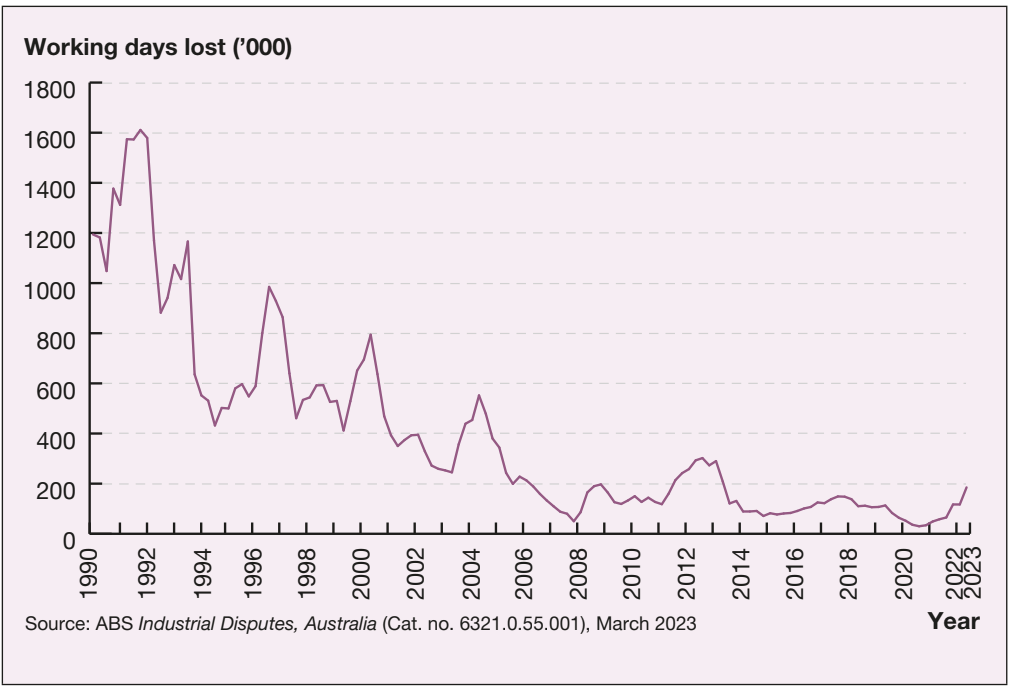
This graph reveals that Australia has experienced very low levels of working days lost to industrial disputes in recent years. This stands in stark contrast to earlier periods – for instance, more than 4 million working days were lost due to disputes in 1981. The data shows a clear downward trend from the early 1990s through to 2023, with working days lost declining from peaks of around 1,600,000 to less than 200,000.
Reasons for declining disputes
Several factors explain this substantial reduction in industrial disputes:
Changed employer-employee relations reflect a fundamental shift in workplace culture. There is now less conflict and a stronger focus on cooperation between employers and employees in resolving disputes themselves. Both parties increasingly recognize the costs of prolonged disputes and seek collaborative solutions.
Increased competitive pressures have made businesses more cost-conscious and less able to absorb the productivity losses associated with industrial action. Globalization and market competition create incentives for both sides to avoid costly disruptions.
Industry structure changes have shifted employment away from traditionally unionized manufacturing sectors toward service industries where dispute patterns differ.
Lower union membership has reduced the organizational capacity for coordinated industrial action. With fewer workers belonging to unions, the ability to organize large-scale strikes has diminished.
Legal restrictions on strikes introduced since the 1990s have also played a role. Laws now only allow industrial action during formal bargaining processes and only in very limited circumstances when an enterprise agreement is in force. These restrictions make it more difficult to take industrial action legally.
Note
The Positive Role of Disputes
Despite trends toward fewer disputes, the Productivity Commission has noted that industrial disputes can play a positive role. They can reduce workplace power imbalances and may improve efficiency in the long term by forcing resolution of underlying problems.
This suggests that the goal should not be to eliminate all disputes, but rather to ensure they are resolved efficiently and fairly when they do arise.
Summary
Key Points to Remember
-
Industrial disputes occur when workplace conflicts lead to actions that disrupt production, highlighting disagreements between employers and employees
-
Three main types of industrial action exist: strikes (withdrawal of labour), work bans (refusal to perform specific tasks), and lockouts (employer denial of workplace access)
-
Conciliation and arbitration are the two traditional methods, with conciliation focusing on facilitated agreement and arbitration involving binding tribunal decisions
-
Australia has shifted from compulsory arbitration to a system where parties resolve most disputes themselves, with Fair Work Commission intervention only in exceptional circumstances through four specific mechanisms
-
Industrial disputes have declined dramatically since the 1990s due to changed workplace relations, competitive pressures, legal restrictions, and lower union membership