Labour Market Equilibrium (HSC SSCE Economics): Revision Notes
📚Revision Notes
Labour Market Equilibrium
Understanding labour market equilibrium
Labour markets differ from most other markets because they do not operate as perfectly competitive markets. Various institutions influence how labour markets function, affecting both wage determination and employment levels. However, examining the theoretical model of labour market equilibrium under perfect competition provides valuable insights into how these markets work.
Note
This theoretical framework shows how supply and demand forces interact to determine wages and employment in the absence of institutional interventions. Understanding this model provides the foundation for analyzing real-world labour markets, even though actual markets rarely achieve perfect competition.
How equilibrium is determined
Labour market equilibrium occurs when the quantity of labour that workers are willing to supply exactly matches the quantity of labour that firms want to hire. This happens at the intersection of the labour supply and demand curves.
The supply curve
The labour supply curve slopes upward from left to right. This means that as wages increase, more people are willing to work or existing workers are prepared to work longer hours.
When deciding whether to work, individuals weigh up two competing factors:
- The satisfaction gained from leisure (non-working activities including rest, recreation and education)
- The satisfaction gained from real income earned through work, which can be spent on goods and services
As wages rise, the opportunity cost of leisure increases. In other words, by choosing not to work, individuals give up more potential income. This makes work more attractive compared to leisure, encouraging people to substitute leisure time for working time.
Note
The Backward Bending Supply Curve
An interesting phenomenon occurs at very high wage rates. Workers can maintain their desired income level by working fewer hours when wages are sufficiently high. This causes the labour supply curve to become backward bending at higher wage levels, meaning labour supply actually decreases as wages continue to rise.
In practice, most economists agree that labour supply does not change significantly in response to wage changes. This means labour supply is considered relatively wage inelastic – though this complexity is not always shown in simplified diagrams.
The demand curve
The labour demand curve slopes downward from left to right. This reflects the law of diminishing marginal returns, which states that when other factors of production remain constant, each additional worker contributes less to total output than the previous worker.
Important
A profit-maximizing firm will only hire an extra worker if the wage they must pay is lower than the marginal revenue that worker generates through their production. Therefore, as wage rates fall, firms become willing to hire more workers, creating the downward-sloping demand curve.
Market equilibrium
Equilibrium in the labour market occurs where the supply and demand curves intersect. At this point, the equilibrium wage rate () ensures that the quantity of labour supplied equals the quantity demanded ().
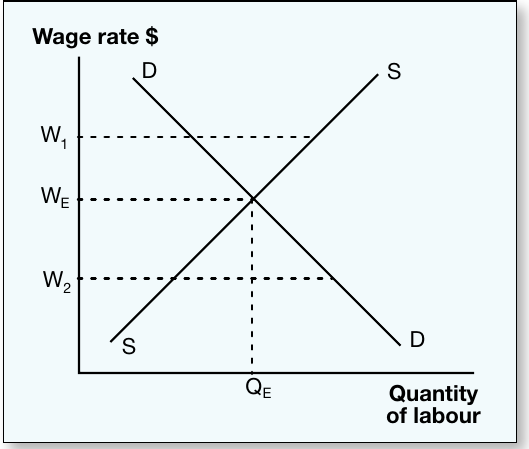
When wages are above equilibrium ():
- The quantity of labour supplied exceeds the quantity demanded
- Unemployment exists
- Unemployed workers will likely offer to work for lower wages
- This competitive pressure pushes wages down toward the equilibrium level
When wages are below equilibrium ():
- The quantity of labour demanded exceeds the quantity supplied
- A labour shortage exists
- Firms compete for workers by offering higher wages
- This competition pushes wages up toward the equilibrium level
Shifts in labour market equilibrium
Changes in the factors that determine labour supply or demand cause the equilibrium wage and employment level to shift. These changes appear as shifts in the supply or demand curves themselves.
Increase in labour demand
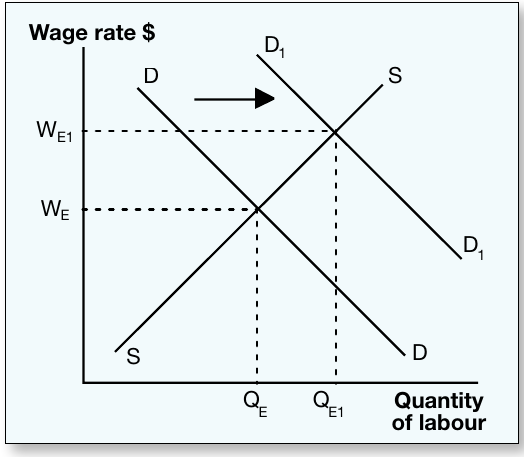
When labour demand increases, the demand curve shifts to the right. This creates a new equilibrium with both higher wages and higher employment levels.
Example
Worked Example: Aging Population and Healthcare Workers
An aging population increases demand for aged care services, raising demand for health workers. This shifts the labour demand curve rightward (from to ).
Analysis of the shift:
- Original equilibrium: wage rate and employment level
- New equilibrium: wage rate and employment level
Result: Both wages and employment increase in the healthcare sector as firms compete to hire the workers needed to meet growing demand for aged care services.
Key factors influencing labour demand
Several interconnected factors affect the demand for labour, making it challenging to isolate the impact of any single factor.
Aggregate demand: The overall level of economic activity in the economy is the most important influence on labour demand. When aggregate demand rises, firms need more workers to meet increased demand for goods and services.
Note
Rising labour productivity increases demand for labour, but only when accompanied by rising aggregate demand. More productive workers are more valuable to firms, encouraging hiring – provided there is sufficient demand for the output they produce.
Labour productivity: More productive workers create greater value for employers, but productivity improvements alone don't guarantee higher employment. The relationship between productivity and labour demand depends critically on whether there is sufficient market demand for the additional output that productive workers can generate.
Relative costs of capital and labour: Changes in the relative price of labour versus capital equipment affect labour demand. However, this influence is often overshadowed by broader changes in economic activity. Persistent declines in labour productivity and rising labour costs create long-term incentives for firms to replace workers with machines (substituting capital for labour).
Important
Multiple Labour Markets and Worker Mobility
An economy contains many interconnected labour markets, each requiring different skills. The ability of workers to move between markets (for example, from airline pilots to bus drivers) depends on their existing skills and the requirements of each occupation.
Labour markets requiring high-level skills – such as medical specialists or scientific researchers – are more closed and have more inelastic supply curves than those requiring lower-level skills. This means that wage changes in highly skilled professions result in smaller changes in the number of workers available.
Summary
Key Points to Remember:
- Labour market equilibrium occurs where supply equals demand, determining both the wage rate and employment level
- The supply curve slopes upward because higher wages make work more attractive relative to leisure, though it can become backward bending at very high wages
- The demand curve slopes downward due to the law of diminishing marginal returns – each additional worker adds less to output
- Above equilibrium wages create unemployment; below equilibrium wages create labour shortages
- Aggregate demand is the most important factor affecting labour demand and employment levels
- Real-world labour markets consist of many interconnected markets with varying skill requirements and mobility between them