The International and Regional Business Cycles (HSC SSCE Economics): Revision Notes
📚Revision Notes
The International and Regional Business Cycles
Understanding the business cycle
Economic activity in any economy is never constant. Rather than growing at a steady rate year after year, economies experience cyclical patterns of growth. These fluctuations are known as the business cycle.
Note
Business cycle: The fluctuations in the level of economic growth caused by changes in aggregate supply and demand, arising from either domestic or international factors.
The business cycle consists of alternating periods:
- Above-average growth (expansion or boom phases)
- Below-average growth (contraction or recession phases)
Despite these fluctuations, economies typically exhibit an overall upward trend in output over time, measured by increases in Gross Domestic Product.
Note
Gross Domestic Product (GDP): The total market value of all final goods and services produced in an economy over a specific period.
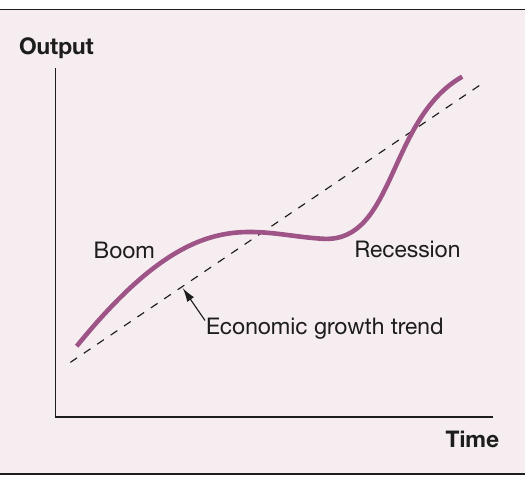
The diagram above illustrates how economic output fluctuates around a long-term growth trend, creating the characteristic boom-recession pattern of business cycles.
The international business cycle
Just as individual economies experience periods of stronger and weaker growth, so does the global economy as a whole. This phenomenon is called the international business cycle.
Note
International business cycle: The fluctuations in the level of economic activity in the global economy over time.
Synchronisation of global growth
Economic growth levels tend to be synchronized across countries. When the global economy is growing strongly, most countries experience higher growth. When global conditions weaken, most economies experience slower growth or recession.
The COVID-19 pandemic in 2020 demonstrated this synchronisation dramatically. Even countries where the pandemic's direct health impact was less severe suffered significant economic damage due to the interconnected nature of the global economy.
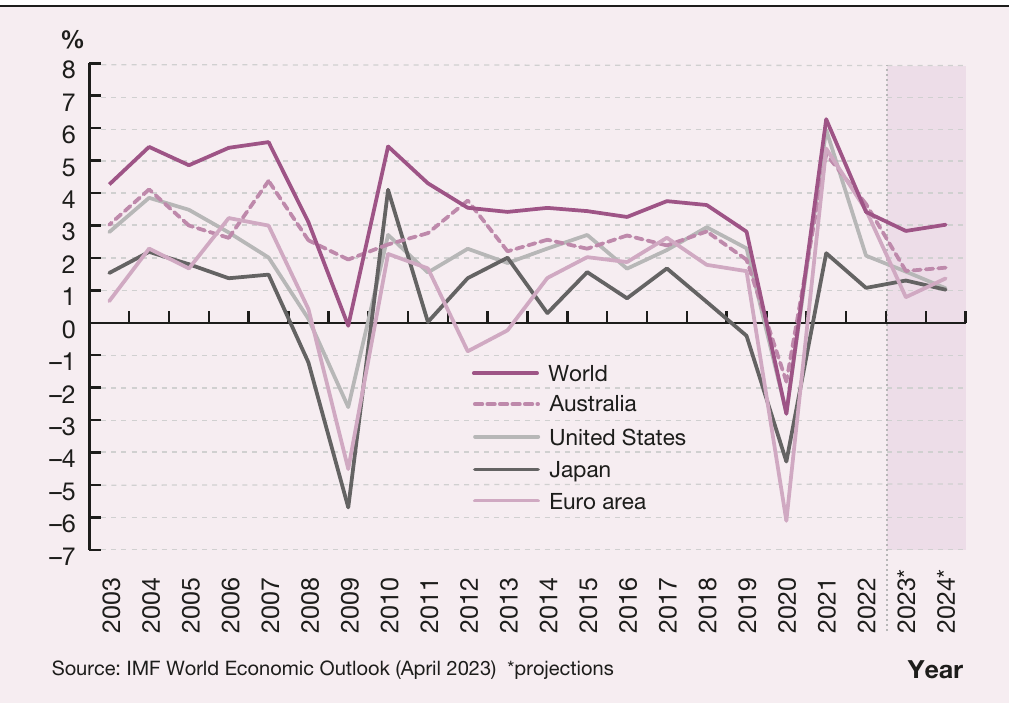
The chart above shows how major economies (the United States, Euro Area, Japan, and Australia) experienced similar patterns:
- Moderate growth through the 2000s
- Sharp contraction after 2008 (global financial crisis)
- Slower growth through the 2010s
- Severe recession in 2020 (COVID-19 pandemic)
- Strong recovery in 2021 (6.2% global growth)
- Return to pre-pandemic growth levels from 2022
Australia's vulnerability as a small open economy
Australia is particularly affected by international economic conditions. Research by the Reserve Bank of Australia (RBA) found that 63% of changes in Australia's output can be explained by changes in interest rates, growth levels, and inflation rates in the G7 economies. This means international factors have approximately twice the influence of domestic factors on Australia's economic growth.
Important
Australia's high vulnerability to global economic conditions makes it one of the most internationally dependent developed economies. Understanding the international business cycle is therefore critical for analyzing Australia's economic performance.
Factors strengthening the international business cycle
Globalisation has intensified the transmission of economic conditions between countries through several key channels:
Trade flows
When one country experiences a boom or recession, its demand for imports from other nations changes accordingly. This creates a flow-on effect that transmits economic conditions across borders.
For example:
- A recession in a major economy reduces its demand for goods and services from trading partners
- This decreased demand causes flow-on effects, potentially triggering recessions in exporting countries
- Conversely, a boom increases import demand, stimulating growth in trading partners
Investment flows
Economic conditions in one country influence business investment decisions in other countries. Strong economic performance typically encourages outward foreign direct investment (FDI), while weak performance reduces it.
Example
Example: Brazil's Investment Flows
Brazil's weak economic performance over the past decade resulted in decreased investment in other economies. Since 2015, Brazil has recorded negative annual FDI outflows on four occasions, meaning more foreign investment was withdrawn from the country than flowed out to other nations.
Transnational corporations (TNCs)
TNCs operate across multiple countries, making them important channels for transmitting business cycle effects globally. When major corporations adjust their operations in response to economic conditions, these changes ripple across all countries where they operate.
Example
Example: Technology Sector Workforce Adjustments
When major US technology companies (Microsoft, Amazon, Google, and Meta) reduced their workforces in 2023, Australian technology company Atlassian followed suit, cutting approximately 5% of its staff.
Financial flows
Short-term financial flows rapidly transmit economic conditions between countries. While Australia benefits from access to global capital markets, the Reserve Bank noted in 2019 that financial integration exposes the Australian economy to shifts in financial conditions in advanced economies.
Financial markets and confidence
Consumer confidence and investor sentiment are strongly influenced by international conditions. Stock exchanges worldwide tend to move in tandem, rising and falling at similar times.
Note
Events threatening global stability can trigger immediate market downturns:
- War risks
- Sovereign debt defaults
- Major business collapses
Example
Example: 2023 Banking Sector Concerns
In 2023, the collapse of Silicon Valley Bank (US) and Credit Suisse (Switzerland) sparked fears of a banking sector crisis, prompting debates about regulatory adequacy and affecting markets globally.
Global interest rate levels
Monetary policy decisions in major economies create pressure on central banks elsewhere to adjust their own interest rates. This synchronisation of monetary policy is a powerful transmission mechanism for business cycle effects.
Example
Example: 2022-2023 Global Interest Rate Increases
When inflationary pressures emerged globally in 2022, central banks worldwide raised interest rates. The US Federal Reserve's rate increases put pressure on the Reserve Bank of Australia, which also raised rates through 2022 and 2023.
Commodity prices
Prices for key commodities (energy, minerals, agricultural products) are determined by global markets and influence inflation, investment, employment, and growth across all economies.
Historically, oil price changes have had major impacts on global growth, with lower prices generally boosting overall economic activity.
Example
Example: 2022 Energy Price Shock
In 2022, global sanctions against Russia (the world's second-largest oil supplier) caused the largest global energy price increases in half a century. The World Bank reduced its 2022 growth forecast by one percentage point as a result.
International organisations
Forums like the G20 and G7 can influence global economic activity by:
- Coordinating global macroeconomic policy during periods of uncertainty
- Resolving tensions between countries that threaten economic stability
- Providing platforms for discussing global economic conditions
Factors weakening the international business cycle
Despite strong international linkages, economic growth patterns differ between countries due to distinctive national conditions:
Domestic interest rates
Interest rates vary between countries (or regions sharing common monetary policy, like the Euro area). Higher rates dampen economic activity, while lower rates stimulate it, creating divergent growth patterns even when global conditions are similar.
Government fiscal policies
Tax and spending decisions by governments can push economic growth in opposite directions between countries. These policy choices reflect different priorities and economic circumstances.
Example
Example: UK Brexit Impact
The UK's decision to leave the EU in 2016 reduced Britain's economic growth as investor confidence fell, while other European economies maintained different growth trajectories.
Exchange rates
Currency values differ between countries and significantly impact trade competitiveness and economic confidence. The Bank for International Settlements (BIS) noted that exchange rates have had increased impact on domestic economies in the past decade as government policy has become less able to address economic shocks.
Structural factors
Economies differ in numerous structural ways that influence their growth patterns:
- Financial system resilience
- Innovation levels and technology adoption
- Consumer attitudes toward consumption versus saving
- Population growth rates and age distribution
- Labour market regulation
- Education and training systems
- Business regulation frameworks
These structural differences influence competitiveness and growth rates, causing economies to perform differently even under similar global conditions.
Regional factors
Some economies are closely integrated with their neighbours and heavily influenced by regional trading partners' performance, while others are more globally oriented.
Research by Colombian academics found that regional business cycles in emerging markets experience different levels of synchronisation depending on:
- Productive structure
- Trade integration levels
Example
Example: Mexico's Regional Integration
Mexico has high synchronisation with North America due to strong trade integration, but nearby Latin American countries have lower impact on Mexico's economy due to weaker trade links.
Note
Summary of key transmission factors
Factors strengthening the international business cycle:
- Trade flows
- Investment flows and investor sentiment
- Transnational corporations
- Financial flows
- Technology
- Global interest rates
- Commodity prices
- International organisations
Factors weakening the international business cycle:
- Domestic interest rates
- Government fiscal policies
- Other domestic economic policies
- Exchange rates
- Structural factors
- Regional factors
Regional business cycles
Note
Regional business cycles: The fluctuations in the level of economic activity in a geographical region of the global economy over time.
Similar to the international business cycle, regional business cycles refer to economic activity changes within specific geographical regions. Countries can be affected by both global changes and regional changes in their immediate geographical area.
Regional influences and dominant economies
Regional business cycles are typically dominated by the largest economies in each region:
North America: US economic changes have ripple effects worldwide, but create more pronounced impacts on nearby Canada and Mexico, which are most closely integrated with the US economy.
Europe: Many of the 27 EU economies are influenced by activity levels in Europe's largest economies, Germany and France.
East Asia: Economic conditions are dominated by China and Japan (the world's second- and third-largest economies). While the regional business cycle in Asia has historically been weaker than other regions, it has strengthened recently due to increased integration between Asian economies. Notably, when growth rates in China and Japan slowed recently, the region continued experiencing stable growth due to moderate upswings elsewhere.
Sub-Saharan Africa: Many economies are less regionally integrated. Countries like Chad, Uganda, and Sierra Leone depend on high-income economies for over 80% of their exports, making them as likely to be influenced by the world economy as by neighbouring African economies.
South Asia and Latin America: Regionally dominant economies (India and Brazil respectively) play key roles alongside influences from outside the immediate region.
Complexity of regional business cycles
While regional business cycles are often dominated by the largest economies, smaller economies can also significantly affect regional performance:
Example
Examples: Smaller Economies Affecting Regional Performance
-
Early 2010s: Financial turmoil in the relatively small economy of Greece weakened economic conditions across European economies
-
2020: A financial crisis in Argentina and severe COVID-19 impact in Brazil weakened Latin American economies
-
2022: The war in Ukraine reduced growth, trade, and affected economic policy across Europe and Central Asia
Regional cycles and globalisation
Regional business cycles can differ substantially from patterns in global economic activity. Some regions perform more strongly than others and fluctuate more independently. However, regional cycles are themselves a product of globalisation, resulting from increased cross-border integration.
Important
These business cycles of different regions interact in complex ways to influence worldwide economic activity. Understanding these regional patterns is essential for comprehending global economic dynamics.
Remember!
Summary
Key Points to Remember:
-
Economic growth moves in cycles: Economies experience alternating periods of above-average growth (booms) and below-average growth (recessions), rather than steady growth rates.
-
The international business cycle is strongly synchronized: When major economic downturns occur (like the 2008 financial crisis or 2020 COVID-19 pandemic), they affect almost all countries simultaneously.
-
Australia is highly vulnerable to global conditions: As a small open economy, 63% of Australia's output changes can be explained by conditions in G7 economies—international factors have twice the influence of domestic factors.
-
Multiple channels transmit economic conditions globally: Trade flows, investment flows, TNCs, financial flows, financial market confidence, interest rates, commodity prices, and international organisations all strengthen the international business cycle.
-
National and regional factors create divergence: Despite strong global linkages, economies experience different growth patterns due to domestic interest rates, fiscal policies, exchange rates, structural differences, and regional integration levels.