Methods of Protection (HSC SSCE Economics): Revision Notes
📚Revision Notes
Methods of Protection
Most countries use some form of protectionist measures to shield their domestic industries from foreign competition, despite living in an era of relatively free global trade. Over time, there has been a shift from traditional protectionist tools like tariffs and subsidies towards less obvious measures such as administrative barriers and industry assistance programs.
Tariffs
What is a tariff?
A tariff is a tax imposed by the government on imported goods. By raising the price of imports, tariffs make domestically produced goods more competitive in the local market.
How tariffs work
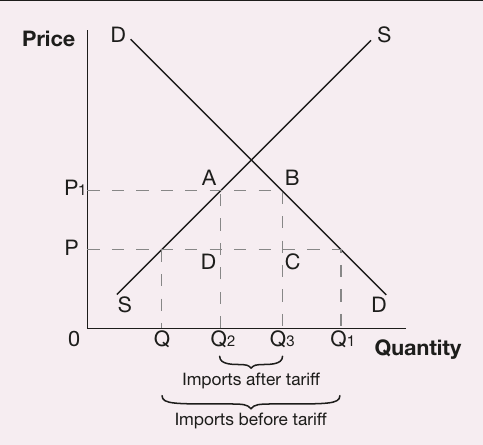
The diagram above illustrates how tariffs affect a market. Consider the following key points:
- The supply curve (S) and demand curve (D) represent domestic supply and demand
- At the free trade price , consumers demand quantity , domestic producers supply quantity , and imports equal to
- When a tariff equal to is imposed and fully passed to consumers, several changes occur:
- Consumer demand contracts to
- Domestic supply expands to
- Imports fall to to
- The government collects tariff revenue shown by the shaded area
Economic effects of tariffs
Impact on domestic production and employment
When tariffs are introduced, domestic producers can supply a greater quantity of goods at higher prices. This stimulates local production and creates employment in the protected industry. However, this comes at a cost to economic efficiency.
Important
Resource allocation concerns
Tariffs attract more domestic resources to the protected industry. This leads to a reallocation of resources towards less efficient producers who cannot compete equally with foreign producers. The consequence is a decline in world GDP. For example, a 2019 IMF study found that if tariff rates of 15% were imposed on $300 billion of Chinese goods, with China retaliating similarly, world GDP would decrease by 0.8%, equivalent to $700 billion.
Consumer welfare effects
Consumers face higher prices and can purchase fewer goods when tariffs are imposed. This represents a redistribution of income from consumers to domestic producers. Economic modelling by the Productivity Commission suggested that for every $1.00 increase in Australian tariff revenue, economic activity would fall by $0.64. GDP would decline by over 1%, equivalent to around 100,000 lost jobs, and the average household would lose approximately $1,500 per year in income.
Note
Government revenue
While tariffs do generate revenue for government, this is not their primary purpose. There is an important trade-off: the more successful a tariff is at restricting imports, the less revenue it raises. In 2023–24, the Australian Government expected to collect $1.5 billion in tariff revenue, representing roughly 0.3% of total government revenue.
Risk of retaliation
Tariffs can trigger retaliation from trading partners. When one country imposes a tariff, affected countries may respond with their own trade barriers. For instance, after Australia imposed a 144% tariff on Chinese steel imports in 2014 as an anti-dumping measure, China retaliated by imposing tariffs on several Australian exports, including barley (74% in 2018) and wine (over 200% in 2020).
Quotas
What is a quota?
An import quota is a restriction on the volume of a particular good that can be imported over a specified time period. Quotas are primarily used to protect domestic production, though they may also limit the entry of undesired goods. For example, in 2018 Australia implemented a quota system for hydrofluorocarbons (HFCs) used in refrigeration due to environmental concerns.
Quotas guarantee domestic producers a share of the market by physically limiting the quantity of imports.
How quotas work
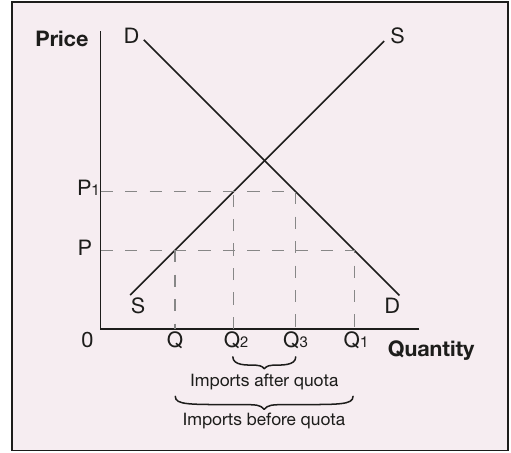
The diagram above shows the market effects of an import quota. The key points are:
- At the free trade price , consumers demand , domestic producers supply , and imports equal to
- When the government restricts imports to to , this creates scarcity
- The reduced supply pushes the price up to
- At this higher price, domestic supply expands to
- Overall consumption falls to
Note
Tariff quotas
A variation on standard quotas is the tariff quota system. Under this arrangement, goods imported up to the quota limit pay the standard tariff rate, while goods imported above the quota face a higher tariff rate. Historically, many of Australia's most protected industries, including textiles, clothing, footwear and motor vehicles, used this system.
Economic effects of quotas
Production and employment effects
Similar to tariffs, quotas stimulate domestic production and employment in the protected industry by guaranteeing local producers a share of the market. For instance, the European Union imposes an import quota allowing no more than 7,150 tonnes of high-quality beef imports. This provides certainty for European producers who can supply any demand exceeding this limit, even if their production costs are higher than overseas competitors.
Resource reallocation
More resources flow into the protected industry, drawn away from other sectors where production and employment consequently fall. This represents an inefficient allocation of resources from an economy-wide perspective.
Consumer impacts
Consumers pay higher prices and have access to fewer goods. This transfers income from consumers to domestic producers in the protected industry and results in lower overall economic growth.
Important
Government revenue
Unlike tariffs, quotas do not directly generate government revenue. However, governments can sometimes raise small amounts by administering quotas through the sale of import licences that allow firms to import limited quantities.
Retaliation risk
As with tariffs, imposing quotas can invite retaliation from countries whose exports are reduced. This can result in lower exports for the country that initiated the quota.
Subsidies
What is a subsidy?
A subsidy is a cash payment from the government to businesses to encourage production of a good or service. Subsidies enable domestic producers to reduce their selling prices and compete more effectively with overseas producers. They are designed to influence the allocation of resources in the economy.
How subsidies work
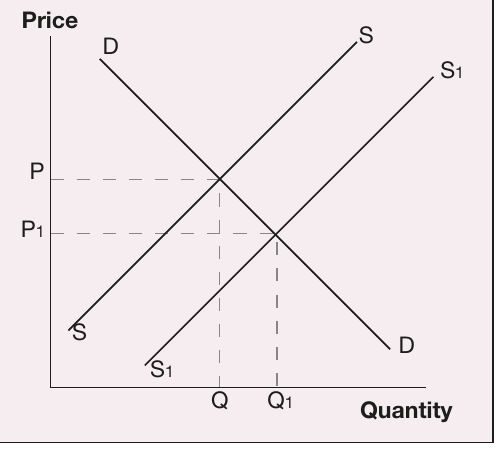
The diagram illustrates the effect of a subsidy on a market. When a subsidy is provided to producers:
- The supply curve shifts rightward from to
- This results in a lower market price (from to )
- The quantity produced and sold increases from to
- The vertical distance between and represents the per-unit subsidy amount
Businesses can sell a higher quantity of their product in both domestic and global markets at lower prices.
Economic effects of subsidies
Stimulating production and employment
Subsidies enable domestic producers to supply greater quantities of goods, thereby stimulating production and employment in the protected industry.
Resource allocation impacts
More resources are attracted to the protected industry, leading to reallocation away from other sectors where production and employment decline.
Consumer benefits and indirect costs
Consumers benefit from lower prices and access to more goods because the subsidy shifts the supply curve rightward. However, consumers still pay indirectly through higher taxes needed to fund the subsidies.
Important
Government budget implications
Subsidies impose direct costs on government budgets through payments to producers. This reduces resources available for other priorities like education and healthcare. For example, in the 2023–24 Budget, the Australian Government increased the Fuel Tax Credits Scheme (Australia's largest fossil fuel subsidy) by $2.1 billion to $9.6 billion, with expected costs of $41.1 billion over four years.
Note
Economist preferences
While economists generally oppose protectionist policies, many prefer subsidies to tariffs. This is because subsidies tend to be abolished more quickly since they impose visible costs on the budget rather than generating revenue.
Local content rules
Local content rules mandate that goods must contain a minimum percentage of locally manufactured parts. In exchange for guaranteeing a certain percentage of local production, imported components may enter without tariffs.
Australia has a longstanding requirement that the majority of free-to-air television content broadcast from 6:00 am to midnight must be locally produced (currently a minimum of 55%). In 2023, the Australian Government announced plans to introduce local content requirements for streaming services such as Netflix, Stan and Binge as part of its Revive National Cultural Policy.
Export incentives
Export incentive programs provide domestic producers with assistance including grants, loans, or technical advice (such as marketing or legal information). These programs encourage businesses to penetrate global markets or expand their market share.
The popularity of export incentives has grown considerably as nations have shifted focus from protecting import-competing businesses to capturing foreign markets as a strategy for achieving higher economic growth and employment.
Note
Australia operates a program called the Export Market Development Grant (EMDG) that has assisted over 51,000 businesses in promoting and marketing their exports. While export incentives do not protect businesses from foreign competition in the domestic market, they are still regarded as barriers to free trade. World Trade Organization rules restrict their use, though countries can still provide some forms of export assistance to local producers.
Overall economic effects of protectionism
Beyond the impacts on individual domestic economies, protectionist policies have broader consequences for the global economy.
Reduced global trade
Protectionist policies reduce the overall level of trade between nations. For any individual economy, this means exports and imports represent a smaller share of national output. A Boston Consulting Group report for the B20 group of business leaders estimated that major economies imposing protectionist policies following the COVID-19 pandemic could reduce global economic output by as much as $10 trillion by 2025 compared to what it would otherwise reach.
Lower living standards and economic growth
Overall, protectionist policies reduce living standards and constrain global economic growth by shielding inefficient producers. A major 2019 International Monetary Fund study titled "The Macroeconomic Consequences of Tariffs" examined the tariff policies of 151 countries over 50 years. The study concluded that countries raising tariffs experience:
- Lower output
- Weaker productivity
- Increased unemployment
- Increased inequality
Important
The research found that an average tariff increase of 3.6% contributed to an average 0.4% reduction in GDP over five years, with a larger 1% fall in GDP in advanced economies. The study also noted that tariff increases tend to lead to exchange rate appreciation, which can worsen the balance of trade.
Reduced specialisation and efficiency
Protectionist policies make it more difficult for individual economies to specialise in production where they are most efficient. Businesses are less able to achieve economies of scale, resulting in lower profits and dividends. With reduced competitive pressures, prices for goods and services rise. This leads to slower economic growth in individual countries.
Disproportionate impact on developing economies
The negative economic impact of protectionist policies tends to be larger relative to the size of economies for developing countries, which are often excluded from access to the markets of advanced economies. The World Bank has highlighted that increased trade helps reduce global poverty. Between 1990 and 2017, developing economies increased their share of global exports from 16% to 30%, while the number of people in extreme poverty globally fell from 36% to 9%.
Summary
Key Points to Remember:
- Tariffs are taxes on imports that raise prices and protect domestic producers, but they reduce consumer welfare, create economic inefficiency, and risk triggering retaliation
- Quotas physically limit import quantities, guaranteeing domestic market share but raising prices without generating government revenue
- Subsidies provide direct financial assistance to producers, lowering prices for consumers but imposing costs on government budgets
- Protectionism reduces global trade, lowers living standards, and constrains economic growth by preventing economies from specialising efficiently
- Developing economies are disproportionately affected by protectionist policies, with research showing that increased trade is linked to significant reductions in global poverty