Reasons for Protection (HSC SSCE Economics): Revision Notes
📚Revision Notes
Reasons for Protection
What is protection?
Protection refers to government policies that give domestic producers an artificial advantage over foreign competitors. The main methods of protection include tariffs (taxes on imports), import quotas (limits on quantities) and subsidies (financial support to domestic firms).
Despite the economic benefits of free trade, most countries have historically used some form of protection to help local producers compete against foreign firms. Understanding why governments choose to protect certain industries is crucial for analysing trade policy decisions.
Note
The three primary instruments of protection are:
- Tariffs: Taxes imposed on imported goods, making them more expensive
- Import quotas: Physical limits on the quantity of goods that can be imported
- Subsidies: Financial assistance provided to domestic firms to reduce their costs
Infant industries
The rationale for protecting new industries
New industries face significant challenges in their early years. They typically operate on a small scale with relatively high costs compared to established competitors in other countries. The infant industry argument suggests that these new industries need temporary protection to:
- Build production capacity
- Establish market presence
- Achieve economies of scale (lower average costs through increased production)
- Develop the efficiency needed to compete globally
Many emerging economies have used this approach to develop new industries in recent decades.
The credibility test
The key test for whether infant industry protection is economically justified is whether the protection is removed over time. Without a clear exit strategy, protected industries have no incentive to become efficient enough to compete without government support.
Important
Governments should therefore only provide temporary assistance to industries that demonstrate genuine potential to achieve comparative advantage in the long run. The industry must show it can eventually compete independently in the global market.
Problems with the infant industry argument
Historically, many industries protected as "infants" have continued to rely on government assistance for decades. National airlines in the global aviation industry are a prime example of this problem. The infant industry argument has been used to justify support for many industries that would never have become internationally competitive.
For this reason, economists are generally skeptical when businesses seek protection based on infant industry claims. Today, when governments do support new industries (such as battery manufacturing for electric vehicles), they tend to use direct financial assistance for limited time periods rather than ongoing trade barriers.
Prevention of dumping
What is dumping?
Dumping occurs when foreign firms sell goods in another country's market at unrealistically low prices—specifically, below the price charged in their home market. This practice may be used to:
- Dispose of large production surpluses
- Establish market position in a new country
- Drive out local competitors
Why dumping is harmful
While consumers benefit from lower prices in the short term, these prices are usually temporary. Local firms that could normally compete with foreign producers may be forced out of business, causing:
- Loss of productive capacity
- Higher unemployment
- Reduced competition in the long run
Important
Once local competition is eliminated, foreign producers typically raise their prices. Under these circumstances, imposing restrictions on dumped imports is generally considered justified.
Economist support for anti-dumping measures
Using protectionist methods to prevent dumping is the only reason for protection that is widely accepted by economists. However, the World Trade Organization (WTO) has recently questioned whether some countries might be unfairly accusing efficient low-cost foreign producers of dumping. There are concerns that countries may be abusing "anti-dumping" processes simply to protect their domestic industries from legitimate competition.
Anti-dumping measures in practice
Since the WTO was formed in 1995, member countries have lodged more than 6500 anti-dumping complaints. By 2023, around 4500 anti-dumping measures (such as special duties) were legally in force. The sectors most affected include base metals, chemicals, plastics, resin and rubber.
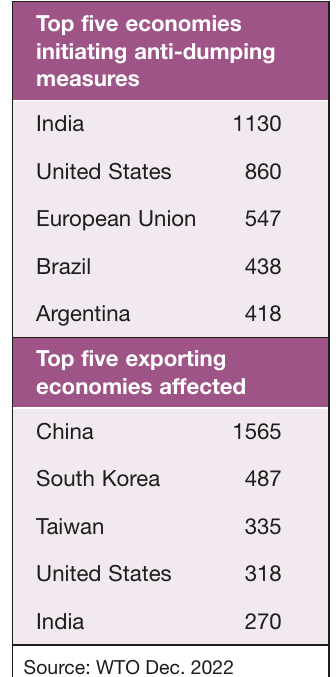
Australia has been quite active in this area, ranking sixth in the world with over 375 complaints initiated. The table below shows which countries have been most active in both initiating anti-dumping measures and being targeted by them.
Note
Key observations from the data:
- India leads in initiating anti-dumping measures (1130)
- China is most frequently affected by such measures (1565)
- The United States appears in both lists, both initiating complaints and being targeted by them
Protection of domestic employment
The popular argument
One of the most politically popular arguments for protection is that it saves local jobs. The logic appears straightforward: if local producers are shielded from cheaper foreign imports, demand for locally produced goods will increase, creating more domestic employment. This argument gains strongest public support during recessions when unemployment is rising, even though technological change and automation often play a more significant role in job losses than international trade.
Why economists reject this argument
Despite its political appeal, there is little support among economists for protecting industries to preserve employment. Protection distorts the allocation of resources in an economy, shifting production away from efficient industries towards less efficient ones. This misallocation of resources is likely to lead to:
- Higher unemployment in the long run
- Lower economic growth rates
- Reduced international competitiveness
Important
By removing protection, economies can create better and more sustainable jobs in sectors that are internationally competitive. These jobs are built on genuine competitive advantages rather than artificial government support.
The retaliation problem
If one country protects its industries, other countries may retaliate with similar protectionist policies. The net result could be:
- Higher employment in less efficient protected industries
- Lower employment in more efficient export industries that face new barriers abroad
- Overall reduction in economic welfare for all countries involved
This demonstrates why employment protection through trade barriers is generally considered an ineffective policy approach.
Defence and national security
Non-economic justifications
Countries sometimes have strategic rather than economic reasons for retaining certain industries. Major powers typically want to maintain their own defence industries to ensure that during conflicts they can produce necessary military equipment. This represents a legitimate national security concern that goes beyond pure economic efficiency.
Recent examples of security-based restrictions
National security concerns have expanded beyond traditional defence industries in recent years:
Note
Technology and telecommunications
Concerns about threats to national security from China have prompted Australia and other countries to restrict Chinese telecommunications company Huawei's involvement in building 5G mobile networks. This restriction applies despite Huawei's technology being regarded as cheaper and more advanced than competitors' offerings.
Note
Medical supplies and vaccines
The COVID-19 pandemic exposed vulnerabilities in global supply chains for essential medical equipment and vaccines. In response, governments changed policies to build greater domestic capacity. Australia, for example, announced plans to establish a local mRNA vaccine production facility to reduce dependence on overseas suppliers.
Note
Food security
Russia's invasion of Ukraine in 2022 disrupted global food supply chains and raised concerns about food security. This led several countries to restrict agricultural exports. By 2023, 101 export restrictions remained in force, representing over 11% of food trade globally.
The challenge for Australia
The disruptions to "just in time" global supply chains caused by the pandemic led governments and businesses to reconsider how to prepare for future crises. This presents particular challenges for Australia because of:
- High integration with global supply chains
- Heavy reliance on imports
- Limited domestic manufacturing capacity
Important
Balancing economic efficiency with strategic resilience has become a key policy challenge.
Rising barriers to trade
The past decade has marked the end of a long period of expanding free trade that stretched back to the post-Second World War era. While many countries have experienced backlash against globalisation for decades, a new era of "deglobalisation" and rising protectionism has emerged in response to:
- Vulnerabilities in supply chains exposed during COVID-19
- Disruptions caused by the war in Ukraine
- Growing geopolitical tensions
An International Monetary Fund (IMF) report in 2023 estimated that increasing fragmentation in world trade could ultimately cost the global economy 7% of its output.
Changing priorities
While the basic principles of free trade remain widely embraced and global tariff levels remain relatively low, governments have become more concerned about:
- Dependence on other economies
- Vulnerability to overseas developments
- Supply chain resilience
Governments are now focusing on improving supply chain resilience through:
- Increasing inventories
- Expanding local production capacity through subsidies
- Prioritising security interests over pure comparative advantage
Beyond protectionist trade policies, deglobalisation may also involve greater restrictions on migration and foreign direct investment, plus weaker commitment to international cooperation.
US-China decoupling
At the heart of deglobalisation is the "decoupling" between the United States and China. In 2023, President Biden introduced:
- Export restrictions limiting China's access to semiconductor chips and technology
- $11 billion in grants and subsidies to support green technology transitions in rural areas
These measures aim to strengthen national security and reduce risks from the interdependent US-China economic relationship. The Boston Consulting Group estimates these measures will decrease trade between the US and China by $63 billion by 2031.
Other arguments for protection
Wage differentials and labour standards
Some economists argue that producers should be protected from competition with countries that use low-cost labour. They contend that labour costs are artificially low in many developing economies because of:
- Weak labour standards
- Restrictions on workers' rights to form unions
- Low workplace safety standards
This argument suggests that allowing such imports creates unfair competition for producers in countries with higher labour standards.
Modern slavery and forced labour
Growing awareness of modern slavery in global supply chains has led governments to prohibit trade in goods produced using forced labour, including:
- Prison workers
- Child labour
- Other forms of coerced work
Note
These restrictions are generally accepted as legitimate regulations that prevent human rights abuses, even though they can have protectionist consequences. For example, in 2021 Australia restricted certain imports from China due to concerns about forced labour in Xinjiang.
Environmental factors
Countries sometimes block trade in goods because of environmental concerns. Overseas producers may be able to produce items cheaply because they:
- Operate with less environmental responsibility
- Do not comply with the tougher environmental standards in advanced economies
- Contribute more to pollution and climate change
In recent years, some countries have proposed introducing "carbon tariffs" on goods produced in countries making slower progress on reducing carbon emissions. These measures aim to prevent "carbon leakage" where production simply shifts to countries with weaker environmental standards.
Summary
Key Points to Remember:
-
Protection gives domestic producers an artificial advantage over foreign competitors through measures like tariffs, quotas and subsidies.
-
Infant industry protection may be justified temporarily for new industries with potential for comparative advantage, but must be time-limited to maintain incentives for efficiency.
-
Prevention of dumping is the only reason for protection widely accepted by economists, as dumping harms domestic producers through artificially low prices that are not sustainable.
-
Employment protection through trade barriers is economically inefficient because it distorts resource allocation and may provoke retaliation, ultimately reducing overall employment.
-
Defence and national security concerns have expanded beyond traditional defence industries to include technology, medical supplies, and food security, especially following COVID-19 and the Ukraine war.
-
The recent trend toward deglobalisation reflects growing concerns about supply chain vulnerabilities and geopolitical tensions, with governments prioritising security over pure economic efficiency.