Curve-Sketching Using the Derivative (HSC SSCE Mathematics Advanced): Revision Notes
📚Revision Notes
Concavity and Points of Inflection
Introduction to concavity and the second derivative
Understanding concavity is crucial for sketching curves accurately. The concavity of a curve tells us whether it curves upward (like a cup) or downward (like a cap). The second derivative gives us this information.
Note
Think of concavity as the "direction" the curve is bending. Just as the first derivative tells us about the slope, the second derivative tells us about the curvature.
Let's examine how a function, its first derivative, and its second derivative relate to each other. Consider the cubic function:
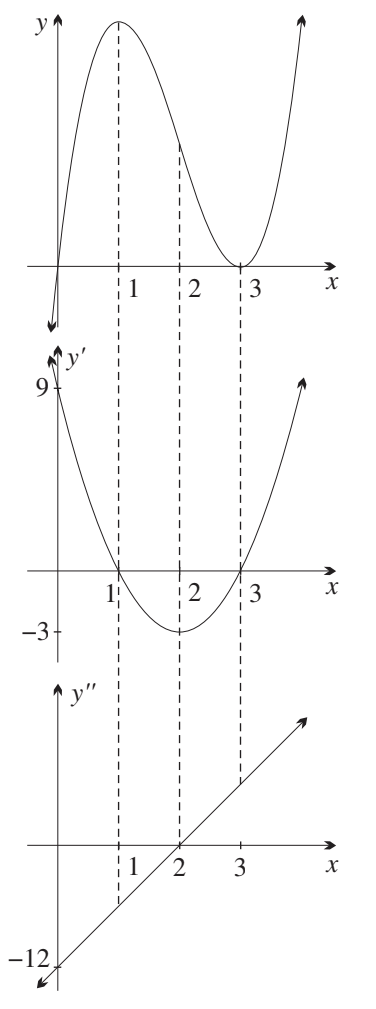
The three graphs above show the function , its first derivative , and its second derivative . Notice how each derivative describes the gradient of the function above it. The second graph shows the gradient of the first, and the third graph shows the gradient of the second.
To the right of :
The top graph is concave up. As you move along the curve to the right from , the tangent gets steeper. This means the gradient is steadily increasing. In the middle graph, you can see that is increasing for . Since the bottom graph represents the gradient of the middle graph, is positive for .
To the left of :
The top graph is concave down. Its gradient function is steadily decreasing as increases. The bottom graph shows that is negative for .
This example demonstrates a fundamental principle in calculus.
Concavity and the second derivative
The concavity of a graph at any point is determined by the sign of its second derivative at that point.
Important
Key principle:
- If is negative, the curve is concave down at
- If is positive, the curve is concave up at
Think of it this way:
- Concave up (positive ): The curve looks like a cup that could hold water ()
- Concave down (negative ): The curve looks like a cap or dome ()
Note
Memory Aid:
- Positive second derivative = Cup (concave up) - can hold water
- Negative second derivative = Cap (concave down) - like an upside-down cup
Points of inflection
A point of inflection is a point where the tangent crosses the curve. This means the curve curls away from the tangent on opposite sides, which indicates that the concavity changes sign around that point.
Looking back at our cubic function example, the point of inflection occurs at . This point of inflection on the top graph corresponds to a minimum turning point at in the middle graph of . Consequently, the bottom graph of has a zero at and changes sign around this point.
Important
Critical Condition for Points of Inflection:
A point of inflection requires TWO conditions:
- (or is undefined)
- must change sign around the point
Simply having is NOT sufficient for a point of inflection.
Inflectional tangents
The tangent line at a point of inflection is called an inflectional tangent. It's often useful to find the gradient of this tangent when sketching curves. To find it, simply evaluate at the point of inflection.
Method for analysing concavity and finding points of inflection
The second derivative can only change sign at:
- A zero of , or
- A discontinuity of
Note
Step-by-step procedure:
- Find the second derivative
- Identify all zeroes and discontinuities of
- Create a table of test values for , choosing values that "dodge around" the zeroes and discontinuities
- Record the concavity underneath each test value
- Look for sign changes in the concavity to identify points of inflection
The table will show both the points of inflection and the concavity across the entire domain of the function.
Worked example: Finding points of inflection
Example
Worked Example: Analysing Concavity and Finding Points of Inflection
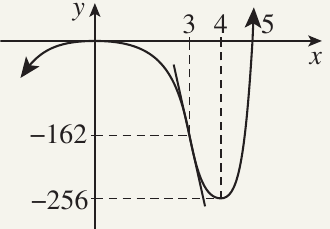
For :
a) Find any turning points
b) Draw up a table of concavities, find any points of inflection and the gradients of the inflectional tangents, describe the concavity, then sketch
Solution:
First, find the derivatives:
Part a) Finding turning points
has zeroes at and , with no discontinuities.
Create a table of test values for :
| slope | / | — | \ | — | / |
The slope symbols show:
- / means increasing (positive gradient)
- \ means decreasing (negative gradient)
- — means zero gradient (stationary point)
From this table:
- is a maximum turning point
- is a minimum turning point
Part b) Analysing concavity
has zeroes at and , with no discontinuities.
Create a table of test values for :
| concavity | . | . |
The concavity symbols show:
- means concave down (negative )
- means concave up (positive )
- . indicates a potential point of inflection
From this analysis:
- is a point of inflection (concavity changes from down to up)
- is not a point of inflection (concavity remains down on both sides)
At the point of inflection :
So the inflectional tangent has gradient .
Concavity description:
- The graph is concave down for and
- The graph is concave up for
Important
Key Observation from Example:
This example demonstrates that f''(x) = 0 is NOT a sufficient condition for a point of inflection. At , we have , but the concavity doesn't change, so is not a point of inflection. At , we have AND the concavity changes, so is a point of inflection.
Using the second derivative to test stationary points
The second derivative provides an alternative method for classifying stationary points.
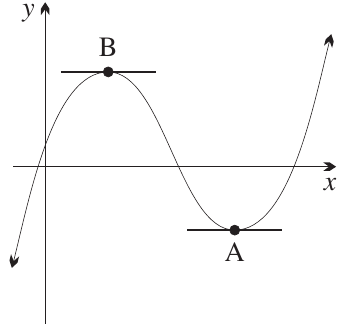
If a curve is concave up at a stationary point, the point must be a minimum turning point (like point A above). Similarly, if a curve is concave down at a stationary point, the point must be a maximum turning point (like point B above).
Note
Second derivative test for stationary points:
Suppose the curve has a stationary point at (meaning ).
- If , the curve is concave up at , so there is a minimum turning point
- If , the curve is concave down at , so there is a maximum turning point
- If , the test is inconclusive — you must go back to the table of values of to determine the nature of the stationary point
Important
Exam tip: When at a stationary point, don't assume it's a point of inflection. It could be a turning point (as we saw with in the previous example) or a point of inflection. You must check the sign of around the point.
Worked example: Stationary point of inflection
Example
Worked Example: Identifying a Stationary Point of Inflection
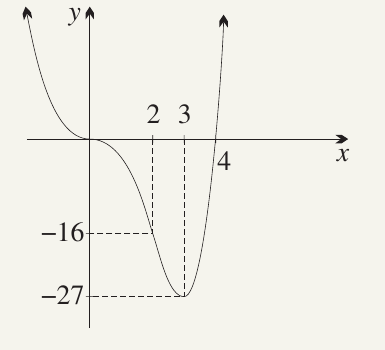
Use the second derivative, if possible, to determine the nature of the stationary points of . Find also any points of inflection, examine the concavity over the whole domain, and sketch the curve.
Solution:
Find the derivatives:
Finding stationary points:
when or
Test using the second derivative:
At :
Since , the point is a minimum turning point.
At :
The second derivative test is inconclusive at . We need to check the first derivative around this point.
Create a table for :
| slope | \ | — | \ | — | / |
The function is decreasing on both sides of , so is a stationary point of inflection.
Analysing concavity:
when or
Create a table for :
| concavity | . | . |
From this table:
- is the stationary point of inflection we already found (concavity changes from up to down)
- is a non-stationary point of inflection (concavity changes from down to up)
At the point :
The inflectional tangent at has gradient .
Concavity description:
- Concave up for and
- Concave down for
Worked example: Finding parameter values
Example
Worked Example: Determining Parameter Values for Given Concavity
For what values of is concave down when ?
Solution:
First, find the second derivative:
When :
For the curve to be concave down at , we need :
Therefore, the curve is concave down at when .
Remember!
Summary
Key Points to Remember:
-
Concavity is determined by the second derivative: If , the curve is concave up at . If , the curve is concave down at .
-
A point of inflection requires TWO conditions: The second derivative must equal zero (or be undefined) AND the second derivative must change sign around the point. Having alone is not enough.
-
Points of inflection occur where concavity changes: Use a table of test values for to identify where the concavity changes sign. This is the most reliable method.
-
The second derivative test for stationary points: If and , there's a minimum at . If and , there's a maximum at . If and , the test is inconclusive—check the first derivative table.
-
Don't forget inflectional tangents: At a point of inflection, calculate to find the gradient of the tangent line. This helps create more accurate sketches.