Applications of Maximisation and Minimisation (HSC SSCE Mathematics Advanced): Revision Notes
📚Revision Notes
Applications of Maximisation and Minimisation
Introduction to real-world optimisation
In everyday life and industry, we often need to find the best possible outcome for a given situation. Calculus provides powerful tools to solve these optimisation problems. Some common applications include:
- Maximising the volume of a box constructed from a sheet of cardboard
- Minimising fuel consumption during a flight
- Maximising profits from manufacturing and selling products
- Minimising the amount of material used in product packaging
These problems can be solved using differentiation techniques, but only when we can establish a clear mathematical relationship between the variables involved. The key is transforming a real-world scenario into a mathematical function that we can analyse.
Important
Critical Principle: Whenever you claim that a stationary point represents a maximum or minimum value, you must always justify this claim through proper mathematical analysis. Simply finding where the derivative equals zero is not enough.
The four-step problem-solving process
When tackling maximisation and minimisation problems, follow this systematic approach:
Step 1: Define your variables
Clearly identify and label the quantities involved. Typically, you will need to:
- Let (or another appropriate letter) represent the quantity you want to maximise or minimise
- Let (or another appropriate letter) represent the quantity that can be varied (the independent variable)
Note
Drawing a diagram is usually helpful at this stage to visualise the problem and understand the relationships between variables.
Step 2: Form the equation
Create an equation connecting your two variables, making sure to note any restrictions on the domain. These restrictions might come from:
- Physical constraints (e.g., lengths cannot be negative)
- Practical limitations (e.g., a box cannot have zero dimensions)
- Given conditions in the problem
Step 3: Find the global maximum or minimum
Use calculus techniques to locate and verify the global maximum or minimum:
- Differentiate the function with respect to the independent variable
- Find stationary points by setting the first derivative equal to zero
- Use the second derivative test or first derivative test to determine the nature of each stationary point
- Check boundary values if the domain is restricted
- Identify which stationary point gives the global maximum or minimum
Step 4: Write a clear conclusion
State your answer clearly, including:
- The optimal value of the quantity being maximised or minimised
- The values of all relevant variables at this optimal point
- Units where applicable
Worked example: Maximising box volume
This example demonstrates how to maximise the volume of an open box created by cutting squares from the corners of a flat sheet.
Example
Worked Example: Maximising the Volume of an Open Box
Problem: An open rectangular box is to be made by cutting square corners from a square piece of cardboard measuring 60 cm × 60 cm, then folding up the sides. What is the maximum volume of the box, and what are its dimensions?
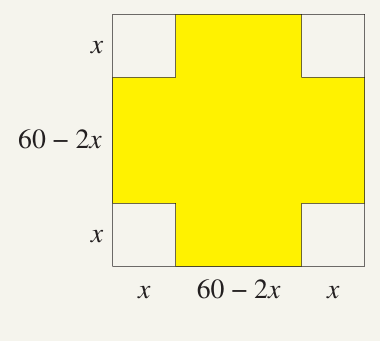
Solution:
Step 1: Define variables and understand the setup.
Let be the volume of the box (this is what we want to maximise).
Let be the side length of each square that is cut from the corners.
When we fold up the sides, the box will have:
- Height: cm
- Base: a square with side length cm (because we remove from each end)
Step 2: Form the volume equation.
The volume of a rectangular box is length × width × height:
Expanding this expression:
The domain is (we cannot cut squares larger than half the cardboard's side length).
Step 3: Find the maximum value.
Differentiate with respect to :
Factor this expression:
Set to find stationary points:
Therefore or
These are the only stationary points, with no discontinuities in the domain.
Now use the second derivative test to determine the nature of each stationary point:
At :
This indicates a local maximum (the curve is concave down).
At :
This indicates a local minimum (the curve is concave up).
Calculate the volume at :
Since this is the only local maximum in the domain , the point gives the global maximum.
Step 4: State the conclusion.
The maximum volume is 16 000 cm³, achieved when the box has dimensions 10 cm × 40 cm × 40 cm (height × length × width).
Worked example: Minimising surface area
This example shows how to minimise the amount of material needed to construct a cylindrical container with a fixed volume.
Example
Worked Example: Minimising the Surface Area of a Cylindrical Can
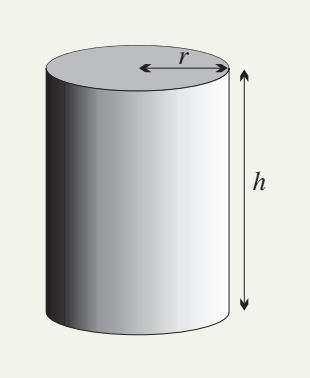
Problem: A cylindrical soft drink can must have a volume of 250 cm³.
a) Show that the height of the can is , where is the base radius.
b) Show that the total surface area is .
c) Show that gives a global minimum of in the domain .
d) Show that to minimise the surface area, the diameter of the base should equal the height.
Solution:
Part a: Establish the relationship between height and radius.
Let the height of the can be cm.
The volume of a cylinder is:
Since the volume must be 250 cm³:
Solving for :
Part b: Derive the surface area formula.
The total surface area consists of:
- Two circular ends, each with area
- One curved side with area
Therefore:
Substitute the expression for from part a:
where
Part c: Find and verify the minimum surface area.
Differentiate with respect to :
Rewrite with a common denominator:
Set to find stationary points:
Now apply the second derivative test:
Since , both terms are positive, so for all .
This confirms that the stationary point is a local minimum. Since it's the only stationary point in the domain , it must be the global minimum.
Part d: Verify the diameter equals height relationship.
When :
Therefore, the diameter equals the height when the surface area is minimised. This is an elegant result showing that the most efficient cylindrical can has equal height and diameter.
Cost and time optimisation problems
Many real-world problems involve finding the optimal speed or rate to minimise costs. There are often competing factors to balance:
Note
Understanding the Trade-offs:
At slow speeds:
- Wages and fixed costs increase (because the journey takes longer)
- Time-dependent expenses accumulate
At high speeds:
- Fuel consumption increases (often proportional to speed squared)
- Wear and tear on equipment increases
- Operating costs rise
The optimal speed lies somewhere between these extremes, where the total cost is minimised. If we can express the cost as a mathematical function of speed, calculus enables us to find this optimal value.
Worked example: Minimising travel costs
This example illustrates how to find the most economical speed for a journey.
Example
Worked Example: Finding the Optimal Speed to Minimise Travel Costs
Problem: The cost (in dollars per hour) of running a boat depends on its speed km/h according to the formula:
a) Show that the total cost for a 100 km trip is .
b) What speed will minimise the total cost of the trip?
Solution:
Part a: Derive the total cost formula.
The fundamental relationship is:
For a 100 km journey at speed km/h:
The total cost equals the cost per hour multiplied by the time taken:
where
Part b: Find the speed that minimises total cost.
Differentiate with respect to :
Rewrite with a common denominator:
Factor the numerator:
Set :
This gives or
Since (speed must be positive), the only relevant stationary point is . There are no discontinuities in the domain.
Apply the second derivative test:
For all , we have , confirming that gives a local minimum.
Since this is the only stationary point in the domain , it must be the global minimum.
Conclusion: A speed of 10 km/h will minimise the cost of the trip.
Note
This result makes intuitive sense: at this speed, the savings from reduced time (lower fixed costs) exactly balance the additional expenses from increased fuel consumption and operating costs.
Summary
Key Points to Remember:
-
Always justify your answer: When claiming a stationary point is a maximum or minimum, you must use the second derivative test or another valid method to verify this.
-
Follow the four-step process: Define variables, form equations with restrictions, find the global optimum, and write a clear conclusion.
-
Check the domain: Physical constraints often limit the possible values. Always identify and state these restrictions.
-
Use the second derivative test: If at a stationary point, it's a local maximum. If , it's a local minimum.
-
Include units in your final answer: Make sure your conclusion states the optimal value with appropriate units (cm³, km/h, dollars, etc.).