Increasing, Decreasing, and Stationary at a Point (HSC SSCE Mathematics Advanced): Revision Notes
📚Revision Notes
Increasing, Decreasing, and Stationary at a Point
Understanding curve behavior at a point
When we analyze a curve, we often need to describe whether it's going upward, downward, or leveling off at a particular point. We can formalize these ideas using the concept of tangents and derivatives.
The behavior of a curve at any point is directly related to the gradient of its tangent line at that point. This relationship gives us a powerful mathematical tool for understanding and predicting how functions behave.
Tangents and the behaviour of a curve at a point
The gradient of the tangent line at any point tells us about the behavior of the curve at that point:
- When a curve slopes upward at a point, the tangent has a positive gradient, and is increasing as increases
- When a curve slopes downward at a point, the tangent has a negative gradient, and is decreasing as increases
- When a curve is level (horizontal) at a point, the tangent has zero gradient, and the curve is stationary
Note
Memory Aid: Think of the sign of the derivative as an arrow:
- Positive () → upward slope → increasing ↗
- Negative () → downward slope → decreasing ↘
- Zero () → flat tangent → stationary →
Formal definitions
Important
Let be a function that can be differentiated at .
- If , then is called increasing at
- If , then is called decreasing at
- If , then is called stationary at
These definitions form the foundation for analyzing the behavior of any differentiable function at a specific point.
Interpreting the diagram
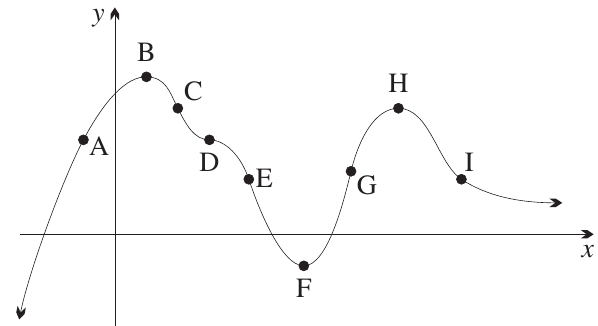
The curve below illustrates different behaviors at various points. Consider the tangent at each labeled point and observe how the sign of the gradient determines the curve's behavior:
Note
Analyzing the curve:
- The curve is increasing at points and (tangent slopes upward, )
- The curve is decreasing at points , , and (tangent slopes downward, )
- The curve is stationary at points , , , and (tangent is horizontal, )
Notice how points , , , and represent local maxima and minima where the curve changes direction.
Worked examples
Example
Worked Example 1: Determining behavior at specific points
Question: Differentiate . Hence find whether the curve is increasing, decreasing, or stationary at the point where:
(a)
(b)
(c)
Solution:
First, differentiate the function:
(a) At :
Since , the curve is increasing at .
(b) At :
Since , the curve is stationary at .
(c) At :
Since , the curve is decreasing at .
Key Strategy: Always evaluate the derivative at the specific -value first, then check the sign of the result to determine the behavior.
Example
Worked Example 2: Finding stationary points
Question: For what value(s) of is the curve stationary?
Solution:
Differentiate the function:
For the curve to be stationary, we need :
The curve is stationary at .
Example
Worked Example 3: Finding stationary points and sketching
Question:
(a) Differentiate
(b) Hence find the values of where the curve is stationary, and where it is decreasing. Then sketch the curve.
Solution:
(a) Expand the expression first:
Now differentiate:
(b) To find where the curve is stationary, set :
The curve is stationary at .
To find where the curve is decreasing, we need :
The curve is decreasing for .
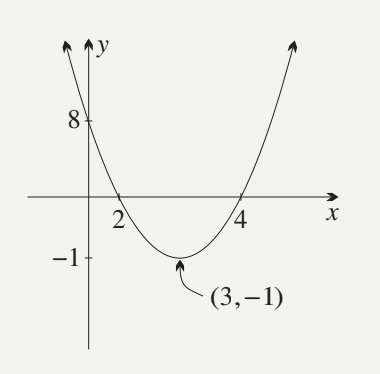
The sketch shows a parabola with vertex at , -intercepts at and , and -intercept at :
Example
Worked Example 4: Always increasing functions
Question:
(a) Show that is always increasing
(b) Find and , and hence explain why the curve has exactly one -intercept
Solution:
(a) Differentiate the function:
Notice that is always greater than or equal to zero (since squares are never negative).
Therefore:
Since can never be less than , the derivative is always positive. This means the function is increasing for every value of .
(b) Substitute the values:
Since is negative and is positive, and the curve is continuous, the curve must cross the -axis somewhere between and .
Because the function is always increasing (never goes back down), it can only cross the -axis once. Therefore, the curve has exactly one -intercept.
Key Insight: If you can show that a derivative is always positive (or always negative), you've proven the function is always increasing (or always decreasing), which is powerful information for understanding the curve's behavior.
Summary
Key Points to Remember:
- The sign of the derivative tells you the behavior of the curve at :
- Positive → increasing
- Negative → decreasing
- Zero → stationary
- To find stationary points, solve the equation
- A curve with a derivative that's always positive (or always negative) is always increasing (or always decreasing)
- Stationary points occur where the tangent is horizontal (gradient equals zero)
- Always evaluate and interpret the derivative before sketching graphs to understand the curve's behavior