Primitive Functions (HSC SSCE Mathematics Advanced): Revision Notes
📚Revision Notes
Primitive Functions
Introduction
Finding primitives is the reverse process of differentiation. Instead of finding the derivative of a function, we work backwards. If we know what the derivative is, what can we say about the original function? This is a fundamental concept that prepares us for integration techniques.
The key question is: "If I know , what was ?"
Note
Think of primitives as "undoing" differentiation. Just as subtraction reverses addition, finding a primitive reverses the process of taking a derivative. This concept is central to many areas of calculus and its applications.
Functions with the same derivative
Many different functions can share the same derivative. Consider these examples, all of which have derivative :
Notice that these functions differ only by a constant term. This pattern holds true in all cases: any two functions with the same derivative differ only by a constant.
Key theorem
Important
Theorem: Functions with Zero or Equal Derivatives
Part A: If a function has derivative zero in an interval , then is a constant function in .
Part B: If for all in an interval , then and differ by a constant in .
Proof
Part A: If the derivative equals zero, then the gradient of the curve is zero throughout the interval. The curve must be a horizontal straight line, which means is a constant function.
Part B: To prove the second statement, we take the difference between and and apply Part A.
Let .
Then for all in the interval .
By Part A, where is a constant.
Therefore , as required.
The family of curves with the same derivative
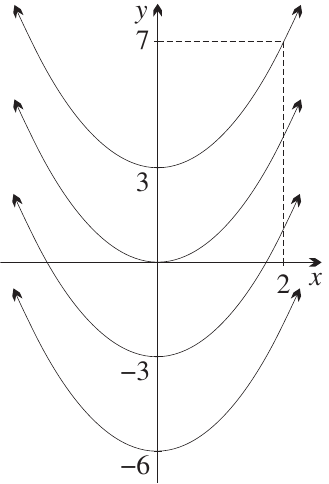
Returning to our first example, the various functions whose derivatives are all have the form:
By choosing different values of the constant , these functions form an infinite family of curves. Each curve is the parabola translated upwards or downwards.
Note
The diagram above shows this family of parabolas. Each curve has the same shape but is shifted vertically. The constant determines how far up or down the parabola is translated from the basic curve.
Initial or boundary conditions
When we know that a function passes through a specific point, we can determine the exact value of the constant . This additional information is called an initial condition or boundary condition.
For example, if we know and the graph passes through the point :
Therefore , giving us .
Note
Instead of an infinite family of functions, we now have one specific function. The initial condition "pins down" which member of the family we need. This is like knowing both the shape of a curve and one point it passes through—enough information to draw the exact curve.
Primitives
We need proper terminology for this reverse differentiation process. The terms primitive and anti-derivative are both commonly used.
Important
Definition: Primitive Function
A function is called a primitive or an anti-derivative of if the derivative of is :
If is any primitive of , then the general primitive of is:
For example, each of these functions is a primitive of :
The general primitive (or just "the primitive") of is:
A rule for finding primitives
We know that a primitive of is , and a primitive of is . By reversing the differentiation formula , we get the general rule:
Important
Power Rule for Primitives
If where , then:
Memory aid: Increase the index by 1 and divide by the new index.
Important
Critical Exception: This rule does not work when (we'll learn why later). Never try to apply this formula when the index is .
Example 20: Finding primitives of polynomials
Example
Worked Example: Finding Primitives of Polynomial Functions
a) Find the primitive of
Let
Then for some constant
b) Find the primitive of
Let
Then for some constant
Example 21: Primitives with negative and fractional indices
Example
Worked Example: Primitives with Negative and Fractional Indices
a) Find the primitive of
First rewrite using negative indices:
Let
Then where is a constant
Converting back:
b) Find the primitive of
First rewrite using fractional indices:
Let
Then where is a constant
Note
When working with negative or fractional indices, always rewrite the expression in index form first. This makes it clear which rule to apply and reduces the chance of errors. After finding the primitive, you can convert back to the original form if needed.
Linear extension
We can extend the primitive rule to handle powers of linear functions. By reversing the formula , we get:
Important
Linear Extension Rule for Primitives
If where , then:
Memory aid: Increase the index by 1, then divide by the new index AND by the coefficient of .
Example 22: Primitives of linear functions
Example
Worked Example: Primitives of Linear Functions
a) Find the primitive of
Let
Then where is a constant
Therefore
b) Find the primitive of
Let
Then where is a constant
Therefore
c) Find the primitive of
First rewrite: Let
Then where is a constant
Therefore
d) Find the primitive of
First rewrite: Let
Then where is a constant
Therefore
Note
Common Mistake to Avoid
When finding the primitive of , don't forget the double division. You must divide by both the new index AND the coefficient of . For example, with , divide by both 5 (the new index) and 3 (the coefficient of ).
Finding the primitive, given an initial condition
When we know both the derivative of a function and one point on its graph, we can find the specific function (not just the family of functions).
Important
Method: Finding a Primitive with an Initial Condition
- First find the general primitive, including the constant
- Then substitute the known point to calculate the value of
Example 23: Using an initial condition
Example
Worked Example: Finding a Primitive with an Initial Condition
Given that and when , find as a function of .
Solution:
Since
The general primitive is for some constant
Substituting and :
Therefore
Hence
Remember!
Summary
Key Points to Remember:
-
Primitives reverse differentiation: Finding a primitive means working backwards from the derivative to find the original function.
-
Always add C: The general primitive always includes a constant of integration , creating a family of functions that differ by vertical translations.
-
Power rule reversed: For (where ), the primitive is . Increase the index by 1 and divide by the new index.
-
Linear extension: For , also divide by the coefficient of :
-
Initial conditions determine C: Use a known point to find the specific value of the constant and identify the exact function from the family.