Stationary Points and Turning Points (HSC SSCE Mathematics Advanced): Revision Notes
📚Revision Notes
Stationary Points and Turning Points
Introduction to stationary points
A stationary point occurs where the derivative of a function equals zero, that is, where . At these points, the tangent to the curve is horizontal.
Note
At a stationary point, the tangent line to the curve is perfectly horizontal, meaning the function is neither increasing nor decreasing at that instant.
For functions that are not constant near the stationary point, we can classify these points into four different types:
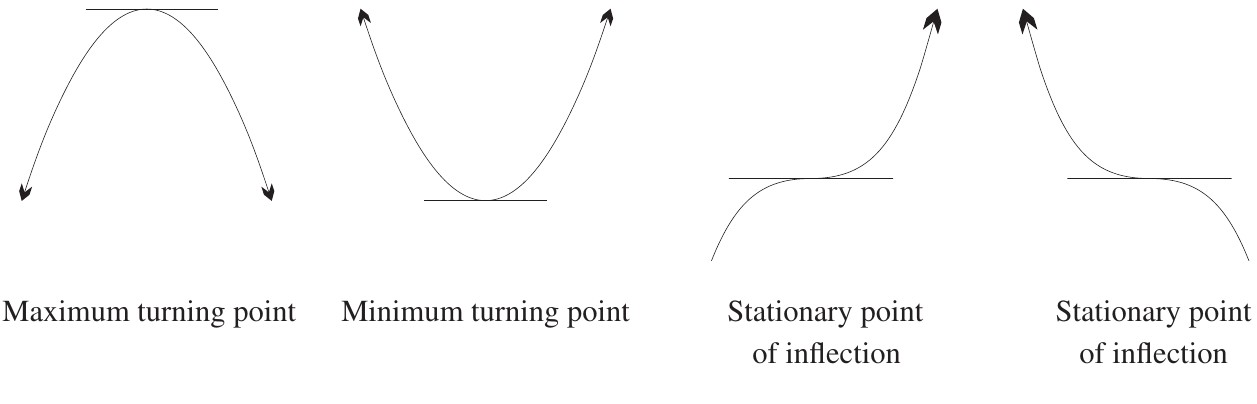
The four types
- Maximum turning point - The curve reaches a peak, turning smoothly from increasing to decreasing
- Minimum turning point - The curve reaches a trough, turning smoothly from decreasing to increasing
- Stationary point of inflection (increasing) - The curve continues increasing on both sides of the stationary point
- Stationary point of inflection (decreasing) - The curve continues decreasing on both sides of the stationary point
Turning points
A turning point is a special type of stationary point where the derivative changes sign.
Key characteristics:
- At a maximum turning point, the function changes from increasing to decreasing. The curve has a maximum value at this point in its immediate neighbourhood.
- At a minimum turning point, the function changes from decreasing to increasing. The curve has a minimum value at this point in its immediate neighbourhood.
Important
The critical feature of a turning point is that the derivative changes sign as you pass through the point. This sign change is what distinguishes turning points from other stationary points.
Points of inflection
A point of inflection is a point on the curve where the tangent line actually crosses the curve. This happens when the concavity changes direction.
What is concavity?
- A curve has upward concavity when it curves upward (like a smile ∪)
- A curve has downward concavity when it curves downward (like a frown ∩)
At a point of inflection, the concavity changes from upward to downward, or from downward to upward.
Note
Stationary points of inflection:
A stationary point of inflection combines two properties:
- It is a stationary point (the tangent is horizontal, so )
- It is also a point of inflection (the tangent crosses the curve and concavity changes)
At these points, the curve "flexes" around the stationary point. Surprisingly, the tangent actually crosses through the curve rather than just touching it.
Local maxima and minima
Sometimes we need to describe maximum and minimum points more precisely. A local or relative maximum is a point where the curve reaches a maximum value when compared only to nearby points.
Formal definition:
Let be a point on the curve :
- Point is a local maximum if for all values in some small interval around
- Point is a local minimum if for all values in some small interval around
Important
A local maximum or minimum may not have a horizontal tangent. The tangent might not even exist at the point (like at a sharp corner). This means not all local extrema are stationary points.
Example: Classifying different types of points
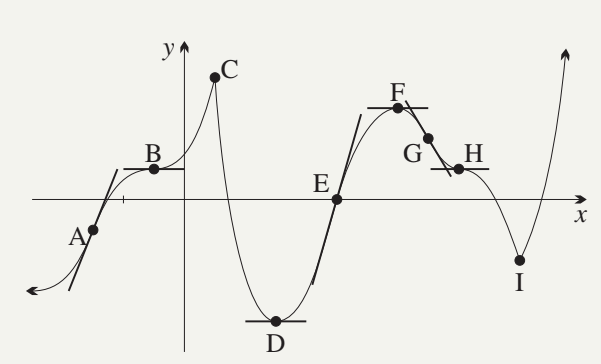
Consider the curve shown above with labelled points through . Let's classify each:
- and are local maxima. However, only is a maximum turning point because it has a horizontal tangent.
- and are local minima. However, only is a minimum turning point because it has a horizontal tangent.
- and are stationary points of inflection because they have horizontal tangents and the curve flexes through them.
- , , and are also points of inflection (the tangent crosses the curve at these points), but they are not stationary points because the tangent is not horizontal.
Analysing stationary points with a table of slopes
The derivative can only change sign at specific locations:
- Where (a stationary point)
- Where is discontinuous (where the function is not differentiable)
This gives us a systematic method for analysing stationary points.
Important
Method for using the derivative to analyse stationary points:
- Find where the derivative equals zero and where it has discontinuities
- Create a table of test values of the derivative , choosing test points on either side of each zero and discontinuity
- Record the slope behaviour underneath using symbols:
- "/" for positive slope (increasing)
- "" for negative slope (decreasing)
- "—" for zero slope (horizontal)
The resulting table shows not only the nature of each stationary point, but also where the function is increasing and decreasing across its whole domain.
Worked example: Cubic function
Example
Worked Example: Finding Stationary Points of a Cubic Function
Find the stationary points of , use a table of slopes to determine their nature, and sketch the curve.
Solution:
First, find the derivative:
The derivative has zeroes at and , with no discontinuities.
Now create a table of slopes:
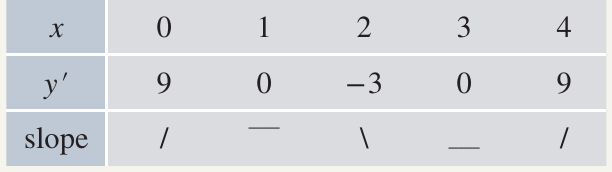
The table shows:
- At : slope changes from positive to negative, so this is a maximum turning point
- At : slope changes from negative to positive, so this is a minimum turning point
Find the -coordinates:
When :
When :
Therefore, is a maximum turning point and is a minimum turning point.
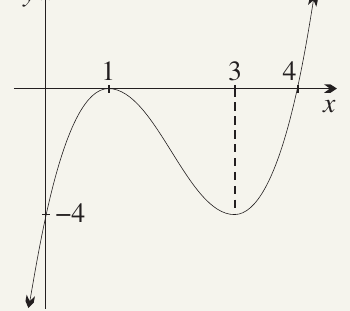
Worked example: Quintic function
Example
Worked Example: Finding Stationary Points of a Quintic Function
Find the stationary points of , use a table of slopes to determine their nature, and sketch the curve.
Solution:
Find the derivative:
The derivative has zeroes at , , and , with no discontinuities.
Create a table of slopes:
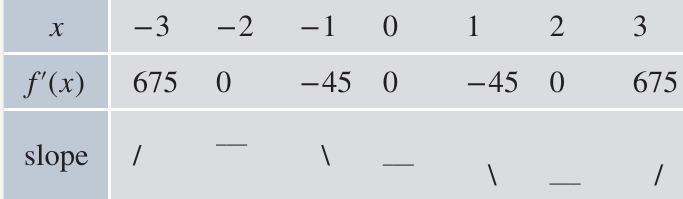
The table shows:
- At : slope changes from positive to negative, so this is a maximum turning point
- At : slope remains negative on both sides, so this is a stationary point of inflection
- At : slope changes from negative to positive, so this is a minimum turning point
Find the -coordinates:
When :
When :
When :
Therefore, is a maximum turning point, is a minimum turning point, and is a stationary point of inflection.
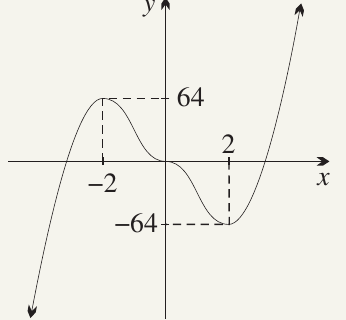
Note
When creating the table, only the signs of matter for determining the nature of stationary points. However, if you don't calculate actual values, you should explain how you determined the signs.
Finding unknown constants in a function
Sometimes we need to find unknown coefficients in a function using information about its stationary points.
Example
Worked Example: Finding Unknown Coefficients
The graph of the cubic has a stationary point at . Find and .
Solution:
We need two equations to find two unknowns.
Since the point lies on the curve, we know :
Since there is a stationary point at , we know .
First find the derivative:
Now use :
Subtract equation (1) from equation (2):
Substitute into equation (1):
Therefore and .
Summary
Summary
Key Points to Remember:
- Stationary points occur where (horizontal tangent)
- Turning points are stationary points where the derivative changes sign. At maximum turning points, the function changes from increasing to decreasing. At minimum turning points, it changes from decreasing to increasing.
- Points of inflection occur where the tangent crosses the curve and concavity changes direction
- Stationary points of inflection have both a horizontal tangent and changing concavity. The curve continues in the same direction (either increasing or decreasing) on both sides
- Use a table of slopes to systematically analyse the nature of stationary points by testing the sign of on either side of each critical point