Graphs and Equations (HSC SSCE Mathematics Advanced): Revision Notes
📚Revision Notes
Trigonometric Graphs
Introduction to radian measure
When working with trigonometric functions in mathematics, we measure angles in radians rather than degrees. A radian is a pure number without units, making it ideal for calculus and advanced mathematics.
Note
Radians are the natural unit for measuring angles in mathematics because they simplify many formulas and make calculus operations much cleaner. One radian is the angle subtended at the centre of a circle by an arc equal in length to the radius.
The key conversions between radians and degrees are:
The three fundamental trigonometric graphs
There are three primary trigonometric functions whose graphs you need to understand: sine, cosine and tangent. Each has distinct characteristics that make it unique.
The sine function
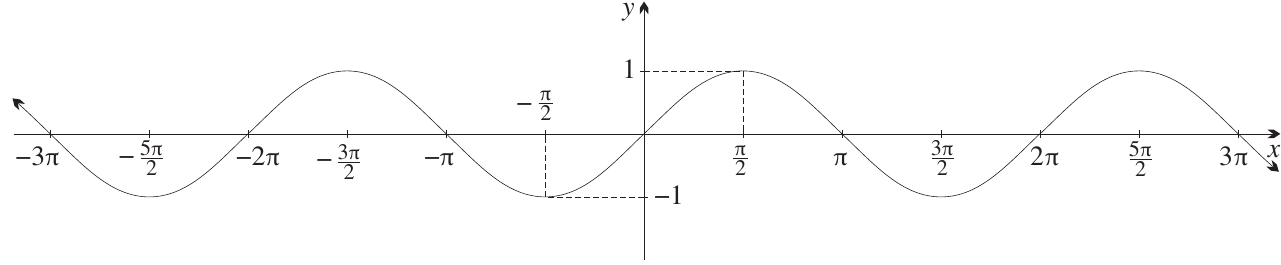
The graph of is a smooth wave that oscillates between 1 and -1. It crosses the -axis at multiples of (that is, at , and so on).
The cosine function
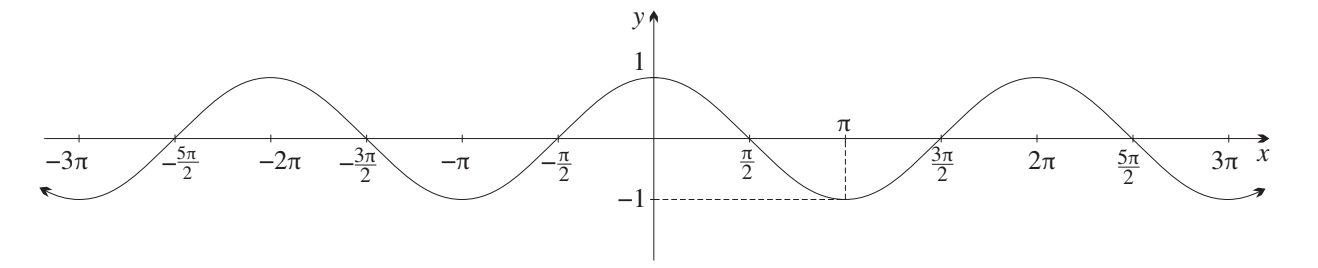
The graph of is also a smooth wave oscillating between and , but it starts at its maximum value when . The cosine graph looks like the sine graph shifted horizontally.
The tangent function
The graph of is quite different. Instead of being bounded like sine and cosine, the tangent function has vertical asymptotes (lines the graph approaches but never touches) at , and so on.
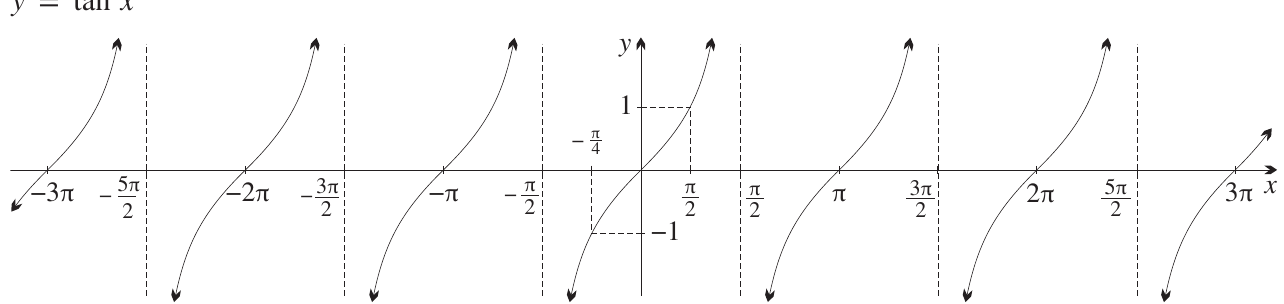
Between each pair of asymptotes, the tangent curve increases from negative infinity to positive infinity, creating a repeating pattern of S-shaped curves.
Vertical dilations and amplitude
The amplitude of a wave measures how far above the middle position the wave reaches at its peak. For the basic functions and , the waves oscillate between and , with a middle position at . This means both have amplitude .
When we multiply a sine or cosine function by a constant , we stretch the graph vertically. The function will now oscillate between and , giving it an amplitude of .
Important
Amplitude Formula:
For the functions and , the amplitude is .
This represents the maximum distance the wave reaches above (or below) its mean position.
Key properties:
- and both have amplitude
- and both have amplitude
- These are created by stretching or vertically by factor
The tangent function increases without bound near its asymptotes, so amplitude doesn't apply. However, we can still stretch it vertically to get . For this function, when , we have .
Example
Worked Example: Finding Amplitude and Period
Question: Find the period and amplitude of:
a)
b)
Then sketch one period of each function.
Solution:
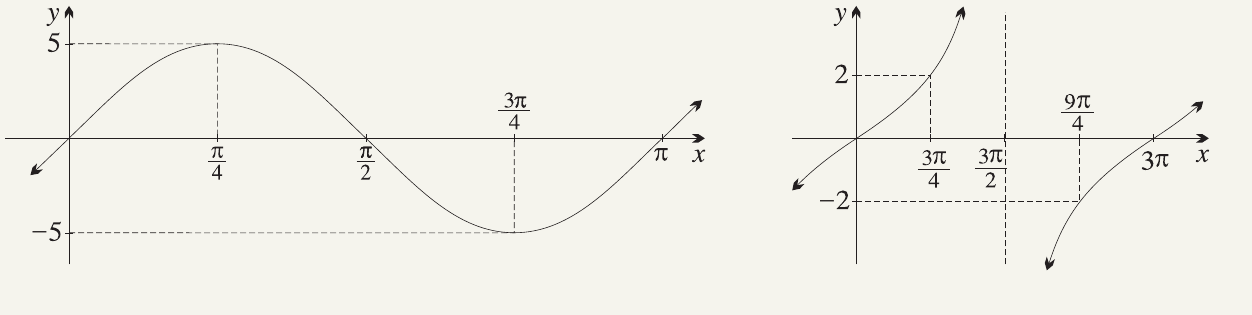
a) For :
The amplitude is 5 (the coefficient in front of sine).
The period is (we'll explain the period formula in the next section).
b) For :
The period is .
There's no amplitude (tangent isn't bounded), but when , we have .
Horizontal dilations and period
Periodic functions are functions that repeat themselves over and over. The period is the length of the smallest repeating section of the graph.
For the basic trigonometric functions:
- and complete one full wave cycle every units (one full revolution), so they have period
- repeats every units (half a revolution), so it has period
When we introduce a coefficient inside the function, we compress the graph horizontally. Consider . This can be written as , showing it's a horizontal compression by factor .
Note
Since the original function has period , when we compress it horizontally by factor , the period becomes times smaller, giving us .
Since the original function has period , the compressed function has period .
Important
Period Formulas:
- and have period
- has period
- All three are created by compressing horizontally with factor
Horizontal translations and phase
The phase (or initial phase angle) of a trigonometric function tells us the angle value when . For example, has phase because when , the angle inside the sine function is .
When we add a constant inside the function, we shift the graph horizontally. The function is the result of shifting to the left by units.
Key properties:
- The phase is the angle when
- , and all have phase
- These functions are created by shifting left by (if ) or right by (if )
Example
Worked Example: Horizontal Translations
Question: Sketch these functions and state their phase:
a)
b)
c)
Solution:
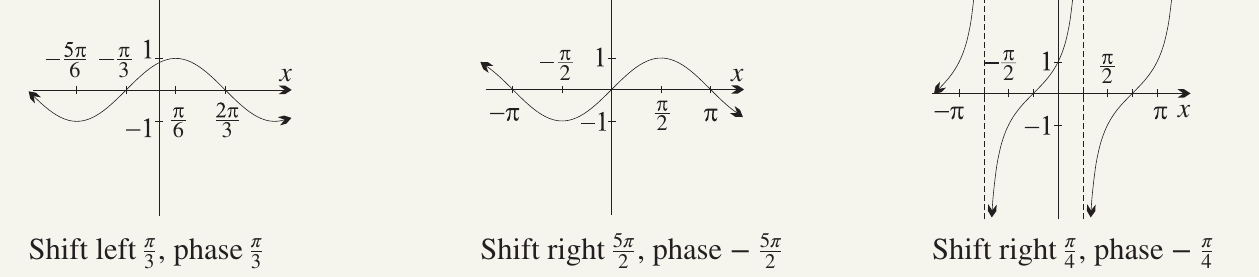
a) Shift left by . Phase:
b) Shift right by . Phase:
c) Shift right by . Phase:
Important
Phase is Not Unique:
Phase is not uniquely defined because we can add or subtract multiples of the period. For example, in part b above, we could also express the phase as or .
Combining period and phase
When we have both a horizontal compression and a horizontal shift, we need to be careful about the order of transformations. Consider the function:
This function has:
- Period:
- Phase: (found by setting )
There are two ways to think about creating this graph:
Method 1: Starting from
- Shift left by to get
- Then compress horizontally by factor to get
Method 2: Starting from
- Compress horizontally by factor to get
- Then shift left by to get
Important
Both methods work, but remember: horizontal dilations and horizontal translations don't commute (the order matters).
General formula: For :
- Period:
- Phase:
Vertical translations and mean value
The mean value of a wave is the average of its maximum and minimum values. For and , the maximum is and the minimum is , so the mean value is .
When we add a constant to a trigonometric function, we shift it vertically. The function has:
- Mean value:
- The wave still has the same amplitude, but it now oscillates around instead of
Key properties:
- and both have mean value
- These are created by shifting up by units (or down if )
- When combining transformations, do vertical translations last to avoid confusion with amplitude changes
Note
The function isn't a wave and doesn't have a mean value, but it's still shifted up by units.
The function isn't a wave and doesn't have a mean value, but it's still shifted up by units.
Example
Worked Example: Combining All Transformations
Question: Use four successive transformations to sketch , and specify the amplitude, period, phase and mean value.
Solution:
We can rewrite this as and build it step by step:
Step 1: Start with
Step 2: Shift left to get
Phase is now
Step 3: Compress horizontally by factor to get
Period is now
Step 4: Stretch vertically by factor to get
Amplitude is now
Step 5: Shift down units to get
Mean value is now
Final answer:
- Amplitude: 3
- Period:
- Phase:
- Mean value: -2
Symmetry properties of trigonometric functions
The three basic trigonometric functions have important symmetry properties that affect how they behave with negative inputs.
Odd functions: sine and tangent
The functions and are odd functions. This means:
Graphically, odd functions have point symmetry about the origin. If you rotate the graph about the origin, it looks unchanged.
Even function: cosine
The function is an even function. This means:
Graphically, even functions have line symmetry in the y-axis. If you reflect the graph across the -axis, it looks unchanged.
Note
These symmetry properties are extremely useful when solving equations and simplifying expressions. Remember: odd functions have rotational symmetry around the origin, while even functions mirror across the -axis.
These symmetry properties are extremely useful when solving equations and simplifying expressions.
Graphical solutions of trigonometric equations
Many trigonometric equations cannot be solved using algebra alone. However, we can use graphs to find approximate solutions. By sketching both sides of an equation on the same axes, we can:
- Determine how many solutions exist
- Find approximate values for the solutions
Example
Worked Example: Graphical Solution
Question:
a) Find, by drawing a graph, the number of solutions of
b) Then use the graph to find approximations correct to one decimal place
Solution:
a) We sketch and on the same axes. The intersections show where .
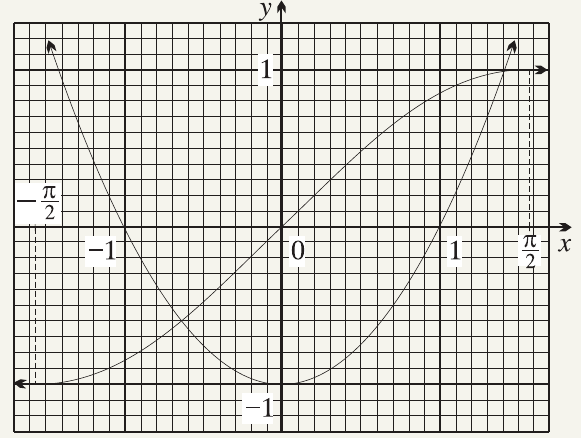
From the graph, we can clearly see there are two solutions.
b) Reading from the graph:
- The positive solution is
- The negative solution is
Summary
Key Points to Remember:
- Radians: , (a full circle)
- Amplitude: For or , the amplitude is (how high the wave reaches above centre)
- Period: For or , the period is ; for , the period is
- Phase: The angle value when ; for , the phase is
- Mean value: For , the wave oscillates around
- Symmetry: Sine and tangent are odd functions (point symmetry); cosine is an even function (line symmetry)
- When combining transformations, do vertical translations last to keep them separate from amplitude changes