A Curve-Sketching Menu (HSC SSCE Mathematics Advanced): Revision Notes
📚Revision Notes
A Curve-Sketching Menu
Understanding curve sketching
When working with unfamiliar functions, you need a reliable approach to understand their behaviour and produce accurate sketches. A sketch is different from a precise plot - it's a clear diagram that captures the essential features of a curve without requiring exact plotting of every point.
Note
A "sketch" of a graph is not an accurate plot. It is a neat diagram showing the main features of the curve - the big picture of how the function behaves.
The curve-sketching menu presented here brings together four key techniques into a systematic process. This method works well for many common functions, though it cannot handle every possible case. As you progress in your studies, additional techniques involving calculus will expand what you can analyse.
What makes a good sketch
A proper mathematical sketch must include certain key features to be useful. The goal is to communicate the function's behaviour clearly through a well-organized diagram.
Important
Essential elements of any sketch:
- All x-intercepts and y-intercepts (when they can be found)
- Any vertical asymptotes
- Any horizontal asymptotes
- Other significant points on the curve
- Labels on both axes
- Some indication of scale on both axes
Remember that a sketch shows the general shape and important features, not every tiny detail.
The curve-sketching menu
Here is a systematic approach for sketching an unknown function. Follow these steps in order to build up a complete picture of the function's behaviour.
Step 0 - Preparation
Before analyzing the function, simplify it as much as possible. Combine any fractions using a common denominator, then factorise both the numerator and denominator completely. This preparation makes the remaining steps much easier.
Note
Think of Step 0 as "cleaning up" the function. A well-prepared function reveals its key features much more readily in the steps that follow.
Step 1 - Domain
Always start by finding the domain. Ask yourself: what values of are allowed? Look for values where the function is undefined (such as where a denominator equals zero). The domain tells you where the function exists.
Important
Finding the domain first is crucial - it reveals any discontinuities that might lead to vertical asymptotes and prevents you from trying to evaluate the function at impossible values.
Step 2 - Symmetry
Check whether the function has any symmetry:
- If , the function is even and has line symmetry in the y-axis
- If , the function is odd and has point symmetry about the origin
- Otherwise, the function has neither type of symmetry
Identifying symmetry can save you work and helps you understand the function's shape.
Step 3A - Intercepts
Find where the curve crosses the axes:
- y-intercept: Substitute into the function
- x-intercepts (zeroes): Solve to find where the curve crosses the x-axis
Step 3B - Sign
Determine where the function is positive and where it is negative. Use a table of test values, checking the sign of in each region between zeroes and discontinuities. This tells you which parts of the curve lie above or below the x-axis.
Step 4A - Vertical asymptotes
Examine the behaviour near any discontinuities. A vertical asymptote occurs at when the denominator equals zero but the numerator does not. Investigate what happens as approaches the discontinuity from each side.
Step 4B - Horizontal asymptotes
Examine what happens as and as . If the function approaches a constant value , then is a horizontal asymptote.
Worked example 1: even rational function
Example
Worked Example: Sketching an Even Rational Function
Question: Sketch
Solution:
Step 0 - Preparation:
Factorise the denominator:
Step 1 - Domain:
The function is undefined where the denominator equals zero.
Setting gives or
Domain: and
Step 2 - Symmetry:
Test if the function is even:
Since , the function is even and has line symmetry in the y-axis.
Step 3 - Intercepts and sign:
When :
The function has a zero at and discontinuities at and .
Testing values in each region:
| * | * | ||||||
| sign | * | * |
The asterisks (*) indicate discontinuities.
Step 4A - Vertical asymptotes:
At and , the denominator equals zero but the numerator does not, so these are vertical asymptotes.
From the sign table:
- as and as
- as and as
Step 4B - Horizontal asymptotes:
Divide numerator and denominator by :
As ,
Therefore as and as
The line is a horizontal asymptote.
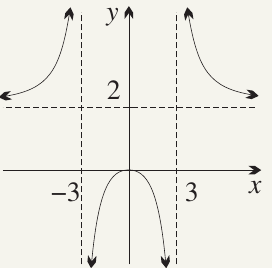
Worked example 2: sum of fractions
Example
Worked Example: Sketching a Sum of Fractions
Question: Sketch
Solution:
Step 0 - Preparation:
Find a common denominator:
Factorise the numerator:
Step 1 - Domain:
The domain is and
Step 2 - Symmetry:
Testing shows that is neither even nor odd.
Step 3 - Intercepts and sign:
When :
The y-intercept is at
There is a zero at (where the numerator equals zero) and discontinuities at and .
Using a sign analysis table:
| * | * |
The asterisks indicate discontinuities. This table shows that:
- when
- when
- when
- when
Step 4 - Asymptotes:
At and , the denominator equals zero but the numerator does not, so and are vertical asymptotes.
For horizontal asymptotes, look at the original form of the function:
As : both and
Therefore as and as
The line (the x-axis) is a horizontal asymptote.
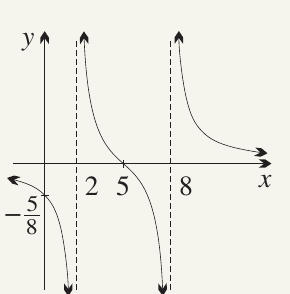
Remember!
Summary
Key Points to Remember:
-
A sketch is not a plot: Show the key features clearly with labeled axes and scale, but don't worry about plotting every point precisely
-
Always find the domain first: This tells you where the function exists and reveals any discontinuities that might lead to vertical asymptotes
-
Check for symmetry early: If a function is even or odd, you only need to sketch half of it and use symmetry for the rest
-
Vertical asymptotes occur where denominators vanish: Look for values where the denominator equals zero but the numerator doesn't - these create vertical asymptotes
-
Sign analysis is crucial: A table showing where the function is positive or negative helps you understand which parts of the curve sit above or below the x-axis