Solving Inequalities (HSC SSCE Mathematics Advanced): Revision Notes
📚Revision Notes
Solving Inequalities
What are inequations?
When we replace the equals sign in an equation with an inequality symbol like , , , or , we create an inequation.
For example, the equation has the solution . If we change this to the inequation , the solution becomes . This is because any number greater than makes the statement true, whilst any other number makes it false.
Inequations vs inequalities
There is an important distinction to understand:
Note
Understanding the Terminology
- An inequation is a statement like that is only true for certain values of
- An inequality is a statement like that is true for all values of
Think of inequalities as similar to identities in equations. For instance, is true for all values of .
Note
Different textbooks may use these terms differently. Sometimes "inequality" is used for both concepts, so don't be confused if you're asked to "solve an inequality" - it means the same as solving an inequation.
Understanding "less than"
The phrase "less than" can be understood in two helpful ways. For real numbers and :
Geometric interpretation
We say that if is to the left of on the number line.

Algebraic interpretation
We say that if is positive.
Both interpretations are useful tools when solving inequations. The geometric interpretation helps us visualise solutions, whilst the algebraic interpretation is helpful for algebraic manipulation.
Solving linear inequations
The methods for solving linear inequations are very similar to those for solving linear equations, with one crucial difference.
Key rules
- Add or subtract the same value from both sides (just like equations)
- Multiply or divide both sides by the same value (just like equations)
- Never multiply or divide by
Important
Critical Rule: Reversing the Inequality
When multiplying or dividing both sides by a negative number, you must reverse the inequality symbol.
For example: If , then dividing by gives (note the sign reversal).
Example
Worked Example: Solving Linear Inequations
Example (a): Solve
Solution process:
Add to both sides:
Divide by and reverse the inequality:
Example (b): Solve
This is a compound inequality. We need to work with both parts simultaneously.
Subtract from all parts:
Divide by and reverse both inequalities:
Important
Exam Tip
Always remember to flip the inequality sign when dividing or multiplying by a negative number. This is one of the most common mistakes in examinations.
Solving quadratic inequations
The most effective way to solve a quadratic inequation is to sketch the graph of the associated parabola. This graphical method makes the solution clear and visual.
Method for quadratic inequations
Note
Step-by-Step Approach
- Move everything to the left-hand side
- Sketch the graph of , showing the x-intercepts
- Read the solution off the graph
Example
Worked Examples: Quadratic Inequations
Example (a): Solve
Step 1: Move everything to the left:
Step 2: Factorise:
Step 3: Sketch and identify where the graph is above the x-axis.
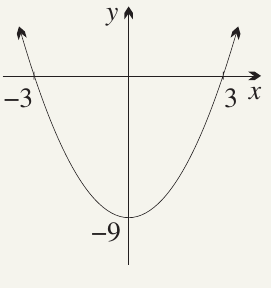
The parabola is above the x-axis when or .
Note
This example is straightforward and can be solved by recognising that means is further than units from zero.
Example
Example (b): Solve
Step 1: Move everything to the left:
Step 2: Factorise:
Step 3: Sketch and identify where the graph is below or on the x-axis.
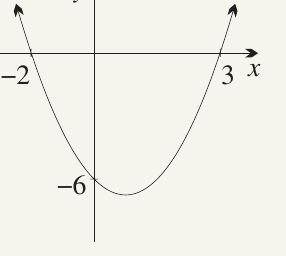
The parabola is below or on the x-axis when .
Important
Exam Tip
For quadratic inequations, always sketch the parabola. The visual representation helps prevent sign errors and makes the solution region clear.
Solving absolute value equations and inequations
Absolute value problems can be solved using two main approaches: the number line method (for simple cases) and the algebraic method (for more complex cases).
Using the number line
Most absolute value equations and inequations in this course can be solved by thinking about distances on the number line.
Note
Key Principle
represents the distance from to on the number line.
Method for simple absolute value problems
Note
Step-by-Step Approach
- Rewrite the equation or inequation in the form , or , or
- Interpret this as a distance on the number line
- Find the solution by considering which values of satisfy the distance condition
Example
Worked Examples: Number Line Method
Example (a): Solve
This asks: "What values of are distance from ?"
On the number line, we see that or .
Example (b): Solve
Rewrite as: "What values of are distance from ?"
This gives or .
Example (c): Solve
First, divide by :
This asks: "What values of are less than distance from ?"
This gives .
Example (d): Solve
Multiply by :
This asks: "What values of are at least distance from ?"
This gives or .
Algebraic method
For more complex absolute value problems, we can use algebraic rewriting.
Note
Algebraic Rewriting Rules
Absolute value equations:
Rewrite as:
Absolute value inequations:
Rewrite as:
Rewrite as:
Important
Special Case: Negative Values of
The absolute value cannot be negative. Therefore, if is negative:
- and have no solutions
- is true for all values of in the domain of
Example
Worked Example: Algebraic Method
Consider with different conditions:
Part (a): Solve
Rewrite as two equations:
Subtract :
Divide by :
Part (b): Solve
Rewrite as a compound inequality:
Subtract :
Divide by and reverse inequalities:
This can be written as:
Part (c): Solve
Rewrite as two separate inequalities:
Subtract :
Divide by and reverse inequalities:
This can be written as: or
Important
Exam Tip
When solving absolute value inequations, pay careful attention to whether you need "and" (for problems) or "or" (for problems) in your final answer.
Summary
Key Points to Remember
- Reversing the inequality: When multiplying or dividing both sides of an inequation by a negative number, always reverse the inequality symbol
- Quadratic inequations: Sketch the parabola and identify where it's above or below the x-axis to find your solution
- Absolute value as distance: Think of as the distance from to on the number line
- Algebraic rewriting: For , rewrite as . For , rewrite as or
- Check your work: Test a value from your solution in the original inequation to verify your answer is correct