Integration (HSC SSCE Mathematics Advanced): Revision Notes
📚Revision Notes
The Trapezoidal Rule
Why we need approximation methods
Sometimes we cannot calculate definite integrals exactly using antiderivatives. This happens in two main situations:
Note
Two key scenarios requiring approximation:
-
Some important functions have antiderivatives that cannot be written as simple formulas. For example, the normal distribution function used in statistics has no simple antiderivative.
-
When working with experimental data, we might only know certain values of a function from measurements, without knowing the actual function formula.
In these cases, we need approximation methods to estimate the value of definite integrals.
The basic concept
The trapezoidal rule provides a straightforward way to approximate integrals. Instead of finding the exact area under a curve, we replace the curve with a straight line (called a chord) connecting the two endpoints. This creates a trapezium shape whose area we can easily calculate.
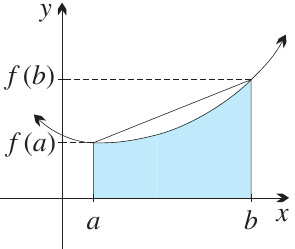
To find the area of the trapezium, we use the formula:
For a function on the interval :
- Width =
- Average of parallel sides =
Therefore:
We use this area as our approximation for the integral.
Single subinterval formula
For a continuous function on the closed interval :
Important
Key properties of the basic formula:
- If the function is linear (a straight line), the chord coincides exactly with the curve, so the formula gives the exact value of the integral.
- Always begin by constructing a table of values showing the x-coordinates and corresponding function values.
Improving accuracy with multiple subintervals
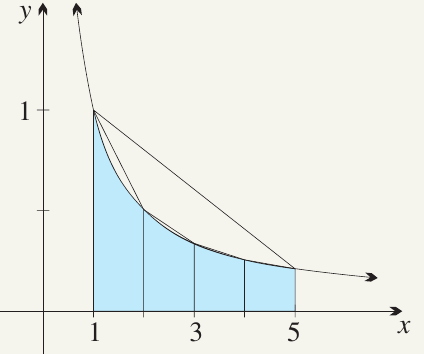
We can improve the accuracy of our approximation by dividing the interval into several smaller subintervals and applying the trapezoidal rule to each one. This gives a better fit to the curve.
Let's see this method applied to the reciprocal function :
Example
Worked Example: One subinterval vs four subintervals
Let's approximate using different numbers of subintervals.
Part (a): Using one subinterval
With one subinterval, we use just the two endpoint values:
Part (b): Using four subintervals
Now we divide the interval into four equal parts: , , , and .
Each subinterval has width , so:
Applying the trapezoidal rule to each:
Notice that using more subintervals gives a different (and usually more accurate) result.
Important
Essential rule: Always use subintervals of equal width unless specifically instructed otherwise.
Understanding concavity and accuracy
The shape of the curve determines whether the trapezoidal rule overestimates or underestimates the integral.
How concavity affects estimates
Note
Three key rules for concavity:
-
Concave up: The curve bends upward (like a smile). Every chord lies above the curve, so the trapezoidal rule overestimates the integral.
-
Concave down: The curve bends downward (like a frown). Every chord lies below the curve, so the trapezoidal rule underestimates the integral.
-
Linear: If the curve is actually a straight line, the chord coincides with it exactly, so the trapezoidal rule gives the exact value.
We can test concavity using the second derivative :
- If , the curve is concave up
- If , the curve is concave down
Example
Worked Example: Analysing concavity
Let's approximate using one subinterval, then explain whether this overestimates or underestimates.
First, construct a table of values for :
Applying the trapezoidal rule:
Now let's check the concavity:
The function is
Differentiating:
Differentiating again:
Since is negative throughout the interval , the curve is concave down throughout this interval.
Therefore, the trapezoidal rule underestimates the integral (our answer of is less than the true value).
The general formula for multiple subintervals
When using many subintervals, performing separate calculations becomes tedious. We can develop a single formula that combines all the applications of the trapezoidal rule.
Setting up the division
To divide the interval into equal subintervals, each of width :
Label the division points as:
In general: for
Deriving the formula
Applying the trapezoidal rule to each subinterval:
Notice that the middle values appear twice (once as the right endpoint of one trapezium and once as the left endpoint of the next). Collecting like terms:
The formula
For a continuous function on , using subintervals:
where and for
An alternative form, using nested brackets:
Note
Memory aid: "First and last once, middle terms twice"
Practical tips for using the formula
Note
Tips for successful calculations:
- Start with a sensible value for the width of each subinterval
- Construct a clear table of values before calculating
- Check your arithmetic carefully, especially when working with many subintervals
- Consider using a spreadsheet or calculator for problems with many subintervals
Real-world application: experimental data
Often we need to estimate integrals when we only have experimental measurements, without knowing the actual function formula. Here's an example using real hydrological data.
Example
Worked Example: Peachtree Creek flow
The graph below shows the flow rate at Peachtree Creek after a storm on December 24, 2002. The flow rate (in cubic feet per second) is recorded as a function of time (in hours).
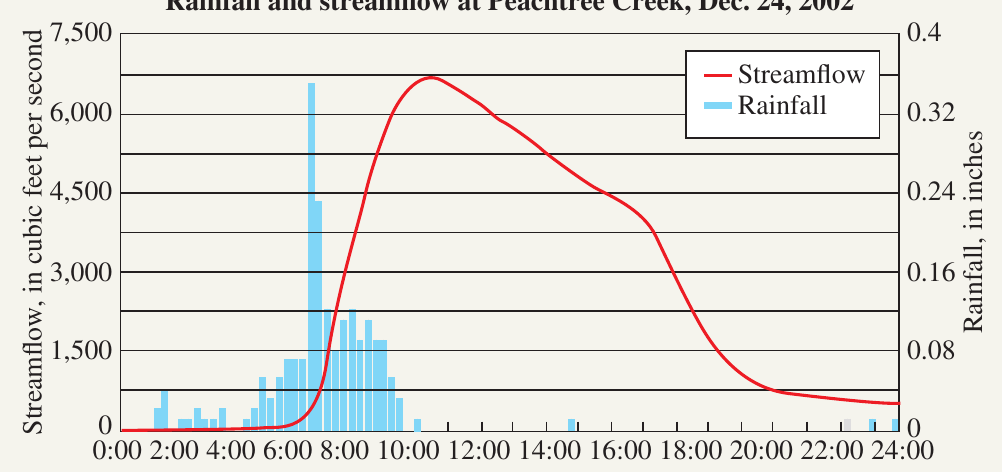
We want to estimate the total amount of water that flowed down the creek from 4:00 am () to midnight (). Let's use the trapezoidal rule with two-hour subintervals.
Step 1: Create a table of values
Reading from the graph (approximately):
| Flow rate |
Step 2: Handle units carefully
The time is in hours, but flow rate is in cubic feet per second. We need to convert to cubic feet per hour by multiplying by .
To avoid too many zeros, let be the flow rate in millions of cubic feet per hour:
Step 3: Apply the trapezoidal rule
Here and . Also , , .
Using the formula:
Therefore, approximately 223 million cubic feet of water flowed down Peachtree Creek from 4:00 am to midnight on that day.
Using technology
The trapezoidal rule formula is well-suited for spreadsheet calculations. While detailed step-by-step instructions vary between software versions, the general approach involves:
- Creating a row of x-values (using formulas to generate equal spacing)
- Calculating corresponding function values
- Applying the coefficient pattern (1 for endpoints, 2 for middle terms)
- Summing and multiplying by
This allows you to easily experiment with different numbers of subintervals to see how accuracy improves.
Important
Exam tips
- Always start with a table showing x-values and function values clearly
- Check concavity if asked whether the approximation is an overestimate or underestimate
- Use equal widths for all subintervals unless told otherwise
- Remember the pattern: first and last function values appear once, all middle values appear twice
- Be careful with units when working with real-world data
- Show your working clearly, even when using a calculator
Summary
Key Points to Remember
- The trapezoidal rule approximates integrals by replacing curves with straight-line chords, creating trapezium shapes
- Single subinterval formula:
- Multiple subintervals improve accuracy: where
- Concave up curves make the trapezoidal rule overestimate; concave down curves make it underestimate
- Always construct a table of values before calculating, and use equal-width subintervals unless instructed otherwise