Areas and the Definite Integral (HSC SSCE Mathematics Advanced): Revision Notes
📚Revision Notes
Areas and the Definite Integral
Introduction to area calculation
Every method we use to calculate area builds on two fundamental principles:
Important
The Two Principles of Area Calculation
- Area of a rectangle = length × breadth
- When a region is dissected, the area remains unchanged
For regions bounded by straight lines (such as triangles or trapeziums), we can calculate the area by cutting the shape into rectangles using a few strategic cuts. However, when dealing with curved boundaries, we need to imagine dividing the region into infinitely many rectangles. This requires a limiting process, similar to what we use in differentiation.
Developing the definite integral
Building from thin strips
Consider the region between a continuous curve and the -axis, from to (where ). For now, assume the function is never negative in this interval.
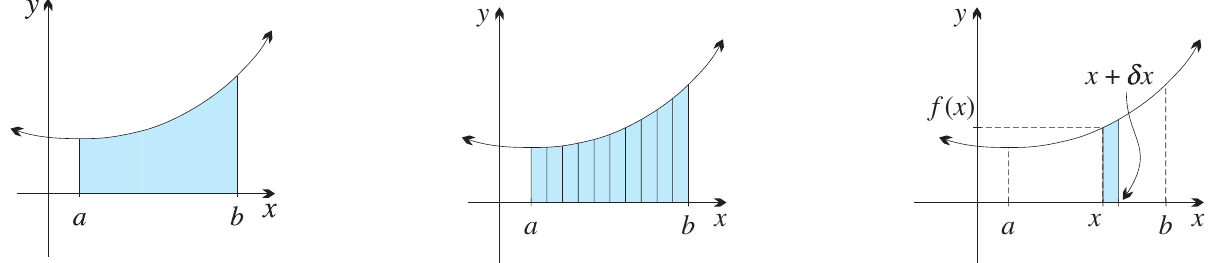
The diagram above shows three stages in developing the integral:
- Left panel: The complete region we want to find the area of, shaded in blue
- Middle panel: The region divided into many thin vertical strips. Each strip approximates a rectangle, though the curved top boundary makes this approximation imperfect
- Right panel: A close-up of a single strip at position on the -axis
Calculating the area of one strip
For a single strip at position :
- The height at the left edge is
- The width is (a very small amount)
- If the strip is thin enough, the height remains approximately across its entire width
Note
The approximation becomes more accurate as we make the strip thinner. The key insight is that for an infinitesimally thin strip, the approximation becomes exact.
Therefore:
Summing all the strips
To find the total area, we add up all the strips using sigma notation:
where the symbol means "sum of all".
Taking the limit
Now imagine infinitely many strips, each infinitesimally thin. The inaccuracy in our approximation disappears as approaches zero. We might expect to write:
However, instead of this notation, we use the elegant system introduced by Leibnitz:
Note
Leibnitz Notation
- Replace with (suggesting infinitesimal width)
- Replace the sigma symbol with (an elongated S, suggesting a smooth infinite sum)
Think of it this way: is a stretched S for "Sum", and is shrunk to zero!
This gives us the definite integral:
The definite integral - formal definition
Important
Definition: The Definite Integral
Let be a function that is continuous in a closed interval , where .
For now, suppose that is never negative in the interval.
-
The definite integral is defined as the area of the region between the curve and the -axis, from to
-
The function is called the integrand
-
The values and are called the lower and upper limits (or bounds) of the integral
Key insight: The term 'integration' reflects the process of combining many small pieces to form a complete whole. The notation captures the idea of building up a region from infinitely many infinitesimally thin strips.
Evaluating definite integrals using area formulae
When the function is linear or involves circles, we can calculate the definite integral by sketching the graph and using standard geometric area formulas.
Standard area formulas
Note
Essential Area Formulas
Triangle:
Trapezium:
Note: For a trapezium, is the perpendicular distance between the parallel sides. Depending on orientation, we might call this the "height" or "width".
Circle:
Worked example: linear functions
Example
Worked Example 1a: Triangle Region
Evaluate
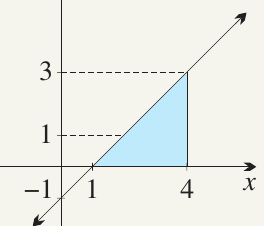
Step 1: Sketch the function
The function is a straight line with gradient and -intercept .
Step 2: Identify the shape
The shaded region is a triangle with:
- Base =
- Height =
Step 3: Apply the area formula
Example
Worked Example 1b: Trapezoidal Region
Evaluate
Step 1: Use the same function
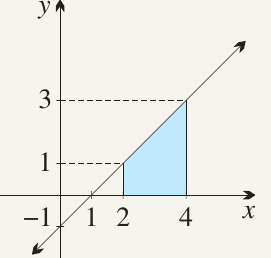
Using the same function :
Step 2: Identify the shape
The shaded region is a trapezium with:
- Width =
- Parallel sides of length and
Step 3: Apply the area formula
Worked example: absolute value and circular functions
Example
Worked Example 2a: Absolute Value Function
Evaluate
Step 1: Sketch the function
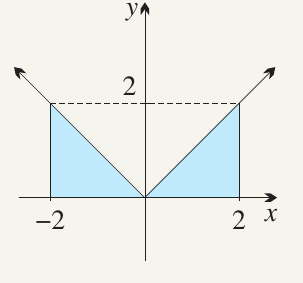
The function forms a V-shape with vertex at the origin.
Step 2: Identify the shape
The shaded region consists of two identical triangles, each with base and height .
Step 3: Calculate the total area
Example
Worked Example 2b: Semicircle Region
Evaluate
Step 1: Recognize the function
The function can be rewritten as , which represents a circle with centre at the origin and radius 5.
Since we're taking the positive square root, we get the upper semicircle.
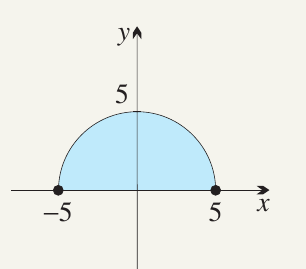
Step 2: Identify the shape
The shaded region is a semicircle with radius .
Step 3: Apply the area formula
Using upper and lower rectangles to approximate integrals
We can estimate the value of a definite integral by trapping it between two bounds using rectangles.
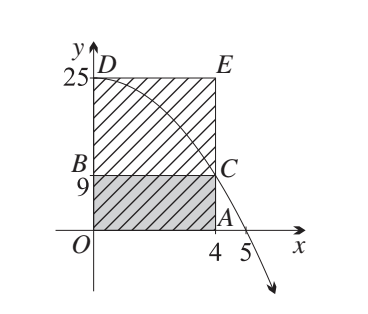
Consider the integral .
We can construct:
- Lower (inner) rectangles: These sit entirely inside the region
- Upper (outer) rectangles: These contain the entire region
Note
The true value of the integral always lies between the lower rectangle sum and the upper rectangle sum. This method gives us a guaranteed range for the answer.
Worked example: successive approximations
Example
Worked Example 3: Progressive Rectangle Approximations
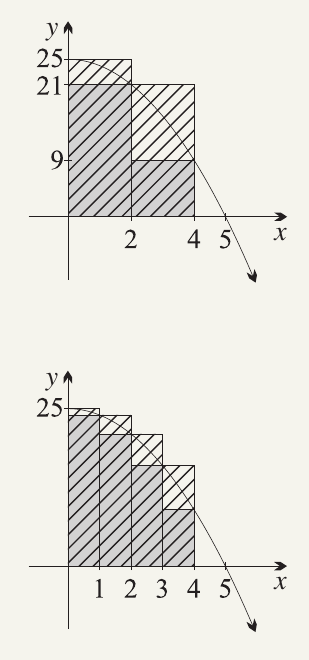
We'll evaluate using increasingly refined subdivisions.
Part (a): Single rectangle approximation
Using one rectangle on the interval :
Lower rectangle area:
Upper rectangle area:
Therefore:
Part (b): Two rectangle approximation
Subdividing the interval as :
Lower rectangles area:
Upper rectangles area:
Therefore:
Part (c): Four rectangle approximation
Subdividing into four subintervals of width :
Lower rectangles area:
Upper rectangles area:
Therefore:
Observation: As we increase the number of rectangles, the bounds get progressively tighter. The exact value is .
Important
The Rectangle Approximation Method
- More rectangles always give better approximations
- The upper and lower bounds converge to the true value as the number of subdivisions increases
- This method is particularly useful when you cannot use standard geometric formulas
- In exams, you may be asked to find bounds using a specified number of rectangles
Special case: the area of a circle
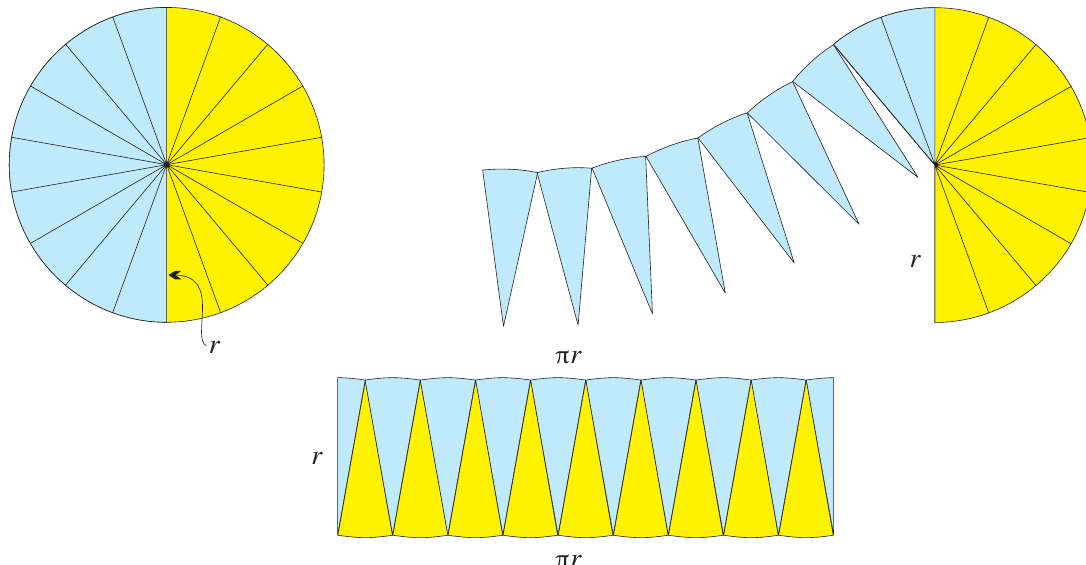
The formula for the area of a circle is itself derived using integration principles. Here's the classic geometric proof:
Note
Geometric Proof of Circle Area
The proof involves:
- Dividing the circle into many thin sectors (pie-shaped wedges)
- Rearranging these sectors alternately (yellow and blue) to approximate a rectangle
- As the sectors become infinitesimally thin, the arrangement becomes a perfect rectangle
The resulting rectangle has:
- Height = (the radius)
- Length = (half the circumference )
Therefore:
This demonstrates how dissecting a curved region and taking a limit leads to an exact area formula, just like the definite integral does for regions under curves.
Remember!
Summary
Key Points to Remember:
-
Two fundamental principles underpin all area calculations: area of a rectangle = length × breadth, and dissection doesn't change total area
-
The definite integral represents the area under the curve from to . The symbol is an elongated S representing an infinite sum
-
For linear and circular functions, evaluate definite integrals by sketching the graph and using standard area formulas (triangle, trapezium, circle)
-
Upper and lower rectangles can trap an integral between two bounds. More subdivisions give tighter bounds and better approximations
-
Integration is a limiting process involving infinitely many infinitesimally thin strips, similar to how differentiation involves limits