Challenge – Proving the Fundamental Theorem (HSC SSCE Mathematics Advanced): Revision Notes
📚Revision Notes
Challenge – Proving the Fundamental Theorem
Introduction
This section develops a rigorous proof of the fundamental theorem of calculus. The fundamental theorem is one of the most important results in mathematics, as it connects differentiation and integration. This material is challenging and requires careful thought, so take your time working through it.
Note
The fundamental theorem appears in two forms:
- The differential form shows that differentiating an integral gives back the original function
- The integral form provides the familiar method for evaluating definite integrals
Both forms are deeply connected and we will prove each one systematically.
The definite integral as a function of its upper limit
When we write a definite integral , the value changes as we change the upper limit . This means the definite integral can be viewed as a function of its upper limit.
To emphasize this functional relationship, we make two important changes to our notation:
- Replace the upper limit with (the conventional variable for functions)
- Replace the integration variable with (to avoid using twice)
This gives us the integral , which clearly shows the dependence on the upper limit .
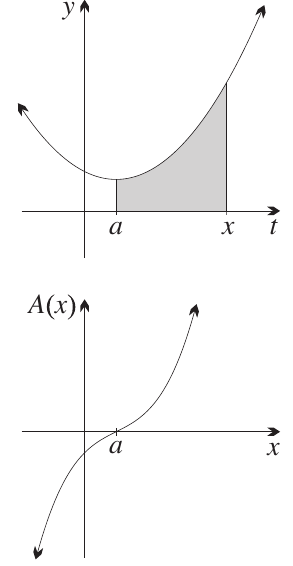
The signed area function
The signed area function for starting at is defined as:
Important
This function has several important properties:
- always (the integral from to has zero width)
- For , the function accumulates area as we move right
- For , the integral runs backwards and is typically negative
- The signed area function is an antiderivative of the original function
The diagram above shows how the area under a curve (top graph) corresponds to the signed area function (bottom graph). As we move right from to any point , we accumulate the shaded area, and this accumulated value is .
Understanding signed areas
The term "signed area" is crucial because areas below the -axis contribute negatively to the integral, while areas above contribute positively.
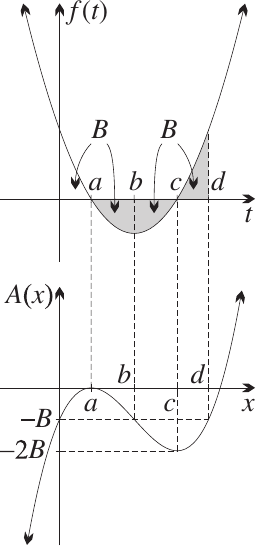
Consider the parabola shown above with axis of symmetry at . The four regions marked all have equal area. Let's analyze the signed area function :
In the interval :
- The function is negative and decreasing
- As we integrate from towards , we accumulate negative area
- Therefore decreases at an increasing rate
In the interval :
- The function is still negative but now increasing
- We continue to accumulate negative area, but more slowly
- Therefore decreases at a decreasing rate
- At , we reach the minimum value
In the interval :
- The function becomes positive
- We start accumulating positive area, which increases
- The signed area function increases at an increasing rate
- At , we have (we've regained one area unit )
Note
Key values:
- (starting point)
- (accumulated one negative region)
- (minimum value, two negative regions)
- (recovered one region)
The lower diagram shows the complete signed area function, illustrating all these features.
Worked example: constructing a signed area function
Let's work through a concrete example to see how signed areas work in practice.
Example
Worked Example: Constructing a Signed Area Function
Let be the signed area function starting at for the piecewise linear function shown below. Use area formulae to construct a table of values for in the interval , then sketch .
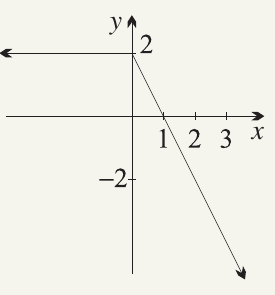
Solution:
For , we can use triangle area formulae. For , we use rectangles, but remember that integrals running backwards produce negative values.

Explanation of values:
-
At : (starting point)
-
At : Triangle with base 1 and height 2, so
-
At : (the triangle above cancels with area below)
-
At : (accumulated negative area)
-
At : These are negative because the integrals run backwards and the curve is above the -axis
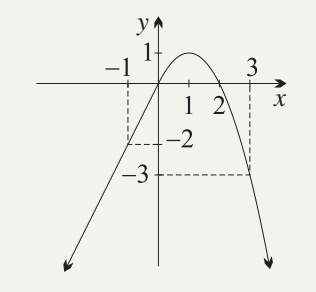
Key observations:
- The area function is increasing for (because in this region)
- The area function is decreasing for (because in this region)
- The maximum occurs at where the original function crosses the -axis
The fundamental theorem — differential form
We can now state and prove the first form of the fundamental theorem.
Important
Theorem (Differential Form): If is continuous, then the signed area function for is a primitive of . That is:
This tells us that differentiating an integral gives back the original function. This is a remarkable result connecting the two main operations of calculus.
Proof of the differential form
The proof begins with the definition of the derivative as a limit:
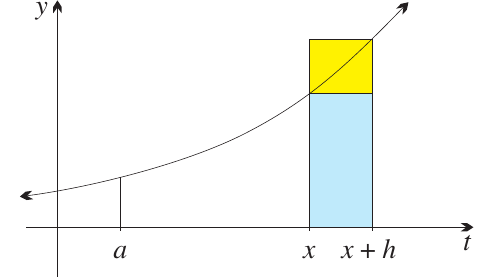
Using the diagram, we can express the difference in areas:
Therefore:
The key step is to use a sandwiching technique. Assume is increasing in the interval (as shown in the diagram).
Setting up the sandwich:
- The lower rectangle on has height and width
- The upper rectangle has height and width
- The integral represents the area under the curve
Therefore, the area under the curve is sandwiched between the two rectangles:
Dividing by (assuming ):
Taking the limit:
Because is continuous, we know that as .
The middle expression is sandwiched between and , so:
This means , as required.
Note
If is decreasing in the interval, the same argument works but with the inequalities reversed.
Using the differential form
The differential form is particularly useful when we want to differentiate an integral without actually evaluating it first.
Example
Worked Example: Applying the Differential Form
Use the differential form of the fundamental theorem to simplify these expressions.
a)
Solution:
The differential form states that .
Applying this directly:
We simply replace with in the integrand.
b)
Solution:
c)
Solution:
Notice that we don't need to evaluate these integrals at all. The differential form immediately gives us the answer by replacing the integration variable with .
The fundamental theorem — integral form
The integral form is the version of the fundamental theorem you've been using to evaluate definite integrals throughout this unit.
Important
Theorem (Integral Form): Suppose that is continuous in the closed interval , and that is a primitive of . Then:
This is the familiar evaluation formula: find an antiderivative , then substitute the limits and subtract.
Proof of the integral form
We now know from the differential form that both and are primitives of .
Step 1: Because any two primitives differ only by a constant:
for some constant .
Step 2: Find the constant by substituting :
But (zero width), so:
Step 3: Substitute back:
Step 4: Change letters from to and from to :
This completes the proof of the integral form.
Verifying consistency
We can check that the differential and integral forms are consistent by evaluating integrals and then differentiating the results.
Example
Worked Example: Verifying Consistency Between Forms
Use the integral form to evaluate each integral, then differentiate your result to confirm consistency with the differential form.
a)
Solution:
First, evaluate the integral:
Now differentiate:
This is consistent with the differential form, which says the derivative should equal (the original function).
b)
Solution:
Evaluate the integral:
Now differentiate:
This matches the original function with replaced by , confirming consistency.
c)
Solution:
Rewrite and evaluate:
Differentiate:
This equals , which is the original function, confirming consistency.
Understanding continuous functions
The fundamental theorem requires that be continuous. Let's clarify what this means.
Note
Continuity at a point: A function is continuous at a point if you can draw the curve through that point without lifting your pencil from the paper.
Continuous in a closed interval : You can place your pencil at the left endpoint and draw the curve to the right endpoint without lifting your pencil.
A continuous function: This is a function that is continuous at every point in its domain.
This last definition can seem confusing. Consider the reciprocal function :
- The function has a discontinuity at (a vertical asymptote)
- However, is not in the domain of the function
- Since the function is continuous at every point in its domain, it is technically called a "continuous function"
Important
So is classified as a "continuous function with a discontinuity" — which sounds contradictory! For this reason, it's best to describe functions as "continuous in a given interval" rather than using the global term "continuous function".
Remember!
Summary
Key Points to Remember:
-
The signed area function represents the accumulated signed area from to , and always satisfies .
-
The differential form of the fundamental theorem states that , meaning that differentiating an integral returns the original function.
-
The proof uses a sandwiching technique where the integral is bounded between two rectangles, then squeezed to the limit as the width approaches zero.
-
The integral form states that , providing the standard method for evaluating definite integrals.
-
The integral form is derived from the differential form using the fact that any two primitives differ only by a constant.
-
Both forms of the fundamental theorem require to be continuous in the interval of integration.