Finding Areas by Integration (HSC SSCE Mathematics Advanced): Revision Notes
📚Revision Notes
Finding Areas by Integration
Introduction
In this topic, we learn how to use definite integrals to calculate the areas of regions bounded by curves, straight lines, and the coordinate axes. This powerful technique extends our understanding of integration beyond just finding antiderivatives.
Important
Areas and Definite Integrals Are Different
An area is always a positive quantity, but a definite integral can be positive or negative, depending on whether the curve sits above or below the -axis. This distinction is crucial for correctly calculating areas.
The process for finding areas
When finding areas using integration, always follow this systematic three-step approach:
Important
Three-Step Method for Finding Areas
Step 1: Draw a sketch of the curves, showing all relevant intercepts and intersection points.
Step 2: Create and evaluate the necessary definite integral or integrals.
Step 3: Write a clear conclusion, stating the required area in square units.
This process ensures you don't miss important features of the region and helps you determine which integrals to use.
Regions above the -axis
When a curve sits completely above the -axis between two points, the definite integral over that interval will be positive. In this case, the area of the region equals the value of the integral (just remember to include square units in your answer).
Example
Worked Example: Parabola Above the -axis
Find the area of the region bounded by the curve and the -axis.
Solution:
First, we find where the curve meets the -axis by setting :
So the -intercepts are at and .
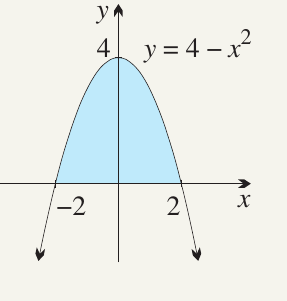
Since the region lies entirely above the -axis, we evaluate:
This integral is positive because the region lies entirely above the -axis.
Therefore, the required area is square units.
Regions below the -axis
When a curve lies completely below the -axis between two points, the definite integral over that interval will be negative. To find the area, we take the absolute value of this integral (or simply write the answer as a positive number).
Example
Worked Example: Parabola Below the -axis
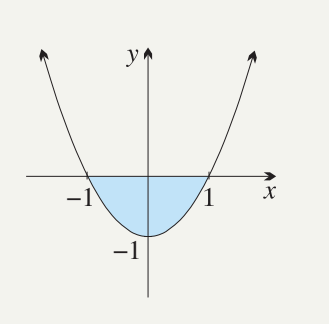
Find the area of the region bounded by the curve and the -axis.
Solution:
The curve meets the -axis when :
So the -intercepts are at and .
The curve is a parabola opening upward with vertex at , so the region between and lies entirely below the -axis.
We evaluate the integral:
This integral is negative because the region lies entirely below the -axis.
Therefore, the required area is square units.
Note
When the integral is negative, we take the absolute value to get the area, which is always positive.
Curves that cross the -axis
When a curve crosses the -axis, we cannot find the total area using a single integral. This is because integrals representing regions below the -axis have negative values, which would cancel out some of the positive area above.
Important
Splitting the Region at -intercepts
When a curve crosses the -axis, you must:
- Split the region at each -intercept
- Evaluate separate integrals for each piece
- Add the absolute values of these integrals to get the total area
Example
Worked Example: Cubic Curve Crossing the -axis
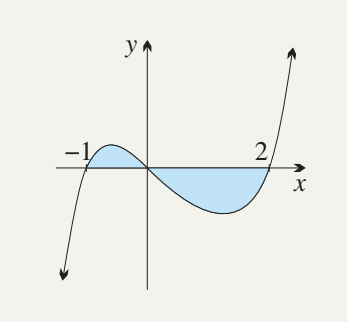
a) Sketch the cubic curve , showing the -intercepts.
b) Shade the region enclosed between the -axis and the curve, and find its area.
c) Find and explain why this integral does not represent the area of the region described in part b.
Solution:
a) The curve has -intercepts at , , and .
The cubic curve crosses the -axis at these three points, creating regions both above and below the axis.
b) To find the area, we first expand the cubic:
For the region above the -axis (between and ):
So the area above the -axis is square units.
For the region below the -axis (between and ):
So the area below the -axis is square units.
Adding these areas:
Total area square units.
c) Evaluating the integral from to :
This integral represents the difference between the two areas: . The result is negative because the area below the -axis is larger than the area above. This is not the same as the total area we found in part b.
Using symmetry: odd and even functions
Recognising symmetry in functions can significantly simplify area calculations. This is particularly useful for odd functions.
Note
Odd Functions and Symmetry
A function is odd if for all in its domain. Graphically, odd functions have rotational symmetry of 180° about the origin.
Example
Worked Example: Odd Function
a) Show that is an odd function.
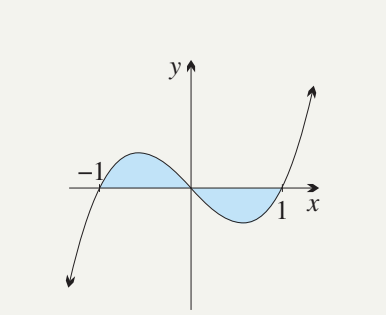
b) Using part a, find the area between the curve and the -axis.
Solution:
a) Let .
Then
Since , the function is odd.
b) First, we factorise to find the -intercepts:
So the -intercepts are , , and .
Because the function is odd, the two shaded regions have equal areas. This means we only need to calculate one area and double it.
We calculate the area of the region below the -axis (between and ):
So the area below the -axis is square units.
Doubling this for both regions:
Total area square units.
Integration with respect to
Sometimes it's more efficient to integrate with respect to rather than . This approach treats as a function of and can avoid complicated calculations involving subtraction.
Important
Key Principle: Integration with respect to
Let be a continuous function of in the closed interval . Then the definite integral is the sum of the areas of regions to the right of the -axis, from to , minus the sum of the areas of regions to the left of the -axis.
Key points:
- A definite integral with respect to represents the signed area between the curve and the -axis
- The limits of integration are -values rather than -values
Example
Worked Example: Triangular Region
a) Sketch the lines and , and shade the region between these lines to the right of the -axis.
b) Write the equation of the line so that is a function of .
c) Use integration with respect to to find the area of this region.
d) Confirm the result using the triangle area formula.
Solution:
a) The line has -intercept at and the horizontal line meets it at .
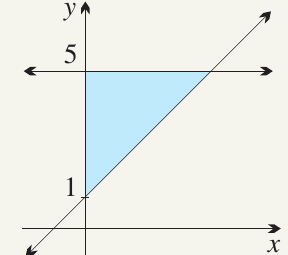
b) Starting with , we rearrange to make the subject:
c) The region extends from to , and we integrate with respect to :
This integral is positive because the region lies to the right of the -axis.
Therefore, the required area is 8 square units.
d) Using the triangle area formula:
This confirms our result.
Example
Worked Example: Cubic Region with respect to
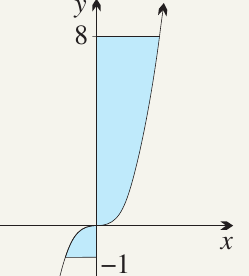
The curve shown is the cubic .
a) Write the equation of the cubic so that is a function of .
b) Use integration with respect to to find the areas of the shaded regions to the right and left of the -axis.
c) Find the total area of the two shaded regions.
Solution:
a) Starting with , we rearrange:
b) For the region to the right of the -axis (from to ):
Now,
So the area to the right is 12 square units.
For the region to the left of the -axis (from to ):
Now,
So the area to the left is square units.
c) Adding the two areas:
Total area square units.
Note
When to Use Integration with Respect to
Consider integrating with respect to when:
- The region is easier to describe using -values
- Rearranging for as a function of is simpler than working with as a function of
- You want to avoid complex subtraction of areas
Remember!
Summary
Key Points to Remember:
-
Always sketch first - drawing the region helps you identify which integrals to use and avoid errors.
-
Areas are always positive - if your integral gives a negative value, take the absolute value for the area.
-
Split at crossings - when a curve crosses the -axis, calculate separate integrals for regions above and below, then add the absolute values.
-
Use symmetry when possible - for odd functions, you can calculate one region and double it; this saves time and reduces calculation errors.
-
Consider integrating with respect to - when a region is easier to describe in terms of , switching to integration with respect to can simplify the problem significantly.