Motion and Rates (HSC SSCE Mathematics Advanced): Revision Notes
📚Revision Notes
Integrating with Respect to Time
Introduction to integration in motion
Integration is the reverse operation of differentiation. When studying motion, integration allows us to work backwards from acceleration to velocity, and from velocity to displacement.
The key relationships are:
- If you know the acceleration function , integrate it to find the velocity function
- If you know the velocity function , integrate it to find the displacement function
This process is fundamental to understanding how objects move when their acceleration or velocity is described by a mathematical function.
Note
Think of integration as "building up" information: we start with acceleration (the rate of change of velocity) and build up to find velocity, then continue building up to find displacement (position). Differentiation does the opposite - it "breaks down" information.
Using initial conditions
When you integrate a function, you always need to add a constant of integration. This is because differentiation removes constants, so when we reverse the process, we must account for them.
What is a constant of integration?
For example, if , then integrating gives , where is the constant of integration.
To find the value of , you need an initial condition (also called a boundary condition). This is a piece of information that tells you the value of your function at a specific time. Common examples include:
- The velocity when
- The displacement when
- The object being initially at rest (meaning when )
Important
Never Forget Constants of Integration
In motion problems, constants of integration must never be omitted. They are essential to obtaining the correct answer. Every time you integrate, you must add a constant (like or ), and you must use the given initial conditions to find its value.
Key principles for integrating with respect to time
Note
Integration Process for Motion Problems
When solving motion problems using integration:
- Given the acceleration function , integrate to find the velocity function
- Given the velocity function , integrate to find the displacement function
- Never omit the constants of integration (like , , etc.)
- Use an initial or boundary condition to evaluate each constant of integration
Example
Worked Example: Finding Displacement from Velocity
Let's consider a particle moving with velocity m/s, where is measured in seconds. Initially (at ), the particle is at position metre.
Part (a): Find the displacement function
Start with the velocity function:
Integrate to find displacement:
where is the constant of integration.
Now use the initial condition. When , :
Therefore .
The displacement function is:
which can be factorised as:
Part (b): When is the particle at the origin?
The particle is at the origin when . Using equation 2:
The particle is at the origin when second.
To find the velocity at this time, substitute into equation 1:
The particle is stationary at the origin.
Part (c): Why is the particle never on the negative side of the origin?
Since , the value of is always a perfect square. Perfect squares are never negative, so for all values of . Therefore, the particle never has a negative displacement.
Part (d): Find the acceleration
To find acceleration, differentiate the velocity function :
The acceleration is constant at m/s².
Example
Worked Example: Finding Velocity and Displacement from Acceleration
Consider a particle with acceleration function cm/s². Initially, it is at the origin with velocity cm/s.
Part (a): Find the velocity function
Start with the acceleration:
Integrate to find velocity:
Use the initial condition: when , :
Therefore .
The velocity function is:
Part (b): Find the displacement function
Integrate the velocity function:
Use the initial condition: when , :
Therefore .
The displacement function is:
Part (c): When is the particle stationary?
The particle is stationary when . Using equation 2:
(taking the positive value since )
The particle is stationary after second.
When :
At this time, the displacement is cm.
Part (d): When does the particle return to the origin?
The particle returns to the origin when . Using equation 3:
So or
Taking the positive non-zero value: seconds.
At this time, the acceleration is:
The acceleration due to gravity
Since the time of Galileo, scientists have known that near the surface of the Earth, any falling object accelerates downwards at a constant rate, regardless of its mass or velocity. This is called the acceleration due to gravity and is given the symbol .
The value of this acceleration is approximately:
or in rounder figures:
Direction matters!
Note
Choosing the Sign of
The sign of the acceleration depends on your choice of positive direction:
- If upwards is taken as positive: the acceleration is (because gravity acts downwards)
- If downwards is taken as positive: the acceleration is (because gravity and our positive direction both point downwards)
This choice is yours to make when setting up a problem, and you should choose whichever makes the arithmetic simpler.
Note
Key Principles for the Acceleration Due to Gravity
- A body that is falling accelerates downwards at a constant rate m/s², provided that air resistance is ignored
- If upwards is taken as positive, start with the function and integrate
- If downwards is taken as positive, start with the function and integrate
Example
Worked Example: Stone Dropped from a Building
A stone is dropped from the top of a high building. How far has it travelled, and how fast is it going, after seconds? Take m/s².
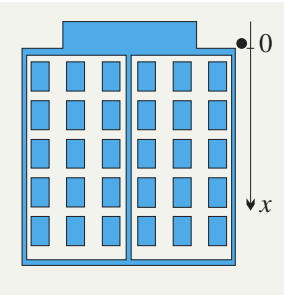
Setting up the problem
Let metres be the distance travelled seconds after the stone is dropped.
This choice means:
- The origin of space is at the top of the building
- The origin of time is when the stone is dropped
- Downwards is the positive direction
- Units are metres and seconds
Finding the velocity function
The acceleration is:
Integrate to find velocity:
The stone was dropped (not thrown), so its initial speed was zero. When , :
Therefore .
The velocity function is:
Finding the displacement function
Integrate the velocity:
The initial displacement was zero (we placed the origin at the top). When , :
Therefore .
The displacement function is:
Calculating the answers
When :
From equation 2: m/s
From equation 3: metres
Therefore, after seconds, the stone has fallen metres and is moving downwards at m/s.
Choosing convenient origins and positive directions
When solving physics problems, you need to make several choices:
- Where to place the origin of space (the zero point for displacement)
- When to place the origin of time (usually when the motion begins)
- Which direction is positive
These choices are not given in the problem - you must make them yourself. Choose options that make the arithmetic as simple as possible.
Note
The previous example made straightforward choices, but sometimes different choices work better. Remember: you are responsible for interpreting what negative values mean in your chosen coordinate system, and your final answer should be expressed in clear language.
Example
Worked Example: Ball Thrown Upwards from a Lookout
A cricketer stands on a lookout that projects out over a valley floor metres below him. He throws a cricket ball vertically upwards at a speed of m/s, and it falls back past the lookout onto the valley floor below.
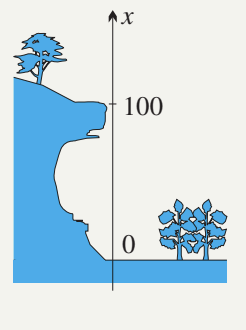
How long does it take to fall, and with what speed does it strike the ground? (Take m/s².)
Setting up the problem
Let metres be the distance above the valley floor seconds after the ball is thrown.
This choice means:
- The origin of space is at the valley floor (not at the lookout)
- The origin of time is when the ball is thrown
- Upwards is positive
- Therefore, the acceleration is (because gravity acts downwards)
Finding the velocity function
The acceleration is:
Integrate to find velocity:
When , (the initial upward velocity):
Therefore .
The velocity function is:
Finding the displacement function
Integrate the velocity:
When , (the cricketer is m above the valley floor):
Therefore .
The displacement function is:
When does the ball hit the ground?
The ball hits the ground when . Using equation 3:
Divide by :
Factorise:
So or
Since the ball was not in flight at , we take seconds.
What is the impact speed?
Substitute into equation 2:
The negative sign indicates downward motion (since we chose upwards as positive).
Therefore, the ball hits the ground after seconds at a speed of m/s downwards.
Important note about physics formulae
Important
Do Not Use Standard Physics Equations
Some students may be familiar with three standard equations for motion with constant acceleration:
These equations cannot be used in this course.
These formulae automatically incorporate the integration process, which defeats the purpose of learning calculus methods. In the HSC Mathematics Advanced course, you must solve problems by integrating the acceleration function from first principles.
The standard approach is:
- Start with the acceleration function
- Integrate to find velocity
- Integrate again to find displacement
- Use initial conditions to find constants
Integrating trigonometric functions
The same integration methods apply when dealing with trigonometric functions. Remember to integrate carefully and use the chain rule in reverse when necessary.
Example
Worked Example: Trigonometric Velocity Function
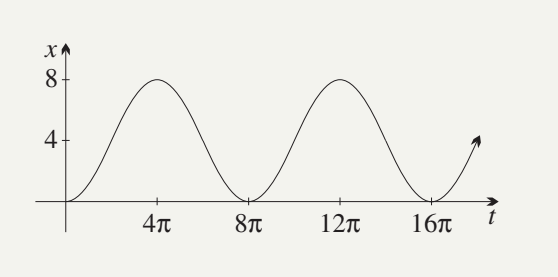
The velocity of a particle initially at the origin is , measured in metres and seconds.
Part (a): Find the displacement function
The velocity is:
Integrate to find displacement:
Use the initial condition: when , :
Therefore .
The displacement function is:
Part (b): Find the acceleration function
Differentiate the velocity function:
Part (c): Find displacement, velocity and acceleration when
When :
Using equation 2:
Using equation 1:
Using equation 3:
Part (d): Describe the motion
The particle oscillates between (when ) and (when ).
The period of oscillation is seconds (since the cosine function completes one full cycle when increases by , which means increases by ).
Integrating exponential functions
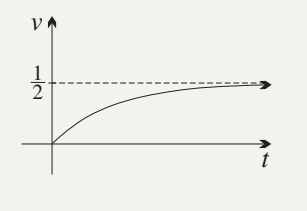
Exponential functions often arise in real-world motion problems. Integration of these functions can reveal interesting behaviour, such as a velocity approaching a limiting value.
Example
Worked Example: Exponential Acceleration Function
The acceleration of a particle is given by (in metres and seconds), and the particle is initially stationary at the origin.
Part (a): Find the velocity and displacement functions
The acceleration is:
Integrate to find velocity:
When , (initially stationary):
Therefore .
The velocity function is:
Integrate again to find displacement:
When , (initially at origin):
Therefore .
The displacement function is:
Part (b): Find the displacement when
Using equation 3 when :
(Note: is an extremely small positive number, approximately )
Part (c): Describe the velocity behaviour
Using equation 2, we can analyse the velocity:
When : (initially stationary)
As increases, approaches zero, so:
The velocity starts at zero and increases, approaching a limiting velocity of m/s as time goes on.
This type of motion occurs when resistance forces (like air resistance or friction) increase with velocity, eventually balancing the driving force.
Practice questions
Here are some foundation-level questions to practise these techniques:
Question 1: A particle moves with velocity function (metres and seconds). At , its displacement is . Find the displacement function, determine when the particle is at the origin, and find the acceleration function.
Question 2: A particle has acceleration (centimetres and seconds). Initially it is at rest at . Find the velocity function, the displacement function, and determine when the particle is at the origin.
Question 3: A particle has acceleration function . Two seconds after time zero, it is stationary at the origin. Find the velocity and displacement functions, then determine the particle's initial position and velocity.
Summary
Key Points to Remember:
- Integration is the reverse of differentiation - use it to work backwards from acceleration to velocity, and from velocity to displacement
- Always include a constant of integration (like or ) every time you integrate, and use initial conditions to find its value
- For motion under gravity, m/s² or m/s². Choose if upwards is positive, or if downwards is positive
- Choose convenient origins and positive directions to simplify your calculations, but remember to interpret your final answer correctly
- You cannot use standard physics formulae (, etc.) in this course - you must integrate from first principles